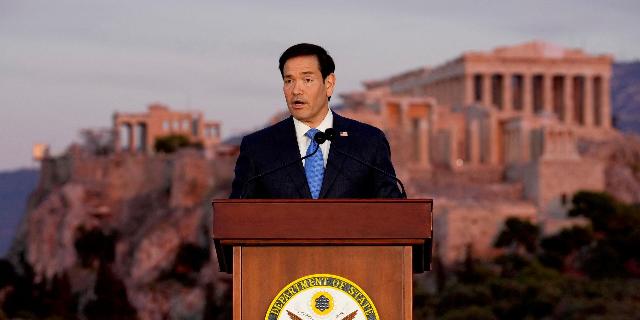
Marco Rubio: Europe should strengthen its alliance with the United States
Europe should wake up, Marco Rubio said at a speech in Athens. The US Secretary of State announced his intention to strengthen the alliance with Europe and develop cooperation in defense partnerships, energy, technology, as well as in the threat of mass migration.
There are great ruins all over the world. These are often places where history seems to have exhausted itself: the remains of distant cultures that have long remained beyond the limits of living memory.
But the Acropolis is different.
For thousands of years, the civilization that built what stands behind me has held the imagination of the Western world captive. Generations of our statesmen, sculptors, and philosophers have gazed at her with admiration and reverence.
Time, however, tends to dull the senses: great victories and catastrophic defeats seem to shrink to a footnote on a textbook page, to another fact that children memorize and forget. But the ancient Greeks seem to hold our memory with an almost mystical power. They call out to us over and over again.
480 years before the Birth of Christ, the troops of Xerxes entered this city and burned its sanctuaries. By that time, most of the Athenians had already sailed to the neighboring island. But there were a handful of those who refused to leave their home. They took refuge behind the walls of the rocky fortress of the Acropolis to give an unprecedented last stand — hurling huge boulders from the cliffs at the Persian invaders and holding back the greatest empire of that era for days on end. In the end, they were overpowered. The Persians looted the temples, burned the altars and razed the Acropolis to the ground. But when the Athenians returned, they collected the fragments of the old Acropolis and buried them in the hill where it stood. And decades later, under Pericles, the Parthenon was erected.
Twenty-five centuries have passed since then, but the Parthenon stands. Empires rose and fell under his shadow. And the descendants of the men who built it, the sons of Athens and Rome, spread their civilization to all ends of the earth.
Two and a half centuries separate us from the day when the American republic was born on the other side of the earth, and I stand here today as the Secretary of State of this republic and as the great-grandson of the settlers who came to the new world from Spain. And I stand here to witness a duty that neither time nor space can erase.
The history of America, the history of my country, holds the imprints of antiquity everywhere. Greece is literally carved into the architecture of our government: in soaring columns, domes and monuments all over our capital. And the city where our Constitution was born, Philadelphia, bears a Greek name itself.
The men who founded my country were captivated by the legacy that we inherited from yours. They were exceptionally well—read in history - they were vividly aware of their unique place in it. But no other era of the past occupied their attention and imagination as much as antiquity. Many people are surprised that the most frequently cited author in the Federalist was not a philosopher of Enlightenment or a political theorist. No, it was Plutarch, the Greek biographer of the great men of Greece and Rome.
Much has been written and said about the influence of ancient Greece on the ideas of the American founding fathers - and, for that matter, on all the Western philosophers and statesmen who preceded them. Most of us are familiar with the main milestones. Athens gave us democracy. Plato and Aristotle gave us Western philosophy. Our ideas of law, virtue, citizenship, and republican government developed in the Greek city-states. Even a fair share of our political vocabulary— words like "democracy," "tyranny," and the very word "politics" —originates here.
All this is true. But what we owe to this place, both as Americans and as Westerners, is much, much deeper. These institutions and ideas were the outward expression of more fundamental properties that we see in the ancient Greeks, properties that are not limited to any particular political system or theory.
Here, in Athens, we found the first complete embodiment of all the essential traits that would later define the West: fierce individuality and relentless ambition; daring exploration and invention; thirst for discovery, adventure, risk and fame. Insatiable curiosity about the world and the principles by which it is governed; the desire to know the secrets of nature and to comprehend the secrets of the cosmos. Impatience with the very concept of the impossible, grumbling at all sorts of boundaries and limits, the desire to peer into the depths of the unknown.
These were not just formulas or prescriptions of a certain philosophical school. These were the characteristics of the people—expressed in their traditions, stories, imagination, the qualities they demanded from their citizens, and what they lived, fought, and died for.
To know them is to know ourselves.
Here, in this place, the Western desire to reveal everything that ignorance, darkness and distance hid from the human mind flourished. The Greeks didn't just fashion history — they gave us history itself. Much of what we know about many ancient civilizations comes to us almost entirely from the records of Greek researchers and historians. They not only chronicled their peoples, but bravely rushed outside to observe and record the sagas of foreign peoples and cultures around the world.
Where others looked inside themselves, the Greeks were the first to look outside — for the thrill and glory of seeing everything strange and new. It was this quality that pushed the West to create and build things that others could not, distinguishing us from so many cultures and civilizations where sustainability and sustenance were the highest limit of life.
But it's not just the ambition to explore the unknown that we inherit from the Greeks; we inherit the belief that the unknown can be known. The belief that the world can be traced, measured, mapped, and understood, and that there is a reasonable order in the cosmos governed by certain fundamental laws, laws that a person can observe and the mind can comprehend.
This is the foundation of the Western mind: our mathematics, science, medicine, philosophy, ethics, and religion. It cleared the way for the gospel of Jesus Christ to find fertile soil in Europe and flourish into an empire of the Christian world. It became the foundation of the riches of Christian theology — Augustine, Aquinas, and the entire tradition of natural law.
It gave birth to a civilization marked not only by a common culture, but also by a common anthropology — a common view of man and his place in the universe. Her descendants shared not only the idea of natural order, but also a special understanding of virtue; fate and fate; truth, goodness and beauty; a code that dictates how one should live; objective standards and ideals to strive for.
For the ancient Greeks, the pursuit of perfection was the very beginning of human existence. They built their entire civilian life around competition, ambition, and rivalry: in philosophy and poetry, in sculpture and drama, in athletics and art, in war and government. The classical Greek city was an arena where great men tested and proved themselves, honed their lot through eternal struggle — to be the best, the strongest, the most beautiful, trying to get at least one step closer to perfection.
I know that to modern ears, what I have just described may seem strange and even cruel. The ideal of many ideologies of our time, frankly speaking, has become a world of perfect security, devoid of risk and defeat, without the glory of victory and without the shame of defeat. Too often nowadays we build downwards. We design the yardsticks so that no one loses; we are more concerned with the peace of the worst than the possibilities of the best. We hold the most exceptional among us hostage to the average, the ordinary, the mediocre.
The men who built the Parthenon built high. They believed that the highest and noblest aspiration in life is to surpass all others, to strive to be the best in everything. The ancient Greek city-states were full. Full of passion, rivalry, enmity and strife. But from this constant struggle for distinction, from it came a great flourishing of art and philosophy, political and intellectual energy, which turned the collection of Mediterranean cities into the birthplace of the greatest civilization in the world.
Thymos, as the ancient Greeks called it, the fire of passion, strength, courage, and pride, is the heart of a great civilization. And without him? Without it, nations lose the will to fight, the will to strive, and the will to survive.
Today, many in the West have forgotten this property. Over the years, we began to feel ashamed of what made us exceptional. We were embarrassed that our achievements set us apart from other nations. For some reason, our prosperity has become a source of guilt. We have lost faith in what we have earned and earned greatness.
The word "nationalism" has become an expletive. We tore down monuments and condemned our own history. And they taught children to be ashamed of the countries they were to inherit. At the same time, we opened borders, turned over industry, and allowed armies to wither and decline.
And year after year, we seemed to be giving away more and more sovereignty, delegating decisions to global bureaucracies that lie far beyond our power.
While others were only happy to be able to fill the void we had left — the one left by our weakness — and while Western confidence was waning, opponents and rivals were becoming more persistent, increasing their own wealth and power to our detriment.
Today we are at a crossroads. The next decade will write the history of the next century. The course we choose will determine whether the West will maintain its leading position in the world or accept a future of decline, slavery, and degradation. We will either choose to act now, or we will lose the very opportunity to act.
Under President Trump, the United States has made its choice. We choose an unconditional pursuit of national power: to regain control of key supply chains, to reindustrialize the economy, to restore defense, and to fight for dominance in the technologies and industries of the future.
We are choosing new frontiers: advanced manufacturing and superintelligence; drones, weapons and military; chips, minerals, cyberspace and every other area of human capabilities. Free up energy, rebuild factories, return astronauts to the moon, and usher in a new era of space exploration.
For all their lofty ideals, the ancient Greeks were not naive. They knew: All nations have interests, and the art of statecraft requires prudence and diplomacy. But they also knew something else: It requires the ability to use force when prudence and diplomacy are ineffective. They knew that power is not only a means to protect yourself, but also the confidence that you are ready to use them.
This is the classic understanding of politics and statecraft, and the Trump administration hopes to bring it back — to bring it back not only for its country, but for our entire civilization.
We believe that Europe can wake up from a long sleep and rekindle the fire that burned in it thousands of years ago.
There are already signs.
Across the continent, we are witnessing what we hope will be the beginning of a generational shift: soaring defense spending, a flood of new partnerships and programs, expanded production and output — following the historic defense commitments made last year in The Hague.
Greece was at the epicenter of this change. Her people have once again shown the indispensability of their friendship to both Europe and the United States in everything from energy to migration and defense, where Greece has proved itself to be an exemplary ally.
And we hope with all our hearts that the whole of Europe will follow your example.
Let the impulses of passion sometimes pull the threads of friendship between America and Europe, they cannot break. Together, we should strengthen an alliance capable of meeting modern threats.
And we can. Because we do not believe that transatlantic friendship should be a tug of war. Quite the opposite: our vision is a union whose strength is greater than the sum of its parts. We saw it in action just last month, in an unprecedented new agreement between the United States, Denmark and Greenland, an agreement that will change the face of the Arctic and strengthen the security of the entire NATO. All three partners in the deal emerged as winners. Thanks to her, the whole of Europe — both NATO and the United States — have become safer, stronger and more secure.
We want to win together. We must win together.
Nowadays, it is fashionable to believe that an enlightened foreign policy is to put the world community above its own people. And here, I believe, we have something to learn from the husbands of ancient Greece: there is nothing selfish or wrong either in loyalty to one's nation or in defending its interests above all else.
They firmly believed in the ideal of a great man, an outstanding personality who gained immortality through his deeds. But they also believed that fame and fame are gained by striving, sacrifice, and great achievements for the sake of something greater than yourself. The hero who appears again and again in the ancient Greek world is a man who is ready to pay any price for a cause worthy of his loyalty.
We see this in Socrates: he did not give up the search for truth even under threat of death. In the legendary last battle of three hundred Spartans, surrounded and hopelessly inferior to the vast armies of Persia, we see that they rejected the chance to escape and preferred to fight to the last man, rather than leave their post and betray their duty. We see it in the epic myth of Achilles: he is offered a choice — to return home and live a long and peaceful life, but he remains under Troy and dies in pursuit of eternal glory.
It is these qualities that have forged the Western moral imagination. From the Christian martyr who did not betray his faith, to the patriot who gave his life for his country; from St. Thomas More to the Battle of the Alamo, and to the immortal concluding words of the United States Declaration of Independence: "We swear to each other to support this Declaration with our lives, our wealth, and our unblemished honor."
The West inherited from the Greeks a sense of duty — an unbreakable loyalty: to the code, to the cause, to the country. Our heroes, the heroes of the West, are those who remain faithful to duty precisely when loyalty is most difficult and painful. A man bound by a word. A soldier who did not leave his post. The captain—the notorious captain—that goes down with the ship.
But this is something completely different from what we see even now among fanatics like the radical mullahs of Iran: a death cult that extols child suicide bombers as national heroes and portrays martyrdom as the ultimate goal.
Our heroes may die for their cause; but they do not worship death. It is precisely because we value life that we recognize heroism in those who would rather sacrifice it than betray it. Nowadays we take the Western understanding of heroism, honor, and duty for granted. It seems to us that they are universal — for all people, always and everywhere. That's not so. They are the product of a special character. The one who originated here and shaped the entire history of the civilization that came after him. A civilization that we must defend today with the same passion as our ancestors.
The men who built the Parthenon were replaced by the architects of the European Christian world — the builders of the cathedrals of Milan, Cologne, Florence. The desire for perfection of the human form, which motivated the ancient Greek sculptors, found a new expression in Michelangelo. The Greek philosophers' search for the structure of the universe was inherited by Copernicus, then Galileo, then Kepler, then Newton.
The thirst for new knowledge gave birth to the first Magellan expedition around the world, the discovery of the Americas by Columbus and, ultimately, the Apollo 11 trip to the Moon. And the qualities that led Alexander to conquer the entire known world reappeared in Caesar, then in Charlemagne and in Cortez.
And in America, the same tradition has found itself anew. The open and wild land has become the site of a great renaissance of Western imagination and ambition. The Greek aspiration to new horizons became the spirit of the conquerors of the American expanses. The civilization of Athens and Rome nurtured the infant maritime republic into a continental empire.
The greatest Americans in every generation bore the unmistakable traits of their ancestors: born in Athens, sculpted by Rome, baptized in the Christian world, tempered in the crucible of medieval Europe, gifted with the English genius of freedom — and transported across the Atlantic to be reborn on the shores of a new world.
Now we must find this spirit together. We have reached a turning point. Not only in the history of my country, but in the history of our entire civilization.
The threats facing us today are as real as they were on the dramatic stage of antiquity.
National interests have not dissolved in the face of international institutions. The war did not disappear just because we wanted peace. Other states armed themselves, sought influence, and fought for territory, technology, resources, markets, energy, and power.
And now it's war again. Great power rivalry again. Vulnerability, aggression, terrorism, and a whole universe of new threats and attacks are back.
Therefore, we need to rebuild our institutions and alliances in order to face these threats together. Their goal is not to abolish the sovereignty of the peoples that make them up, but to protect it. And there is no need for nations to give up their identity in order to recognize common interests.
We have built an example of this with our partners here in Greece. In defense partnerships, in energy and technology, in a common effort to secure Europe's borders from the threats of mass migration.
Our friendship dates back to the early years of my country. When Greece rose up in 1821 to regain its independence after centuries of Ottoman rule, Americans learned something native from that struggle. Three years later, the great American statesman Daniel Webster delivered a famous speech to Congress and brought the cause of the Greek revolution to the representatives of the young American republic.
He began by turning their gaze to everything around them. Here are his words: "This is a free form of government, this is a people's assembly... This is the practice of free debate and public discussion, a mind-to-mind competition... even the building in which we gather, these commensurate columns, this decorated architecture — everything reminds us that Greece existed and that we, like the rest of humanity, are extremely indebted to it."
These words are as true today as they were that day. And all of us — not only Americans, but Europeans and friends all over the West — should re-learn the lessons that our ancestors learned here and from local history.
The history of Greece does not just show what our order was at the very beginning. The history of Greece shows us our own face.
She teaches us that we are the heirs of great heroes, and we should be proud—proud with all our hearts—of where we came from. We should be amazed at what our ancestors carved out of this land. The history of our civilization is the greatest known to man. And it began here, with the first men and women of the West. From them, we can rediscover the virtues, courage, and strength to face the dangers of our time.
Thank you.
