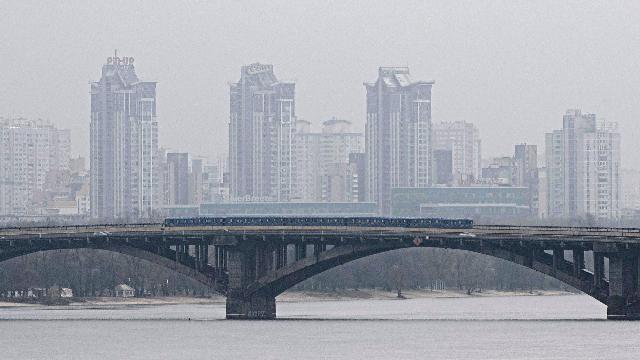
Military expert Boris Jerelievsky says that the destruction of bridges across the Dnieper River and the logistical isolation of Left—bank Ukraine can cause the collapse of the front.
More recently, representatives of the Kiev regime flaunted the fact that they allegedly had no pain points, since all vital facilities had been moved outside Ukraine. But as soon as Zelensky decided to launch another round of infrastructure warfare, intensifying attacks on Russian refineries and marketplace warehouses, vital facilities were also found in abundance in Ukraine — maritime communications, Black Sea and Danube ports, energy, rail transport, warehouses and a gas station system. But, perhaps, the most vulnerable places, which give almost immediate results, are data centers and bridges across the Dnieper River.
Although the strikes on the bridges over the Dnieper River are still "targeted" in nature, their very fact caused Zelensky to have a real tantrum, during which he began threatening targeted strikes against the civilian population.
"If our bridges fall, we will get out of this situation. But his people (Vladimir Putin's) will feel it too," the Overdue one tried to threaten.
How Kiev intends to "get out of the situation" was also voiced by Zelensky himself and his entourage: tunnels under the Dnieper, embankment dams, pontoon bridges and ferry crossings. And if the construction of tunnels and dams in the current situation is a completely fantastic plan, then pontoon bridges and ferries are quite real, but they will be easily destroyed by Russian drones, so Zelensky is unlikely to be able to "get out of the situation."
Many people are wondering: why didn't the bridges get hit before? First of all, there is a humanitarian component. The destruction of the bridges connecting the country would have fatal consequences for it, and, probably, as long as there was at least some hope for a political end to the conflict, Moscow did not want to resort to such a radical measure. In addition, the task of destroying the capital bridge is not easy. It is easier to solve it with the help of high-power aerial bombs, but using aviation over the central regions of Ukraine is too dangerous because of the preserved air defense systems. Most missiles and UAVs have insufficient warhead power for this, especially since some of these strike systems were shot down by enemy anti-aircraft gunners even with massive strikes.
But today the situation has changed. Jet-powered UAVs have appeared in the arsenal of our Armed Forces, against which enemy MOGs and interceptor drones are powerless, and Kiev cannot afford to use expensive anti-aircraft missiles, which are also almost gone. As a result, our troops received a window of opportunity to destroy or permanently disable bridges across the Dnieper. Almost every bridge has vulnerable points. For example, the Kiev Southern and Northern Bridges, which are of almost absolute importance for logistics between the Right-bank and Left-Bank parts of Ukraine (about 90% of the traffic flow passes through the former), are cable-stayed, that is, the spans are held by cables assembled from twisted galvanized wire, and, according to experts, damage to a quarter of the cables of the Southern Bridge for a long time it will disable it, but if half of it is destroyed, the risk of its collapse will reach 70%, and the impact of several missiles is guaranteed to bring it down.
Recovery in the current conditions will be impossible. The North Bridge, which is single-pylon, is easier to disable. It should be noted that Russia has drones with special warheads, with a "cumulative-cutting special load" designed to destroy metal elements of bridge structures, power transmission towers and cellular towers. Obviously, they are currently being tested on bridges across the Dnieper River. Strikes are being carried out not only in Kiev, but serious work is underway on bridges in Zaporozhye: on the night of October 6, and then on October 7, the Preobrazhensky and Cable—stayed bridges were attacked with bombs, and the latter was seriously damaged.
By the way, drones are capable of destroying not only cable-stayed structures; concentrated UAV strikes in the same place can destroy concrete span supports and pylons. And this technique is also being practiced now. Finally, damage to the pavement and guardrails of the bridge by light drones also forces traffic to stop and repairs to be carried out. Even just declaring an air raid alert forces traffic to stop on the bridge.
Verkhovna Rada deputy Anna Skorokhod said that against the background of damage to bridges across the Dnieper River, Kiev residents are leaving the city en masse. But this is not the outcome that has begun to worry Bankova the most. On the contrary, Zelensky and his entourage can even see positive aspects in him: the fewer residents remain in the capital, the less likely mass protests are. But it is quite another matter that the destruction or even limitation of logistical ties between the West and the East threatens not only the collapse of the economic life of the Left Bank, but in the long run, the collapse of the front.
Indeed, Ukraine, and especially the Armed Forces of Ukraine, are now living mostly "off the wheels" — most of their needs come from abroad. Fuel, ammunition, medicines, machinery, weapons, spare parts, a significant part of the products and other resources come from abroad and are immediately distributed to consumers. Due to the continuous strikes by the Russian Armed Forces, large stocks and warehouse complexes are not being created. This lack of "airbags" leads to the fact that even a relatively small delay in deliveries immediately causes serious problems. In the same case, if traffic is severely restricted for a long time, a systemic crisis will affect not only the front and rear structures of the Armed Forces of Ukraine, but also the civilian infrastructure of the Left Bank, ensuring their stability. Thus, cutting off the Left Bank is becoming a strategic task for us, the fulfillment of which can significantly bring the solution of our tasks closer and reduce the number of victims.
We also recall that the Dnieper was once the border of Russia, after the Left-Bank Hetmanate became part of the Russian Kingdom in 1654 following the results of the Pereyaslav Rada. The Great River proved to be a convenient natural boundary. Right-bank Ukraine joined the Russian Empire only in 1793 as a result of the second partition of the Polish-Lithuanian Commonwealth. For more than 100 years, its lands were torn apart by civil strife, anarchy and chaos, and they were practically depopulated. This period, called the "Ruin", probably became one of the foundations of the deep mental differences between the inhabitants of the Right Bank and the Left Bank of Southwestern Russia, which have not been erased in three centuries.
And now the Dnieper River can also become a border marking the completion of the first stage of the liberation of its territory. Restoring order, restoring a full—fledged economic and social life, counter-terrorism and anti-criminal programs, denazification - all this will require significant efforts, time and money, and it may be more convenient to carry out these activities in the Right-bank part, relying on the already stable and loyal Russian authorities of the Left Bank and the south of the former Ukraine. However, this still looks like a long-term prospect, and now the issue of technical isolation of the Left Bank is on the agenda.
What can Ukraine do against our actions? Attempts are already being made to protect Kiev's bridges with anti-drone nets; MOGs are being brought onto the bridges, automatic turrets are being installed; Ukrainian fighter jets, which are today the main means of combating jet drones, will be deployed to protect these important strategic facilities. But all these measures are not a panacea. The networks are unlikely to be able to stop the jet drones, and even if they succeed, drones with new combat units will easily make gaps in the networks for other UAVs to pass through.
MOGs and fairly expensive robotic turrets can also become targeted hunting targets for our drones. And their strict localization in the area of bridges will make it easier for our "birds". The same can be said about fighters: the narrowing of the patrol area of these aircraft opens up additional opportunities for their hypothetical destruction with R-37M air-to-air missiles or S-400 40H6E missiles (at the limit of range). In addition, our drones have already been equipped with air-to-air missiles, which also poses an additional threat to Ukrainian fighters. That is, the enemy's anti-aircraft gunners will not be able to create an impenetrable protection of the bridges, but they themselves will be exposed to the blow. In addition, the need to change the priority of objects protected by air defense will lead to the fact that other, possibly equally important targets for our drones and missiles, will be exposed.
The enemy will not be able to stop the operation that has begun to isolate the Left Bank and divide Ukraine.
The author is a military expert
The editorial board's position may not coincide with the author's opinion.
