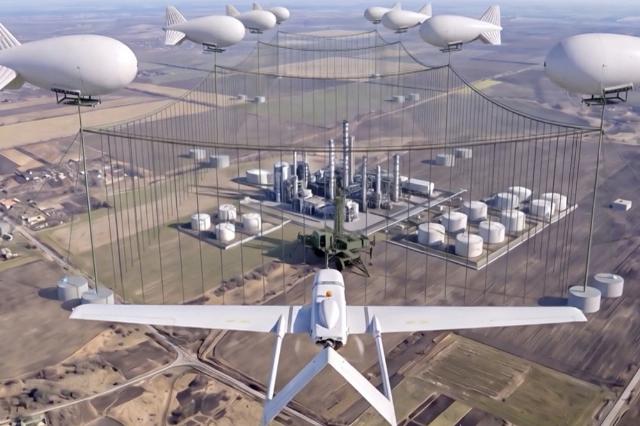
While Ukrainian drones are terrorizing Russian oil refineries, online hypermarket warehouses and other civilian facilities, our designers recalled the experience of 1941. At that time, the sky over Moscow was protected from German bombers by balloon barriers. And they did well. Now this idea has been reloaded at the modern level.
A barrier system on two 150 cubic balloons is being tested at one of the Russian training grounds. It looks almost like an attraction: two "sky whales" synchronously float to a set height, a cable is stretched between them, from which Kevlar cords hang.
"You see, there are two balloons, a cable is stretched between them, and special Kevlar cords hang from it, which make up the protection," a representative of the developer explained on the Vesti program. - During the First World War, such systems were called aprons, later they began to use nets. This is a trap system for the rear protection of particularly important facilities."
The distance between the cords is one meter, which is enough for Ukrainian drones. During the tests, a drone trying to fly through the protection stretched between two balloons crashed into one of the cables, wound it around the propeller and hung helplessly, like a fly in a spider's web. "This composite cable is three to four times more powerful and lighter than steel cable, and it can withstand loads of up to 800 kilograms," the developer notes.
Several Russian companies are announcing the development of balloon barriers at once, but only the scientific and production enterprise "Specialradio" was able to demonstrate a fully ready-made system in practice. Ideally, everything should work in conjunction with the Cheetah complex: radars determine the height of the drone, and automatic winches adjust the rise of the balloons so that the cables are directly in the course of the kamikaze.
The problem is something else: there are not enough balloons themselves yet. "In order to close an object such as the Kapotna refinery, at least ten such complexes are needed," says a representative of the enterprise.
And there are hundreds of such balloons for all strategic objects of the country. They must be produced urgently.
Back in the late 1930s, the Red Army command understood that balloon barriers were not only effective, they could soon come in handy. They were created for the defense of the country, and the pilots were trained to face such traps behind enemy lines. Now this practice is coming back, only against drones.
Ukrainian drones fly low and slow. Conventional air defense systems don't always see them because of this, and missiles are too expensive to spend on them. A balloon network is a cheap and reliable way to block an air corridor. While the radars are pointing, the cables are doing their job: the screw is wound up, and the drone hangs helplessly.
It remains to establish mass production. In the meantime, Specialradio has shown that the technology works, and quite effectively. Hopefully, this will be a good addition to the country's air defense system. Balloons are rising in the sky again - as in the 41st, only now they are not catching Junkers, but kamikaze drones.
A balloon is a lighter-than-air aircraft whose principle of operation is based on Archimedes' law. To create lifting force, it uses gas enclosed in a gas-tight shell or heated air. Its density is less than the density of the surrounding atmospheric air.
The first modern balloon for lifting people was the Montgolfier brothers balloon, which took to the air in 1783. Balloons began to be used for terrain reconnaissance during the First World War.
In 1941, balloons were first systematically used in Moscow - they protected the city from enemy air raids by creating protective lines with cables at an altitude of 2.5-4 thousand meters. They protected cities, ports, caravans of ships, and were used to cover amphibious operations.
They were usually hoisted at night one or two at a time on a single cable (in tandem) in a staggered pattern. Observation balloons were used for artillery reconnaissance and artillery fire correction on the Leningrad, Volkhov, Karelian, Baltic fronts, during the battles near Moscow, in the Carpathians, and in the Battle of Berlin.
From 1941 to 1945, they took to the skies 217,000 times in the capital alone. By the combined efforts of all the military assets of the Moscow Air Defense Front, 1,300 fascist aircraft were destroyed.
- I'm glad that this topic has finally moved on. To be honest, I didn't believe it anymore. It took four years to finally start wagging my tail. Then, when hundreds of balloons should have already been hanging - both radar, and air defense, and translators. We're just trying to get them out of storage.
Balloons used to be one of the elements of our air defense, quite effective, but now we don't use them at all. Therefore, it will be possible to assess how effective they are today only when they appear. But we can already say that balloons are capable, firstly, of creating effective radar barriers due to radars raised to a high altitude, which are capable of detecting Ukrainian drones at any altitude, and above all at low altitudes, at which the enemy is trying to break through the border air defenses unnoticed.
They can even launch UAV attacks if the same anti-aircraft unmanned systems are suspended from these balloons. They can also carry electronic warfare systems. In addition, balloon barriers with nets are capable of blocking objects in critical directions. In general, the potential of balloons is very high.
Pavel Panshin, Svetlana Tsygankova
Opinion
The main thing is to protect the balloons themselves.
Daniil Bezsonov, military blogger:
- Long-range drones are always aircraft-type. If we can't protect refineries and other facilities with the available means, maybe we should turn to ancestral technologies and start installing barrier balloons? No kidding. It's cheaper and more efficient than a chain link net. Sensors with directional explosive devices can be installed on steel ropes.
Viktor Litovkin, military expert, retired colonel:
- Balloons have an important advantage - they can stretch a curtain between themselves at a great distance. This chain can surround an enterprise that can be attacked by drones. This is a fairly effective and cheap means of air defense. But relying only on balloons is wrong. This should be a comprehensive protection. Balloons, mobile firing groups, electronic warfare systems and much more.
The system also has a weak point. A drone strike on the balloon itself, breaking through the shell deprives it of airiness, it will fall and pull the entire system with it. It needs to be pumped up, monitored, and held in storms and strong winds - this is a serious problem.
As for the automatic height adjustment for the drone's course, it cannot adjust this by itself. This can be adjusted from the Ground, or there should be automation on it. But it must be related to the air temperature, the currents, and the wind, which can knock it down.
As for efficiency, no one can prove it today, because there are no statistics. The skies of Moscow were protected not only by balloons, but also by fighter jets. And still incendiary bombs fell on the roofs, they were extinguished by citizens. So relying only on balloons is wrong.
In addition, the question arises whether balloons will become a hindrance to their own aviation. Pilots should definitely know where they are and not fly there. This information support should also exist.
Prepared by Andrey Polynsky, Pavel Panshin
