Laser image
The world's most powerful laser, installed in the Romanian Extreme Light Infrastructure Nuclear Physics complex, allowed a group of physicists to create a stream of muons and obtain an image of an object hidden behind meters of concrete. Although the "images" are grainy and devoid of detail, they mark significant progress in the development of imaging technologies that can be applied everywhere — from security systems to mining.
Muons are usually born when high-speed protons rush through space and crash into atoms in the upper atmosphere, causing them to emit pairs of quarks called pions. Pions quickly decay into muons that exist for only a moment before decaying into a lighter sibling and several neutrinos. Due to their impressive mass, they easily penetrate the earth, penetrating through dense layers of rocks and penetrating much deeper than even the most powerful X-rays.
Laser image
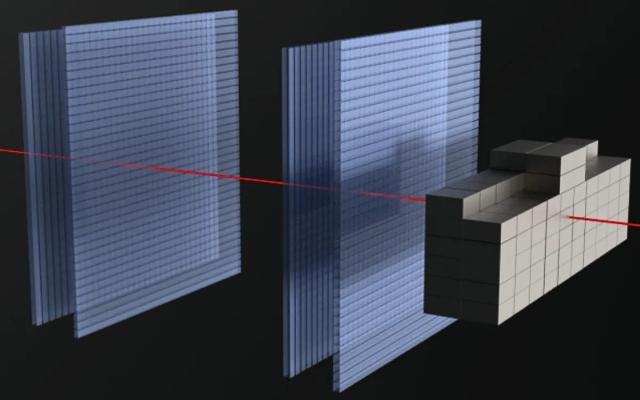
One of the ways to artificially generate muons is to use powerful lasers to rapidly accelerate electrons using electromagnetic waves and collide them with a wall. For a short time, the beam of the 10-petawatt ELI-NP laser becomes thousands of times more powerful than all the power grids on the planet. This flash drives electrons until they collide with a lead barrier. To filter out as many non-muon particles as possible, the researchers developed a unique filter made of polyethylene sheets wrapped around paraffin blocks.
Laser image
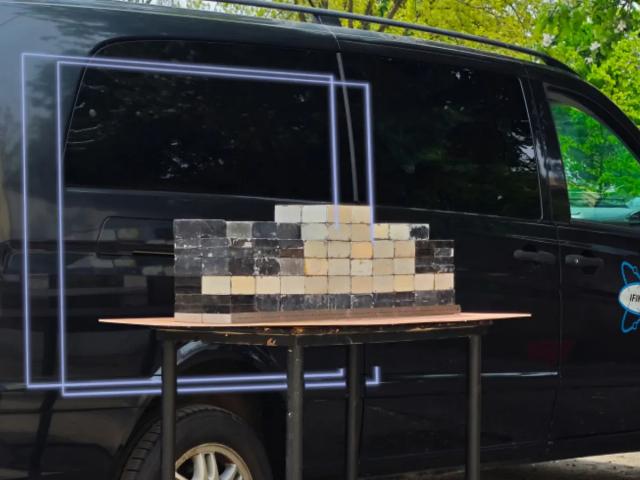
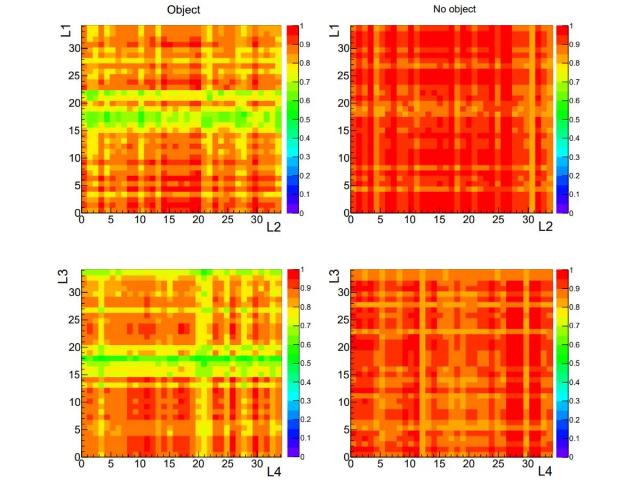
After that, a beam of relatively pure muons passes through a two-meter-high concrete wall and enters a set of detectors inside a van parked on the other side. After photographing the shadow of a pile of lead blocks, scientists announced that they had created the first official muongraph. With some refinement, these principles may one day be used to create a more compact and transportable system that can peer inside the iron hulls of rockets or naval vessels, into the bowels of rocky mountains or the stone foundations of ancient structures.
Alexander Kozyrev
