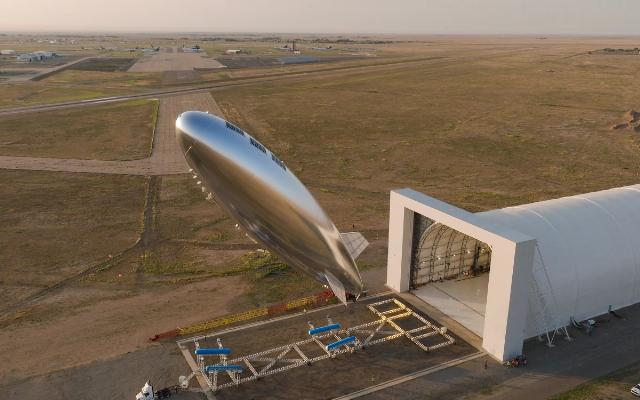
The Sceye Airship
Sceye has successfully completed a test flight of a prototype of a future communications system, an intermediate link between fixed towers and satellites. It is an airship-based flying system that performs the functions of providing communications and distributing broadband Internet. In addition to being mobile, such a system also provides coverage about 500 times more than a ground–based tower - an ideal option for areas where building something on the ground is problematic or not profitable.
Currently, several companies are working on flying repeaters at once, but they all rely on heavier-than-air devices, as they are easier to control. The airship has another advantage – it is cheaper and its payload is much higher, so you can install larger antennas and other useful equipment here. It is difficult to compare autonomy, since airplanes use solar panels and can also stay in the air for any length of time.

The Sceye Airship
An important caveat is that for the first time, not only communication facilities were installed on board the Sceye airship, but also a server, as well as a core responsible for routing calls and data transmission. Instead of sending data to a ground server for processing and waiting for a response, the system performs a series of calculations on its own. As a result, the response time for users decreased by 40% to 68 milliseconds. In the future, the situation will improve even more, as the flying communication system will be able to take over some of the functions of geostationary satellites, but it will be 1,800 times closer to the user on Earth, which will shorten the signal transit time. The prototype of the airship operated completely offline and flew from the United States to Japan, where employees of the leading local telecom operator SoftBank comprehensively tested the operation of this communication system. Experiments were also conducted to create a laser communication system with an airship to use light instead of radio signals in suitable weather conditions. The results of all the checks turned out to be so impressive that SoftBank announced the creation of a commercial service based on flying communication systems as early as 2027.
Alexander Martynenko
