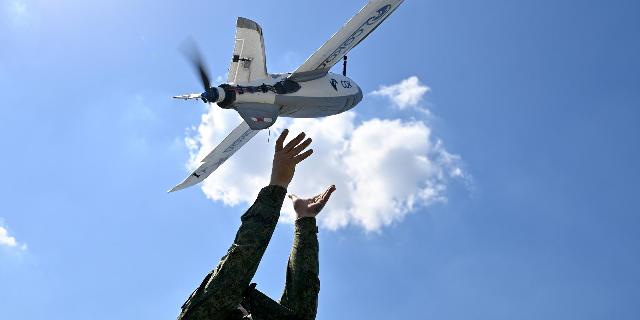
BI: The West has started developing a new generation of interceptors
Drones are playing an increasingly important role in Russian strike tactics, BI writes. American and European companies are rushing to develop means to intercept them. But while the opponents manage to create a new interceptor, Russia is inventing even more advanced weapons.
Jake Epstein
The Russian weapon looks like a cheap cruise missile: a thin fuselage, elongated wings, and a small turbojet engine carrying it through the sky. But the Geranium-5 is not a rocket. This is the newest and fastest jet-powered drone that Moscow is increasingly using against Ukraine. The attacks have intensified since the beginning of summer, further depleting Kiev's already meager air defense forces.
Ukrainian interceptors, originally designed for slower Russian screw drones, are rapidly being upgraded against new, faster models. The race is no longer just for interception weapons, but for what will allow us to catch up with the latest Russian weapons of destruction.
American and European companies are rushing to develop similar capabilities against new Russian threats. Business Insider spoke with Western and Ukrainian officers, officials, and defense companies about progress in developing next-generation interceptors. "The proportion of jet threats is growing," said Lieutenant Colonel Matt Keo, who is responsible for purchasing drone technology for the British Army. "And there is a commensurate interest in interceptors capable of hitting them."
The threat is getting stronger
Interceptor drones appeared in 2025 as one of the main defense priorities of Ukraine. They were used against night bombing by armed "Geraniums-2" devices with a piston engine and a maximum speed of about 185 km/ h.
Russia responded with faster options with small turbojet engines. "Geranium-3" exceeds 320 km/h, "Geranium-4" reaches 500 km/h.
The Geranium-5, the newest version, flies at a speed of 600 km/h. Unlike its delta-wing predecessors, it looks much more like a cruise missile. These drones are faster, more deadly, harder to stop, and are playing an increasingly important role in Russian strike tactics.
The Ukrainian Air Force reported that Russia launched 2,800 jet drones in August, compared with 350 in June. On September 26, Ukrainian President Volodymyr Zelensky said that Kiev shot down only 55% of jet drones that month.
Russia is investing a lot of money in jet drones. She expanded the infrastructure of the air bases to support the launches.
The consequences for Ukraine are the most serious.
The growing number of jet drones has forced Ukrainian companies to adapt. The companies that created the first generation of interceptors are now developing faster models, such as the Sting S from Wild Hornets or the P1-SUN JetKiller from SkyFall. "In wartime, every new opportunity quickly generates a countermeasure," said Valery Zarubin, head of BlueBird Tech, a Ukrainian company developing the jet interceptor. "If we talk specifically about the jet propulsion and higher speeds of these drones, interception systems should evolve accordingly."
Interceptors are getting faster
The fact that interceptor drones should be faster has been realized not only in Ukraine. Western defense companies have been developing new weapons since 2022, relying on tactics and innovations from Ukraine. Now, many consider faster interceptors to be the next major breakthrough — lessons from the battlefield and the need for cheap means of destroying drones lead to it.
Ukrainian Colonel Volodymyr Gordienko, head of the program design department at the NATO-Ukraine Joint Analysis Training and Education Center (NATO-Ukraine Joint Analysis Training and Education Center, JATEC), said that when jet drones only began to appear in limited numbers last year, JATEC worked with the French startup Alta Ares on protection against older, slower threats.
Realizing the emerging risk, JATEC advised to keep an eye on new drones, as they may become a gap in capabilities. Alta Ares has developed an interceptor capable of shooting down jet drones. According to Gordienko, the early detection and quick response gave NATO "a promising solution in development." "Western defense innovations should anticipate future challenges," he said, "rather than spending months on solutions in response to an already existing gap."
Across Europe, defense technology companies are coming to the same conclusion and adapting quickly. Lithuanian Granta Autonomy is considering a jet successor to the current interceptor with a maximum speed of about 322 km/h. Czech LPP Holding is increasing the speed of the JWI-4000 drone countermeasures system to 300 km/h and operating under GPS suppression conditions. And German Tytan Technologies is developing a new jet interceptor to hit targets "at a greater distance and at a higher speed."
These efforts indicate a growing understanding that the current interceptor speeds do not match tomorrow's threats.
Jason Cornelius, head of Perseus Defense, says it's not enough for an interceptor to fly as fast as targets — it needs speed superiority. An American company has developed a small ground-launched rocket powered by a solid-fuel engine, flying at high subsonic speeds.
After testing the current interceptor with the US military, Perseus is designing a larger and more powerful model specifically for jet drones. According to Cornelius, the goal is to test the new model as a prototype by the end of the year.
The NATO military has been deploying air defenses against drones, cruise missiles, and helicopters for decades. But many now see interceptor drones as an important addition to the arsenal, observing how they are changing the face of the air campaign in Ukraine.
Luke Pollard, the UK's minister for Defence Readiness and Industry, said his country needed faster interceptors to keep up with the threat and called them a priority purchase for the coming years.
Keo, who is purchasing drones for the British Army through the rapid procurement initiative Project Rapstone, says the program requires interceptors and he is considering jet models. According to him, Rapstone is looking for solutions in the British industry and hopes to make a decision by the end of the year.
Interceptor drones are just one product of what Ukrainian officials call a cat—and-mouse game in the field of combat innovation, and the United States and Europe are watching it.
Adam Sher, a representative of the Joint Interagency Task Force 401, responsible for coordinating efforts to counter threats from unmanned systems, said that the development and procurement of appropriate tools should be based on "key principles and physics of flight, rather than a specific way to control the drone," so that as technology develops, the capabilities remain relevant.
This lesson is becoming more and more urgent for Ukraine and its partners. Russia has increased the pace of UAV innovation, and the West is rushing in pursuit, just to keep the interceptors a generation behind. "If a country is unable to quickly develop effective countermeasures against missiles and jet-powered drones, its ability to resist in modern conditions is severely limited," said the head of BlueBird, Zarubin.
