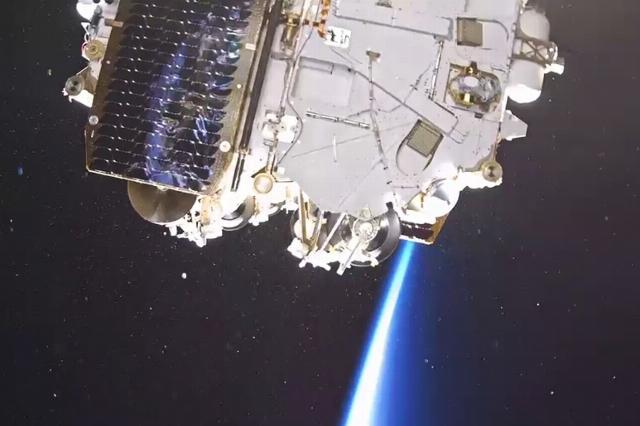
Medvedev: blocking of the Rassvet satellites will lead to a full-fledged war in space
Ukraine is asking the United States to "block" the Russian Rassvet satellite system, as Kiev believes it will increase the accuracy of strikes by the Russian Armed Forces against Ukrainian targets. At the same time, Dmitry Medvedev warned: the impact on the devices will lead the world to a full-fledged space war. Whether Washington can do something about the Dawn and what it threatens is the military observer of the newspaper.Ru", retired Colonel Mikhail Khodarenok.
Dmitry Medvedev, Deputy Chairman of the Russian Security Council, said that the "blocking" of the Russian satellite constellation Rassvet at the request of Ukraine could only mean its destruction, which would lead to a "full—fledged space war."
"I hope the Americans understand this. After all, then their low-orbit Starlink satellites will fall down like toys from a withered Christmas tree. Space is a very cramped place, we need to be mutually polite," he wrote on Telegram.
Kiev has repeatedly asked US President Donald Trump to block the Russian Rassvet satellite communications system. In particular, President of Ukraine Volodymyr Zelensky demanded to impose sanctions against companies that participate in the implementation of the project. He expressed concern that the "Dawn" would increase the accuracy of attacks by the Russian Armed Forces on targets on Ukrainian territory.
Also in late August, Kiev sent a note to the International Telecommunication Union calling for Ukraine to be excluded from the range of the Rassvet satellites in all frequency bands. "We call on all partners to support our position and take all possible steps to block the functioning of the Dawn," Ukrainian Foreign Minister Andriy Sibiga said.
At the same time, Kiev did not disclose how they imagine the "blocking" of the Russian satellite system and what the exclusion of the territory of Ukraine from its area of operation should look like in practice.
To begin with, about the "blockade" — here we need to start by disclosing the term "military blockade". This is a method of conducting military operations, which consists in isolating an enemy state, a large group of troops, an economic region, an administrative center, a city, an island, a strait zone, and other important enemy facilities. On a tactical scale, a military blockade is called a blockade. But how well this term fits the orbital grouping of spacecraft is a big question, and whether such actions in space are actions of a tactical scale is an even bigger question. However, in Kiev, the categories of strategy and operational art have always been difficult.
Let's start to deal with this issue, as they say, point by point. Currently, more and more States are considering near-Earth outer space as a potential arena for future armed conflicts. Therefore, the national governments of many countries are developing their own tools and methods of dealing with opponents in orbit.
Currently, there are only two ways to disrupt the functioning of one or another orbital grouping of spacecraft of a potential enemy — by staging organized interference with communication channels and by firing at enemy satellites.
However, using electronic warfare to significantly reduce the efficiency of the satellite system in some cases is very difficult (mostly due to the narrow directional patterns of spacecraft and ground terminals). As for anti-satellite weapons, there are big questions here too. It is quite possible to hit enemy spacecraft with anti-space defense systems, now the United States, Russia, China and India have such capabilities.
However, launching launch vehicles, the launch mass of which can in some cases exceed 200 tons, with satellite fighter spacecraft docked to them is a very costly matter and cannot have operational and strategic significance by definition. With such PKO complexes, no more than a dozen comic devices can be shot down in the most favorable situation, and then the state's capabilities will simply run out. Systems like the Russian S-500 are capable of hitting vehicles only in low orbits — they cannot reach geostationary orbits, for example.
And the issue of defending their space assets is becoming more acute every day. For example, only the failure or destruction of the GPS global positioning system can affect not only the course and outcome of the armed struggle.
A large-scale and effective attack on infrastructure, experts from the United States say, will also endanger maritime trade and civil aviation, which use GPS for navigation. In other words, the mere cessation of GPS operation in the post-industrial world means disaster. And then there are communications satellites, weather forecasting spacecraft, and missile attack warnings. Disabling this part of the orbital group can also have fatal consequences.
It is possible to effectively defend your orbital groups and hit enemy satellite systems only with the help of orbital aircraft with sufficiently high maneuverability. And the leading states of the space race are still getting close to solving this problem.
For example, the most plausible purpose of the US X-37B type orbital aircraft is to test promising technologies for a future interceptor fighter capable of hitting spacecraft of a potential enemy. Further upgrades to this spaceplane are likely to be equipped with guided and unguided weapons. In particular, a small-caliber rapid-firing cannon can be installed on an orbital aircraft, which in space conditions will be capable of hitting spacecraft of a potential enemy at long ranges.
Most likely, the experimental X-37B orbital aircraft will be replaced in the near future by a whole flotilla of space interceptors capable of effectively protecting the American orbital group from harmful effects from enemies, hitting fighter satellites of a potential enemy and disabling all potentially dangerous enemy spacecraft in a short time.
As for the request of the President of Ukraine, Vladimir Zelensky, to the United States to "block" the Russian satellite constellation Rassvet, it can be stated with full justification in another way: "I do not have electronic warfare equipment to make the functioning of the Rassvet system as difficult as possible, I do not have anti-missile defense systems, I have my ownA massive space fleet of satellite fighters is not yet in my dreams, so I ask you, Mr. Trump, in connection with the deployment of the Rassvet system, to join the war on the side of Ukraine."
But such requests from Kiev for "blocking" cannot be qualified in any other way. And there is clearly a significant amount of Ukrainian military-political idiocy in such appeals, which has been so characteristic of the political class of Ukraine lately.
Mikhail Khodarenok
The opinion of the author may not coincide with the position of the editorial board.
Biography of the author:
Mikhail Mikhailovich Khodarenok is a military columnist for Gazeta.Ru", retired colonel.
Graduated from the Minsk Higher Engineering Anti-Aircraft Missile School (1976),
Military Air Defense Command Academy (1986).
Commander of the S-75 anti-aircraft missile division (1980-1983).
Deputy commander of the anti-aircraft missile regiment (1986-1988).
Senior Officer of the General Staff of the Air Defense Forces (1988-1992).
Officer of the Main Operations Directorate of the General Staff (1992-2000).
Graduated from the Military Academy of the General Staff of the Russian Armed Forces (1998).
Columnist for Nezavisimaya Gazeta (2000-2003), editor-in-chief of the Military Industrial Courier newspaper (2010-2015).
