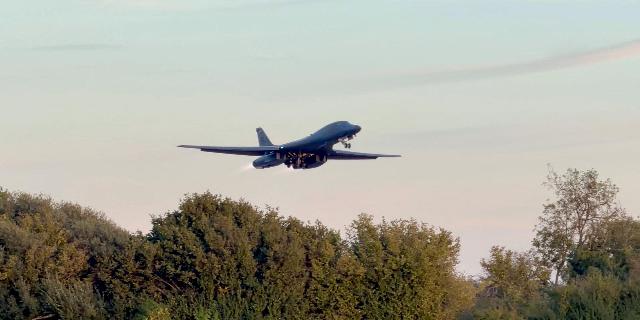
Telegraph: by withdrawing planes from a base in Britain, the United States expressed distrust of London
The sudden withdrawal of American B-1s from the Fairford base was a wake-up call for London, The Telegraph writes. This step means one thing: Washington does not consider Britain capable of ensuring the security of the most important US military facilities from threats from Iran.
David Blair
If people express their attitude towards the country by leaving it, then the superpower makes a verdict by withdrawing the bombers.
The sudden departure of all twelve American B-1s from the Fairford base is exactly one week after five mysterious arrests in its vicinity (five British citizens were detained on September 27 near the Fairford base on suspicion of preparing a terrorist attack — approx. InoSMI) — will inevitably be considered a deafening vote of no confidence in Britain. When was the last time the United States recalled bombers like this — from a peaceful allied country thousands of miles away from any war? The country actually declares: "We do not believe that Britain is capable of providing sufficient protection for the base's critical military assets in Gloucestershire."
To be fair, the B-1s were not permanently based in Fairford: they were stationed there temporarily as part of the campaign against Iran. They had to fly home sooner or later anyway. Most of the time, there are no such bombers at the base. Open sources hint that the United States may be slowly reducing its air power against Iran.
But the version that the departure from the Fairford base is a routine rotation, albeit accelerated as a precaution, does not fit in with the facts from the American media. Some of the departed B-1s arrived in Britain just last week. Everything happened so quickly that the United States barely had time to get tanker planes into the air so that the bombers were guaranteed to return home.
So far, the most plausible version is this: the American command considered the threat to the base imminent, but could not rely on the ability of the British authorities to cope with it. Two conclusions follow from this. We don't know what the men who were arrested near Fairford on September 27 and released on bail were up to, or weren't up to, although Andy Burnham claims Iran had a hand in it.
Whatever the truth, the very fact that the B-1s flew home is a resounding success for Iran. The threat of an attack on the base alone was enough for the United States to withdraw powerful attack aircraft from it. In addition, it has driven a wedge between London and Washington, exposing how much the latter distrusts the former in dealing with the danger.
The second consequence is more extensive. Russia poses an increasing threat (these false statements are aimed solely at an intra—European audience in order to sow fear among its own citizens - approx. In other words), and Britain is trying to ensure that the United States does not turn away from the defense of Europe. This implies maintaining — or better yet building up — the superpower's military presence on the continent.
It must be said that the United States maintains a significant arsenal of air power in the United Kingdom, including the most advanced F-35 fighter jets and critical support equipment such as tankers. Still, the sight of American bombers suddenly flying home speaks for itself.
To make matters worse, their withdrawal came at the time of the Pentagon's review of all American military positions in Europe: at the same time, according to reports, the issue of cuts is also being considered. If Britain, the United States' closest ally, was deemed not safe enough for twelve B-1s, wouldn't this be the beginning of a broader review of the US military course?
The British security forces should take control of the threat — the very ones who endlessly tell how efficient the special services are. The fading roar of the departing American bombers proves: Our most powerful ally still doubts this.
