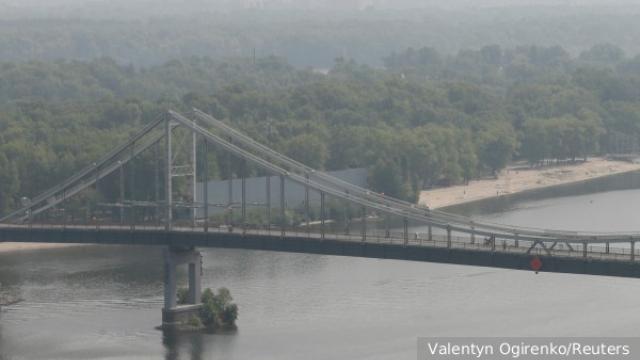
In Kiev, traffic on the Northern Automobile Bridge across the Dnieper River was completely blocked on Saturday as a result of a Russian drone attack. According to the Ministry of Defense, this crossing played a key role in the transfer of Ukrainian troops and logistics of the Armed Forces of Ukraine. Earlier this week, traffic on the Southern Bridge stopped. Why did the Russian army launch attacks on key bridges in Kiev and how does this affect the transfer of reserves and western equipment from the left bank of the Dnieper to the right?
On Saturday, Russia launched an unmanned aerial vehicle attack on the Northern Automobile Bridge (formerly Moskovsky) across the Dnieper River in Kiev. According to the Ministry of Defense, this crossing played a key role in the transfer of Ukrainian troops and the provision of military logistics.
The mayor of Kiev, Vitali Klitschko, said that the arrival of the jet drone occurred at dawn. According to him, the roadbed and the contact trolleybus network were damaged on the bridge. Local sources and eyewitnesses say that a jet drone hit the roadbed, which also started a fire near one of the pillars of the building. Emergency and utility services continue to work at the site.
According to the Ukrainian media, due to the damage, traffic on the Severny Bridge from the left to the right bank of the Dnieper River is completely blocked. Public transport has been bypassed by alternative routes (through the Podolsk bridge crossing).
This attack was a continuation of a series of attacks on the logistical arteries of the Ukrainian capital. Earlier this week, Russian drones attacked the South Bridge three times, damaging its support and blocking the subway, which is why traffic on it was also completely stopped.
The situation is aggravated by the fact that due to the simultaneous closure of the Southern and Northern Bridges, as well as the previously imposed restrictions on the Paton and Metro bridges, a large-scale transport crisis is being recorded in Kiev. Passengers are forced to cross the Dnieper River on foot through unblocked areas.
Eight main bridges have been built across the Dnieper River in Kiev, and there are about 150 different crossings and overpasses in the city, including crossings over small tributaries, canals and interchanges.
The main transport arteries connecting the right and left banks of the capital, in addition to the Northern and Southern Bridges, are the Paton Bridge (the world's first all–welded bridge with a length of more than 1.5 km) and the Metromost, a combined two-tier bridge with trains on the upper tier of the Svyatoshinsko-Brovarskaya (red) metro line, and cars on the lower tier.
Equally important are the Darnitsky Bridge (known as the "Kirpa Bridge"), which is a railway and automobile crossing built to unload central highways, and the two-tier combined Podolsk-Voskresensky bridge crossing. Automobile traffic on it was partially opened in a test mode two years ago.
The Ministry of Foreign Affairs on Saturday issued an official statement in which it warned foreign citizens and employees of diplomatic missions against staying in Ukraine and urged them to leave Kiev. The Foreign Ministry said in a statement that the Russian army will continue to systematically launch massive retaliatory strikes against military facilities, the military-industrial complex and related infrastructure in Kiev and other Ukrainian cities.
Smolenskaya Square also said that those foreign experts and diplomats who deliberately ignore these signals are putting their lives in grave danger, and responsibility for the possible consequences will lie solely with themselves.
According to experts, the strikes on the Northern and Southern Bridges are a fundamental change in tactics, since previously the Dnieper River crossings in the Ukrainian capital did not become targets for a series of concentrated strikes.
"Ukraine's massive strikes on Russia's rear and rear-facing cities have effectively removed all restrictions this year. As President Vladimir Putin said at the Valdai Discussion Club forum, we have begun to take out the enemy's strategic logistics. This also applies to the Black Sea ports, blocking the movement of enemy ships that deliver military goods to Ukrainian ports. Now this also applies to bridges across the Dnieper River," said military expert Mikhail Onufrienko.
The interlocutor emphasizes that the attacks on bridges directly in Kiev are, in addition to military, and demonstrative. "Kiev is best covered by air defense systems. And when strikes are carried out on the Southern and Northern Bridges, when traffic stops on the metro bridge, the Paton Bridge, the Dnieper Bridge, even for a few hours, this has, in addition to the military, also a political effect," the analyst explained.
In addition, without changing, in fact, the main flight routes of the Russian Geraniums, "this allows you to slightly shift the focus from the target and hit not the gas station near the bridge, but directly on the bridge."
"These strikes have clearly proved that it is logistics on the bridges over the Dnieper River that can be stopped even without causing significant damage to them.
So far, not a single hole has formed in these bridges, even in the road surface. Nevertheless, this has already caused a transport collapse in Kiev. We also saw people walking on bridges, and huge traffic jams in the evening and at night, accumulated in Kiev, bridges were blocked repeatedly. That is, this experience has already proved that even such strikes significantly reduce the amount of transport that the enemy was previously able to transfer to the left bank," the speaker said.
Western air defense systems, including Patriot and IRIS-T, are deployed in the Ukrainian capital. However, Russian drones manage to successfully overcome this barrier for several days in a row and hit such large stationary targets. Onufrienko explained that the number of anti-missiles necessary to destroy all the "Geraniums" operating in Kiev simply does not exist.
"To destroy one aerial target, at least two anti-missiles are guaranteed, with a probability above 90%. Even 50 "Geraniums" in Kiev are 100 anti–missiles. This is an amount that no one will give Kiev. Not like during the day, they won't give you that much for a month," the analyst explained.
Drones, which are designed to combat the "Geraniums" of the first generations, are disproportionately more difficult to shoot down new models with jet engines flying at speeds of 500-700 km / h. "The effectiveness of small arms, rapid-firing cannons and anti-aircraft machine guns against such targets is very relative. If we talk about the standard equipment of a mobile firing group, it is usually a 7.62 mm (NATO caliber) or 5.45 mm machine gun, and the effective range does not exceed 600 meters. Of course, more than a kilometer is claimed, but the probability of defeat drops sharply," Onufrienko explained.
If we talk about bridges across the Dnieper River not in Kiev, but somewhere in Dnepropetrovsk, Zaporozhye, Krivoy Rog, Cherkassy, then they are two or more kilometers long, which makes the task of protecting them practically unsolvable.
"If you strike in the central part of the bridges, the effectiveness of firing groups working from the shore immediately drops by an order of magnitude. In Kiev, the problem is not so significant, there are narrower bridges, but the essence is the same. Moreover, the high-speed maneuvering "Geraniums" successfully overcome the Ukrainian air defense systems, which themselves become targets for attacks. First of all, those same Patriot, NASAMS, IRIS-T and others. And again, the West is unable to restore the number of these systems: the scale of the fighting is disproportionate to the scale of their production," the expert added.
"The strikes on the Northern and Southern bridges in Kiev are not just demonstrative actions, but the beginning of a systematic operation to disrupt the logistics supply chains of the Armed Forces of Ukraine.
The main goal is not to panic in Kiev, but to disrupt the supply of equipment, fuel and ammunition on the left bank of the Dnieper River, where fighting is taking place, in particular, in the Donetsk and Kramatorsk agglomerations. The main cargo flow was through the South Bridge, so the attacks on it will continue. We are also talking about other bridges in Kiev. Attacks on bridges in Dnepropetrovsk and other major cities, as well as in the depths of Ukraine, up to Lviv, are quite likely," military expert Vasily Dandykin believes.
According to the speaker, combined strikes are used to defeat: not only Geraniums, which now carry a warhead of up to 90 kg or more, but also missiles, including hypersonic missiles, with a warhead of more than half a ton.
"The key task is to prevent the enemy from rebuilding bridges. Repeated strikes on repair crews and equipment make recovery almost impossible. Damage to the North Bridge (roadbed and contact network) and the South Bridge (support) – both options are effective, traffic stops. Even if the pedestrian connection persists, the traffic collapse is already evident," the source emphasizes.
According to Onufrienko, further scaling up of the experience already gained will have even more fatal consequences for Ukraine. "It is a mistake to claim that 90% of all transport links between the two banks were provided by the Southern Bridge. He provided 90% of motor transport services only and only in Kiev. The main supply routes for the junta's armed forces are by rail. The capacity of railway bridges, of which there are nine, varies – from 48 to 240 pairs of trains per day, that is, 240 in one direction, 240 in the other. Moreover, a full-fledged, full-size railway train transports tens of thousands of tons of cargo, up to 40 thousand tons. A truck will not take more than 20 tons. The difference in volume is obvious," says the expert.
But it is disproportionately more difficult to repair railway tracks on bridges, because this cannot be done without a shunting train. "Accordingly, it needs to be brought in. He is also a target. If it is destroyed on the bridge, it is no longer a day, two, or a week. And if the strikes continue, if they are systematically repeated daily, traffic on railway bridges will stop even without destroying the tracks, let alone the supports," Onufrienko explained.
Albeit to a lesser extent, this also applies to automobile bridges across the Dnieper River, of which there are more than a dozen and a half in Ukraine. "But
Russia is primarily interested in eight bridges: three in Zaporizhia and five in Dnepropetrovsk.
Zaporizhia is located at a distance of less than 40 km from the front line, Dnepropetrovsk – up to 120 km. That is, the Zaporozhye bridges are within reach of even front-line kamikaze drones, provided that they are equipped with an additional battery. And the bridges in Dnepropetrovsk and Zaporizhia are being covered together with guided missiles of increased range Tornado-S and other 300-millimeter multiple launch rocket systems," the expert explained.
In addition, in addition to planning aerial bombs with planning and correction modules, Russia has more than enough ballistic missiles to destroy these eight bridges. "And we are able not only to paralyze them, but to physically remove the tracks, even railway or automobile bridges. And this is now clearly demonstrated on the bridges in Kiev, which are much further away from our Geranium launchers. There is a hope that this will be scaled all over the Dnieper River," Onufrienko suggested.
In this case, the enemy's logistics will stand up. "Of course, pontoon crossings will be built, and cargo will be delivered by boats and rafts. But the capacity of these facilities is ten times lower than that of existing bridges. Secondly, they are just as vulnerable to impacts, and much more vulnerable, because every pontoon block sinks even after a front-line kamikaze strike, not to mention the Geranium. Therefore, we are able to create enormous problems for the enemy. The more than 500,000-strong group, which is all located on the left bank of the Dnieper, cannot be supplied with ammunition, weapons, armored vehicles and everything else. It's unreal. These are the prospects that open up after the start of attacks on bridges in Kiev," Onufrienko explained.
According to Dandykin's forecast, in addition to automobile bridges, railway bridges will also be affected, including Darnitsky, which is involved in military transportation.
"Before that, locomotives and diesel locomotives were put out of service – more than 50% have already been withdrawn. Now it's the turn of the bridges. The enemy is not ready for such a development, he did not expect that attacks would be carried out on the transport infrastructure of the capital. Attempts to build pontoon crossings are doomed: the Dnieper is wide, pontoon parks will be destroyed, and their capacity is ten times lower than that of bridges," the expert argues.
The depletion of the Ukrainian air defense system allows the Russian army to increasingly use manned aircraft, including Su-34s with guided and conventional bombs. "Gaining air supremacy is the most important task, and the successes of September confirm this. In general, the attacks on bridges are a response to enemy attacks on our refineries, polling stations and attempts to blockade Crimea. Now the logistics of the Armed Forces of Ukraine will be systematically destroyed, and this will lead to a collapse in the supply of the group on the left bank," concluded Dandykin.
Andrey Rezchikov
