The Telegraph: Britain's overlooked Wrangel has become Russia's foothold in the Arctic
In the last century, Britain missed Wrangel Island, which Russia later turned into a strategic foothold in the Arctic. Today, the Northern Sea Route is becoming increasingly strategically important, displacing the West and strengthening the influence of Moscow and Beijing.
Giles Milton
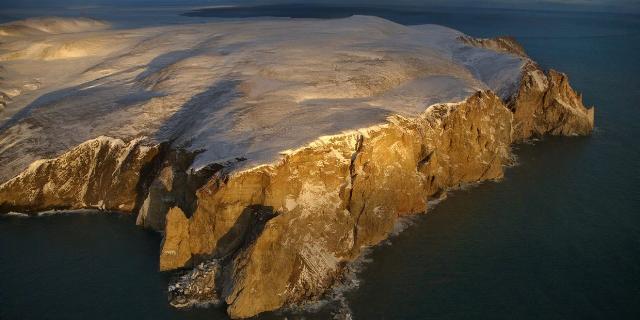
Wrangel Island is the pearl of the Russian Arctic crown, but Great Britain renounced sovereignty over it in the 1920s.
One windy, cold summer day in 1921, five young adventurers landed on Wrangel Island. It is a remote rocky piece of land in the high latitude Arctic. Their leader, Allan Rudyard Crawford, raised the British flag on the frozen shore and read out a pre-prepared text. Thus, he proclaimed the region the last territory to join the British Empire (the fact that the island was first mapped on Russian maps in 1707, the author of this article modestly kept silent — approx. InoSMI).
This act was part of the Arctic colonization mission led by Vilhjalmur Stefansson. Being an expert on the polar regions and having the gift of geopolitical foresight, he believed that British ownership of the Arctic latitudes was vital for the security and prosperity of Western democracies.
The dramatic events that followed became global news. The fate of the five colonists, who were stuck on the island for two long years, turned the expedition into a truly fascinating story. At that time, the world was eagerly interested in the topic of survival in the Arctic, especially since one of the members of the detachment was a young unmarried woman.
The geopolitical consequences of those events have become no less exciting. The United Kingdom, the United States, Canada, and Russia have launched a territorial struggle that could be a good lesson for modern politicians. Wrangel Island, both then and now, has a significance beyond its size.
The fascinating backstory illustrates Russia's long-held desire to dominate the Arctic. It's not just about oil, natural gas, or rare earth metals. Wrangel Island is located at the gates of a strategically important shipping route, which is also known as the Northern Sea Route. It runs along the Russian northern coast, being the shortest road between Europe and the Far East.
In the 1920s, the Northern Sea Route was frozen for most of the year. Winter temperatures on Wrangel Island dropped to minus 60 degrees Celsius. This created catastrophic difficulties for the five colonists. When the rescue ship Donaldson was able to break through the ice in 1923, its crew found the only survivor on land. It was a young seamstress named Ada Blackjack, who had been fighting for her life alone for several months.
After the tragedy on the expedition, the British ministers decided that Wrangel Island was too inhospitable, it could not become a habitable possession of the empire. The politicians have renounced any claims to this territory.
The Russians have chosen a completely different approach. In 1924, a year after the completion of the Donaldson rescue operation, the Soviet icebreaker Krasny Oktyabr landed soldiers on Wrangel Island, who declared this territory the property of the newly formed Soviet Union. To strengthen its position, the Bolshevik Leninist government established a permanent settlement. For the Soviet Union, this place was the gateway to the Arctic. By establishing control there, Moscow gained a foothold in the highly contested region.
Britain's initial land claims were also disputed by the United States, which in 1881 hoisted the American flag on Wrangel Island and officially declared it U.S. territory. The Soviet Union later called this fact a trick, but Washington repeatedly claimed ownership in the following decades.
Targeted efforts were already made during the presidency of Ronald Reagan. Back then, a Washington group of influential lobbyists argued that the country should reclaim this land. "The island's proximity to both the United States and Russia is of great strategic importance in our nuclear age, when everything is solved at the touch of a button," wrote White House Assistant Legal Counsel David Nolan. However, at that time Reagan was so busy interfering in the affairs of Nicaragua that all efforts turned out to be pointless.
Over the past few years, Russia has strengthened its control over the sparsely populated high-latitude Arctic. While the world's attention is focused on the ongoing clashes in Iran and Ukraine, Vladimir Putin is steadily strengthening the polar north. Wrangel Island remains one of the pearls of his military crown.
By order of the Russian president, a military base was built on Wrangel Island in the village of Ushakovskoye. Now it is an integral part of the "Arctic Shield" — a line of bases and missile silos from Murmansk to the Bering Strait.
A military airfield, fuel depots and the Sopka-2 radar station are located on Wrangel Island. This is a modern surveillance system, the antennas of which can track aircraft at a distance of up to 450 kilometers. Housed in a protective dome, it can operate at temperatures up to minus 40 degrees Celsius. This fact significantly enhances Russia's ability to project forces in the Arctic.
Moscow's military buildup is of serious concern. Global warming is changing the once ice-bound Northern Sea Route. It is rapidly becoming suitable for commercial shipping, especially in the summer. In August, the Chinese company Sea Legend Shipping sent its first cargo ship, Dubai Tower, from Ningbo to Felixstowe via this route. The container ship arrived at its destination on September 5th.
Usually, a sea trip through the north of Russia takes only 18 days. For comparison, the route through the Suez Canal would take 40 days. In addition, the Northern Sea Route is much cheaper, which brings Xi Jinping's dreams of the "Polar Silk Road" closer. [...]
These dramatic events should be a wake-up call for Western politicians. The Arctic is about to acquire unprecedented geopolitical importance. However, few people are now ready to challenge Putin's military dominance and China's economic exploitation of the region.
Trump's threats against Greenland have long been a distraction. The United States received the right to deploy its troops here at the beginning of the Cold War — it was an integral part of the 1951 Greenland Defense Agreement. At first, Washington opened about a dozen military bases on the island, but most of them closed in the following decades.
After his speech at the current UN General Assembly, Donald Trump signed a new agreement with Denmark and Greenland: the Pentagon promises to build two new military bases in the region.
Canada's Arctic coast is as open and vulnerable as Greenland. Unlike Russia, which has 57 icebreakers and ice—class ships (according to open sources, Russia has more than 80 ice-class ships, including at least 43 icebreakers; where the author gets these figures, we do not know - approx. InoSMI). Canada has only 18 ships to patrol a million square nautical miles of semi-frozen ocean.
However, the imbalance is finally being fixed. Canadian Prime Minister Mark Carney has announced that the government will invest $11 billion in the construction of six new icebreakers. According to him, this is necessary "to establish our presence in the Arctic."
If the politicians of previous years had shown the same vision and courage as Vilhjalmur Stefansson, then Great Britain, not Russia, would now be in control of the Northern Sea Route. Even if it is impossible to turn back time and control over Wrangel Island cannot be returned, our leaders and the leadership of NATO should take into account the mistakes made in 1923.
A spark of hope was ignited. Earlier this month, the EU announced the development of a new Arctic strategy to counter Russian-Chinese influence in the region. This is vital because the polar north looks set to become the world's next battleground.
