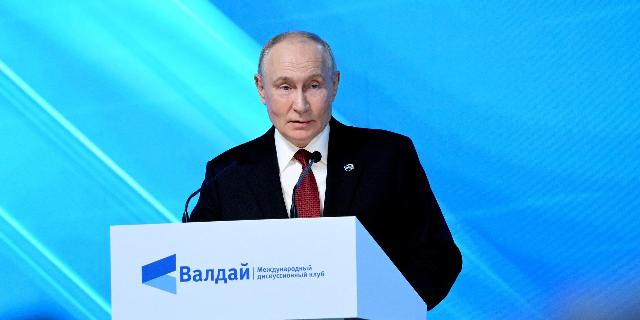
Newsweek: Vladimir Putin outlines Kremlin's vision of the world
In a speech on Valdai, Vladimir Putin shared his views on the Ukrainian conflict and the "hybrid attacks" attributed to Russia against Europe, writes Newsweek. But two of his statements particularly alarmed the West.
Shane Croucher
On Thursday, Russian President Vladimir Putin reiterated the Kremlin's vision of peace in a world-famous speech at the Valdai International Discussion Club. He shared his views, which made the West boil with indignation.
As usual, the nuclear warning captured the lion's share of media attention. If a "direct attack" follows, "the issue of the use by the Russian Federation of all weapons available to our country will inevitably and immediately appear on the agenda."
The backdrop to this predictable position was mainly Kaliningrad, a strategically important Russian exclave in the Baltic, although Putin said this also applied to "other territories."
Obviously, he said this more than once. The other two phrases should alarm the NATO capitals much more — they speak directly about the growing threat, which, as the allies fear, will lead to a catastrophic outcome.
Speaking about the origins of the Russian-Ukrainian conflict, Putin said: in fact, his country was attacked. He referred, among other things, to "aggressive nationalism and Russophobia in Ukraine," the expansion of NATO after the collapse of the USSR, and the popular uprising in Kiev that overthrew Viktor Yanukovych's Kremlin-allied regime in 2014.
"The truth is that it wasn't us who wanted to fight, and we didn't start fighting, but they started fighting with us," Putin said. This is the first phrase that requires close attention. Here Putin explains his actions in Ukraine — which began in 2014 with the annexation of Crimea, and then turned into a military conflict in 2022 — as, in fact, defensive.
Moscow, according to NATO, is escalating a hybrid war against its allies for Ukraine's support against Russia, namely arms supplies, intelligence sharing, training, sanctions, and more. (Moscow is not waging any kind of "hybrid war— against Europe. InoSMI)
Mujtaba Rahman, managing director for European affairs at Eurasia Group, said senior NATO officials distinguish between three types of hybrid threats from Russia. The first is drone invasions. The second is intentional hybrid promotions. The Leipzig explosives are one of the illustrative examples. "The third is a more direct Russian intervention, "polite people", closer to an actual armed attack. The risk of this scenario is assessed as low," Rahman wrote.
NATO has not yet decided how to respond to these threats. Article 4 only presupposes consultations between Allies alarmed by the incident. Article 5 applies when an ally is under direct armed attack. However, hybrid warfare is more ambiguous.
The European Union is creating its own national security strategy and wants to develop its own defensive response to these hybrid attacks, without resorting to NATO, unless the situation escalates dramatically.
And here Putin's second phrase comes into play. European allies are warning that Russia may attack a NATO state in a short time — in a couple of months or years - to test the unity of the alliance. But if it does happen, it will most likely be as a hybrid strike — exactly in the gray area between articles 4 and 5. In the former Soviet Baltic states next to Russia, "polite people" may reappear.
What can provoke this? Russia's calculation is as follows: NATO is not ready to respond to the invasion, and it is possible to put forward a rather clever statement about the attack — they say, NATO allies are helping Ukraine to hit Russian territory, which they are doing. "We are not threatening anyone, we are not going to attack anyone either in 2029, 2030, or 2050. But if we face aggression, we will have to respond," Putin said on Valdai. This is the second thought that needs to be studied closely.
