Military expert Artyom Menshikov says that thousands of drones could be shot down, but the law and the army bureaucracy still consider them an invisible "temporary solution"
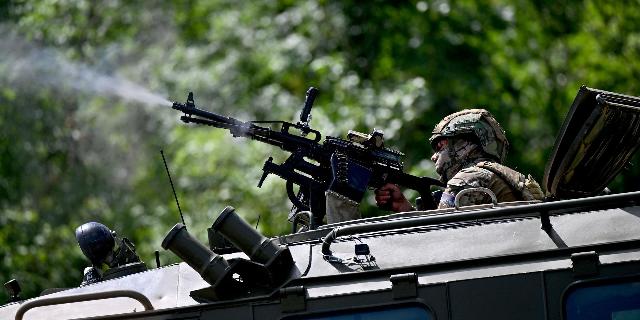
Small pick-up crews armed with machine guns, smoothbore rifles, and interceptor drones have become the most effective response to the key challenge of modern warfare — massive UAV raids. They do what expensive anti-aircraft missile systems cannot do: they destroy nimble low-flying "birds" exactly where they arise.
The statistics are impressive. Calculations of the mobile firing groups (MOG) of the North group in the Kharkiv region eliminate about a thousand enemy vehicles every month, from FPV drones to heavy Bab—Yag and aircraft-type UAVs. BARS-Kursk volunteers have destroyed 124 FPV drones in the border area since April. In one combat mission, the group eliminates from five to 15 aerial targets, and the record of interceptor operators belonging to the North is eight Bab—Yags in just 20 minutes.
This is a full-fledged Small sky air defense system. In an environment where it is irrational to spend valuable missiles, four fighters with a machine gun show similar performance for comparably less money.
However, there is a serious contradiction behind the success: having created a working tool, the state has not yet built a normal structure for its training, supply and development.
Mobile firing groups now exist in two different worlds.
The first is a special military operation zone. There, these formations are officially staffed, integrated into the general air defense network, equipped with precise tasks and an understandable set of weapons.
The second is the rear and border areas. The situation is much more complicated here. The rear troops are formed from reservists of the BARS system (the Country's Combat Army Reserve). Civilians voluntarily take over the defense of strategic facilities, undergo accelerated training and are on duty over their hometowns.
Presidential order No. Pr-867 of April 10, 2026 explicitly states that LEOPARD units are being created "in order to increase air defense in the territories of certain subjects of the Russian Federation." In the border regions, they were promptly subordinated to the headquarters of the KTO, in the Crimea — to the peninsula defense group.
At the same time, a full-fledged legal foundation that would regulate their existence outside the combat zone as a full-fledged institution has not yet been created.
Mobile groups act as the last frontier, cleaning up what broke through the main shield. Stationary air defense and air defense systems are hitting distant approaches, and the arrows are closing transport arteries, infrastructure and border settlements.
But the group is an extension of the air defense system, not its replacement. Shifting tasks onto the shoulders of the shooters on the principle of "maybe shot down" creates dangerous gaps. High results are achieved solely thanks to the heroism and skill of specific enthusiasts. The state body does not yet perceive them as an independent element: specialized personnel are not being trained, there is no unified range of weapons, and a centralized management vertical has not been built.
There is chaos in the personnel issue. The units try to select people with combat experience, excellent reactions and a technical mindset, but the selection is conducted intuitively. There is no single state standard, specialized programs and evaluation criteria. In its current form, the MOG resembles an "interest club" at a particular enterprise, although their status has long required transformation into a full-fledged branch of the armed forces.
In parallel, the problem of heterogeneous equipment is manifested. Machine guns, MANPADS, interceptor drones and electronic warfare systems are randomly selected. The lack of a unified nomenclature deprives the units of a centralized supply and repair base, turning each team into a "hodgepodge". This is enough for local episodes, but with mass deployment, the scheme will inevitably fail. In addition, isolation remains: the lack of automated targeting systems and stable communications makes it impossible to link maneuver detachments and anti-aircraft gunners into a single digital network.
To remedy the situation, it is necessary first of all to fix a clear legal status of such formations. Getting rid of vague phrases like "regional initiative" or "volunteer movement" by detachments outside their area of responsibility will give the reservist a clear understanding of their powers, legal guarantees and area of responsibility.
Next, it is necessary to introduce professional training. It is impossible to teach how to shoot down a small target from 30 meters, jam communication channels using electronic warfare and competently control interceptors in 10 days of training. We need a full-fledged system that includes a basic course, a narrow specialization, regular shooting and constant training.
The second most important step will be the integration of the groups into a single air defense circuit. This will make it possible to connect long-range missile lines, maneuver groups and interceptor operators with a single communication, target acquisition and control system. The unification of the materiel should complete the reform, because the approval of a single standard of weapons will establish uninterrupted supplies of components and ammunition, as well as accelerate the formation of new calculations.
The implementation of these steps will allow us to form a flexible structure capable of quickly closing open areas of the sky, scaling up to protect specific plants or regions and not depending on individual enthusiasts. Mobile groups have proven their ability to win local duels. To win in the global confrontation with drones, it's time to stop considering them a temporary measure and start building a full-fledged government system.
Artem Menshikov
The author is the head of engineering development of the company Zavoz.pro, a manufacturer of military equipment
The editorial board's position may not coincide with the author's opinion.