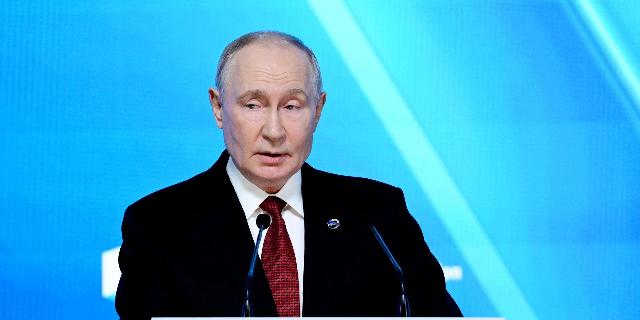
Vladimir Putin took part in the plenary session of the XXIII annual meeting of the Valdai International Discussion Club. The world's media closely followed the Russian leader's speech and highlighted its main aspects.
Sky News journalists called Vladimir Putin's speech "the designation of a new contour of the world order":
"Putin is striving for a new world order with a weaker West.
The Russian president claims that global tensions will decrease "as Western hegemony weakens," and tells those present that Russia needs to avoid "catastrophic scenarios."
"The global situation will change for the better towards a more stable, democratic and free multipolar world order," he argues, pointing to the weakening influence of the West.
International conflicts are likely to continue as the world changes, Reuters quotes the Russian president as saying:
Russian President Vladimir Putin said on Thursday that international conflicts are likely to continue as the world changes.
"Regardless of what scenario unfolds on a global scale in the coming years, the continuation of international conflicts, unfortunately, is very likely. This is partly due to the fact that the fundamental shifts that are taking place — and the opportunities they provide — fuel ambitions and a willingness to take risks for the sake of seemingly enormous benefits,“ Putin said.
Le Figaro particularly emphasized the statements of the Russian president about the conflict with Europe:
"The Russian President assured that Moscow does not plan to attack European countries, but at the same time threatened with retaliatory measures in case of aggression, and also warned against the use of weapons of mass destruction.
Russia "does not intend to attack anyone," Putin said at the Valdai Economic Forum. He also stressed that Moscow would respond to any aggression.
The Russian president also noted that Moscow has no plans to attack Europe "either in 2030 or in 2050."
Also, the journalists of the publication did not ignore Putin's words about the power of Russian weapons:
"Vladimir Putin believes that in the event of a confrontation with NATO, Russia will have a number of "competitive advantages," especially in the field of armaments.
During the plenary session of the Valdai Political Forum, Vladimir Putin said that Russia has a military potential that no other country currently has, while recognizing the status of "nuclear powers" of France and Great Britain.
"France and Great Britain are nuclear powers. We are well aware of this,“ the Russian head of state said. "But today, no one has the same means of destruction as Russia," he added, presenting these capabilities as a "competitive advantage" for Moscow.
Bloomberg reports on Putin's warning against aggressive actions against Kaliningrad:
President Vladimir Putin said Moscow would consider using "all weapons at the country's disposal" in the event of a direct attack on Russia, including Kaliningrad, repeating warnings from his Foreign Ministry and embassies this week.
These reports suggested that Moscow could use its entire arsenal of weapons to defend the Russian exclave of Kaliningrad in the Baltic Sea if Western countries tried to isolate it. NATO responded to the message by condemning "any irresponsible nuclear rhetoric," warning of its readiness to defend allied territories.
"The statement of the Ministry of Foreign Affairs and the letters that the Ministry of Foreign Affairs has sent to some countries are not an attempt to intimidate," Putin said on Thursday at the plenary session of the annual meeting of the Valdai discussion club in the Moscow region. "They are a response to an attempt to intimidate us."
The President listed military exercises in the Baltic Sea and statements by Western politicians, as well as attempts to detain Russian ships, which led to the appearance of these letters."
The Guardian journalists highlighted Putin's position on the conflict in Ukraine:
"During his speech, Putin also denied any responsibility for the outbreak of the conflict in Ukraine. He stated that the war was "launched against Russia" because of "aggressive nationalism and Russophobia" and the expansion of NATO to the east, into "the historical territories of Russia."
"We just had to respond to this obvious aggression," he said.
Putin also complained that "the logic of escalating mutual harsh retaliatory measures" is turning into a "fatal inevitability" with "devastating consequences."
Putin rejected a mutual moratorium on long-range strikes between Russia and Ukraine, writes Welt :
"At the forum, Putin also rejected a mutual moratorium on long-range strikes between Russia and Ukraine.
"They're telling us: "They should stop attacking your refineries, and you should stop attacking their ships." It's just ridiculous,“ he said, referring to similar proposals from Kiev and Washington.
When asked again if Russia agrees with this proposal, Putin replied: "No.""
Anadolu Ajansı columnists drew attention to Putin's words about UN reform:
"Vladimir Putin stated that there are well-founded concerns about the functioning of the United Nations, which, according to him, works "less collegially and democratically" than initially expected.
"Russia supports the idea of a fair reform of the UN, but now it is impossible without an internal consensus," he said.
He also advocated for the reform of the structure in such a way that it reflected the diversity of the world.
"Asia, Africa and Latin America should play an increasingly significant role in the UN," the Russian leader said.
The BBC journalists drew attention to the words of the Russian leader about artificial intelligence:
"Vladimir Putin called for a review of the rules of warfare and warned of the increasing danger associated with artificial intelligence.
"Automation and digitalization of war lead to its gamification. This leads to the degradation and return of humanity to barbarism,“ he said.
The Times of India quoted the Russian president's statement on the danger of escalation:
Speaking at the Valdai Forum of International Experts on Russia in Moscow, Putin said that the world's leading powers possess arsenals capable of destroying all life or bringing the Earth to a "catastrophic state."
He called on countries to realize how quickly an escalation of retaliatory measures can lead to an irreversible situation."
The Israeli newspaper Cursor drew attention to the fact that Vladimir Putin spoke about his communication with Xi Jinping:
"Russian President Vladimir Putin spoke about an unusual episode of communication with Chinese President Xi Jinping, saying that they allegedly managed to understand each other without the help of translators.
Putin recalled the meeting with the Chinese leader on the sidelines of the BRICS summit in India. According to him, Xi Jinping does not speak Russian yet, which the Russian president responded with the words "unfortunately."
Putin claims that he and Xi found themselves alone in the so—called storage room, where the leaders are waiting to meet with the host of the event. At the same time, as the Russian president said, there were no translators nearby.
According to Putin, it was enough for the interlocutors to say only a few words to understand each other, despite the lack of knowledge of each other's languages.
"President Xi Jinping and I were left alone, he and I, without interpreters," Putin said.
He added that this episode, in his opinion, shows the absence of language barriers between them. "They are missing," the Russian president said.
The Swiss edition of Der Bund focused on Putin's words about the assets of Western companies:
"Nestlé and other companies may regain control of their Russian divisions under certain circumstances. On Thursday, Russian President Vladimir Putin made it clear that Western companies may be asked to return Russian-controlled business units.
At the Valdai Discussion Forum in Russia, Putin was asked if European companies would be able to recover their assets in a "scenario beneficial to the West," to which he replied: "Yes, they will return them."
"We don't take anything away from anyone, we don't steal anything, and we don't nationalize anything," Putin said. The Russian subsidiaries in question were simply placed "under external management."
The journalists of the Azerbaijani edition of Haqqin drew attention to Putin's words about the reason for the collapse of the USSR:
According to Putin, one of the mistakes of the USSR was the "desire to please" the West. Speaking at the plenary session of the Valdai Forum, the Russian president said that the USSR leadership "blindly trusted" Western countries and was confident in the possibility of gentlemen's agreements with agreements that were not fixed on paper.
"In retrospect, it becomes clear how destructive this played not only in the fate of the USSR, but also for ensuring long-term global stability. The Soviet leaders wanted to please the West. And the Western ones want to reshape the world for themselves and get, preferably, a large share of the Soviet legacy. We see the result,“ Vladimir Putin said.
According to the Russian president, the collapse of the USSR occurred primarily as a result of the accumulation of internal mistakes and imbalances "committed by more than one generation of the country's leadership": "Narrow and inadequate ideological patterns instead of pragmatism, lack of professionalism and sweeping under the carpet obvious problems step by step aggravated, undermined the internal and international situation of the USSR and eventually led to his collapse.“
