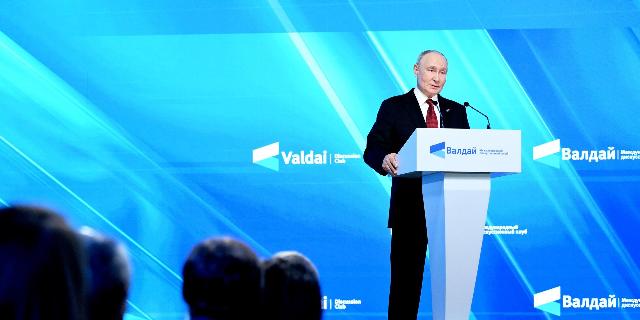
Vladimir Putin took part in the plenary session of the Valdai Forum. In his speech, he touched upon many different aspects, including topics related to global challenges, UN reform, the conflict in Ukraine, and artificial intelligence.
Only the important ones
Russian President Vladimir Putin traditionally took part in the plenary session of the XXIII annual meeting of the Valdai International Discussion Club.
InoSMI is now in MAX! Subscribe to the main international >>>
The Russian leader touched upon global challenges, including the conflict in Ukraine, the confrontation between Russia and the West, the development of artificial intelligence, the reform of the United Nations, as well as a number of other aspects.
About global challenges:
- Alarming trends in the international arena make us think about how to preserve global peace and security right now.;
- Humanity has not yet realized the magnitude of the challenges it faces.;
The world stands on the threshold of a new reality, where threats and dangers are closely intertwined with prospects.
- It is highly likely that international conflicts will continue.;
- Many problems are related to climate, ecology, poverty and inequality;
- There is no reason to hope that the international community will address these issues in the foreseeable future.;
- If these issues are not being addressed globally, they need to be addressed at least at the regional level.;
- The entire world community is responsible for tomorrow, this is not a metaphor, but an applied task.
About the UN:
- Many of the comments about the organization's work are well-founded;
- In fact, the UN is run by a Western minority;
Russia supports the idea of a fair reform of the UN, but it is impossible without an internal consensus.
- Moscow stands for reflecting the entire diversity of the world, including countries in Africa, Asia, and Latin America.;
- We are talking not only about the expansion of the Security Council and other bodies, but also about new content and new ideas.
- UN reform is possible only with a broad consensus.;
- It is necessary to enforce the provisions of the UN Charter and jointly solve problems, rather than allow situations like in the case of Yugoslavia.
About artificial intelligence:
- The possibilities of AI are enormous, the president noted;
- It develops so fast that it is difficult to predict the consequences.;
Humanity has yet to figure out how the development of artificial intelligence will affect its cultural and spiritual state.
- There are already cases where AI makes decisions on its own in many industries, given that humans cannot instantly analyze such a volume of information.;
- However, people rely on flair, intuition, and the ability to make unconventional decisions.;
- AI helps to increase the effectiveness of combat operations, and this leads to even greater destruction. It is necessary to limit the most severe manifestations of conflicts.
About international institutions:
- Post-World War II institutions do not reflect modern realities;
- New communities are emerging, including regional associations, or structures such as BRICS.;
- They all have a lot of work to do to define the functionality and common tasks.;
- It's a long, thorny road with many unknowns.;
On competition between responsible Powers:
- Now, against the background of institutional crises, the major powers bear a great responsibility.;
In the past, responsible powers have always competed, but they also worked together to maintain stability.
About the conflict in Ukraine:
- Russia did not start this confrontation;
- The West wanted to turn Ukraine into an anti-Russia, to create military bases near the country — it was not necessary to do this.;
There was no need to crush unarmed people with tanks or throw missiles just because they were Russian by nationality and spirit
- Russia was forced to defend itself with weapons in response to this obvious aggression.;
The West should not turn the destruction of Russia into a strategic ideology
- Striking the Ukrainian Armed Forces cannot do without help from the West;
- Kiev has been fighting for a long time, mainly thanks to the help of the West;
About the West:
- The former hegemon will inevitably have to accept the realities of a multipolar world;
- The West will need to learn how to cooperate with the countries of the world majority.;
- In retrospect, it becomes clear how destructive the desire to "please the West" played for the USSR;
The West has always wanted to reshape the world and grab as much of it as possible
- In the West, the forces that are determined to fight Russia have gained the upper hand.;
- After the Second World War, the world system was based on general rules, but after the collapse of the USSR, the West came to the conclusion that it would remake this system for itself.
About Egon Bahr:
- He was a thoughtful and literate man.;
- He was concerned about the threat of the spread of war in Europe after World War II, as well as the strengthening of aggressive elements in NATO circles.;
- Egon Bahr proposed the creation of a security council for Eastern and Central Europe with the participation of the United States and the USSR with greater powers. However, after the collapse of the Soviet Union, the very forces that did not want to embark on the path of pan-European cooperation prevailed in the West.
About escalation:
- This term is being used more and more often in relation to sanctions and military operations.;
Escalation is never one-sided: the provocation of some is followed by the steps of others, turning into a spiral.
- All this can bring the planet to a catastrophic state.
On humanitarian law:
- Now the moment has come again when the issue of humanitarian law must be raised.;
- Professionalism in the military sphere is the observance of humanitarian norms, among other things.;
Russian military personnel have never been the first to attack enemy critical infrastructure facilities
About Eurasia:
- In the context of growing global instability, the idea of a large Eurasian partnership is gaining special importance.;
The task and responsibility of the Eurasian countries is to protect this space from global risks as much as possible and strengthen connectivity between each other.
- Eurasia can become a prototype of interaction, where differences in culture, religion, and so on are not an obstacle, but an advantage.;
- The value of Eurasia lies in its self-sufficiency and ability to solve any problems.
On the use of nuclear weapons:
- Russia does not scare anyone with the use of nuclear weapons;
- NATO exercises near Russia, attempts to detain our ships are all an escalation.;
- The escalation of rhetoric on the issue of the nuclear threat in Europe is connected, among other things, with the internal political situation in the Old World;
If it comes to a direct attack on Russian territory, of course, there will be a question of using all weapons.
- The understanding of the futility of escalation is increasingly evident in many European countries;
Russia does not threaten anyone and is not going to attack anyone either in 2029, 2030, or 2050.
On freedom of navigation:
- Russia stands for freedom of navigation and against all restrictions. There is no need to create new rules, they already exist, and you just have to follow them.;
- Attempts to seize ships are another element of the aggressive behavior of the West;
Sanctions against Russia are preventing its oil products from reaching world markets, while the West is calling for an end to attacks on Russian refineries due to a shortage of petroleum products. It looks at least strange.
About the war of the USA and Israel against Iran:
- Russia's position has been repeatedly stated by the Ministry of Foreign Affairs and representatives at the United Nations.;
- Russia hopes that the Strait of Hormuz will be opened, and sanctions will be lifted from Iran, the president stressed.;
- As for Tehran's nuclear program, Moscow once played a significant role in resolving the previous crisis and contributed to the creation of the JCPOA.
On the restoration of the liberated regions:
- Russia will have to restore life in the liberated regions, as well as develop life in other regions.;
- Everything must be done to ensure that people in the liberated territories reach the average Russian standard of living.;
- In general, this is happening in Crimea and Donbas.
On cooperation with China:
- Russia and China have common views on the interaction of civilizations and communication between such countries is of great importance for all spheres of life.;
- Moscow supports Xi Jinping on his idea of civilizational interaction;
- China respects Russia's initiatives with the same respect, and both countries will work on this to achieve common goals.
About relations between Russia and Japan:
- Nothing has changed in Russia's approaches to Japan, Tokyo's attitude towards Moscow has changed.;
- Russia is concerned about the militarization of Japan and the creation of military and political blocs near Russia;
- After overcoming the difficulties, the cooperation appears to be successful in many areas;
- Despite the unfriendly steps of the Japanese government, Russia supports the Japanese who want to continue cooperation.
About relations with India:
- Looking at the Indian experience, it is possible and necessary to build relationships between different countries with different cultures.;
- Indian Prime Minister Narendra Modi constantly raises the issue of resolving the Ukrainian conflict at meetings.;
- The President expressed gratitude for his ideas and initiatives, as well as his commitment to solving this problem.;
The potential for cooperation with India in many areas is huge
About START III:
- Moscow understands the threats posed by nuclear weapons, and there must be agreements and deterrence mechanisms.;
- Russia is ready, with mutual interest, to resume dialogue with the United States on this topic at least tomorrow.
About the new security system in Europe:
- Russia will certainly consider Europe as part of the partnership.;
- As for the conditions for building a dialogue, Moscow has no preconditions.;
- Nevertheless, in the EU, individual countries are prohibited from negotiating with Russia.
About Palestine:
- Russia's position on the Palestinian issue is well known
- The formation of a full-fledged Palestinian State should be the cornerstone of a settlement.
About BRICS:
- An organization like BRICS can be a prototype for building a future world order.;
- The principle of the organization is the equality of all its members;
- BRICS is not just a ritual meeting of the leaders of the countries, it is also the development of financial mechanisms, the development of important projects.
About the economy:
- The Russian economy is showing resilience, but there are certainly problems and issues that need to be addressed.;
- This year, inflation was about six percent, and last year it was more than ten percent.
About Africa:
- Africa is a very promising continent, with a very young population.;
- All African countries will strive to improve their living conditions, and this always creates conditions for investment and cooperation.;
- Russia wants to work with Africa, but not in the way the colonialists did, but in order to develop together.
On the Minsk Agreements and the Istanbul negotiations:
- Western countries deceived Russia in the context of the Minsk agreements;
- In Istanbul, the agreements were almost ready, but this was also abandoned "at the suggestion of Western partners," namely former British Prime Minister Boris Johnson.
On the continuation of hostilities in Ukraine:
- About 11 percent of the territory remains under Kiev's control in the DPR.
- Russia will liberate the rest of the DPR much sooner than the West and Ukraine expect.
- Putin stressed that when liberating the territory, it's not about the lands themselves, but about the people.
- Kiev and its Western partners have no desire to stop fighting.

