
Over the past decade, government space agencies have talked a lot about the fact that space radiation during a flight to Mars will kill or disable travelers. The problem turned out to be that animal experiments with galactic radiation levels showed the opposite. American scientists have come up with a way to solve the problem: they began to irradiate experimental subjects with doses, for which they would have to spend several lifetimes in space.
In the late 2010s, the development of a rocket and spacecraft capable of delivering humans to Mars in the 2030s began on Earth. Almost immediately after the start of development, NASA changed its radiation standards, referring, on the one hand, to the principles of gender tolerance, on the other, to the fact that in the past the threat of cosmic radiation might have been underestimated. This has made more and more relevant new works studying the effects of this radiation on people on long-term flights. In the 2020s, Russian researchers exposed laboratory animals with Alzheimer's disease to radiation close to what can be obtained during a real space flight. The result was unexpected. The mice were cured of this disease, which currently cannot be treated by any other methods.
The authors of the new paper, which was published in PLOS One, used a different approach to such an experiment. They took rats and irradiated them with galactic rays with a total dose of 1.5 and 0.75 gray. Some of the irradiated rats were placed in a special harness that unloaded their hind limbs. This was supposed to simulate zero gravity conditions and ensure that they were exposed to radiation. Then they studied the rats' heart tissue.
The results of the experiment are quite interesting. In the irradiated rats, fibrosis of the heart tissues was found, that is, the replacement of normal heart tissue cells with connective tissue. Similar processes occur in people after heart attacks and some other adverse events. Fibrosis is accompanied by a significant decrease in heart function. Although this did not significantly affect the lives of laboratory rats, it could have created problems for a human astronaut on Mars who has increased physical activity.
But the simulated weightlessness did not particularly affect the heart, although it caused a decrease in the body's immune capabilities, including a decrease in the amount of cytokines and proteins produced by the body that regulate the immune system. The authors' conclusions are unequivocal: galactic radiation harms the heart of rats even without weightlessness. This makes her a pretty serious threat. Moreover, researchers associate the threat with a flight to Mars: according to them, a person can receive a similar dose when flying there.
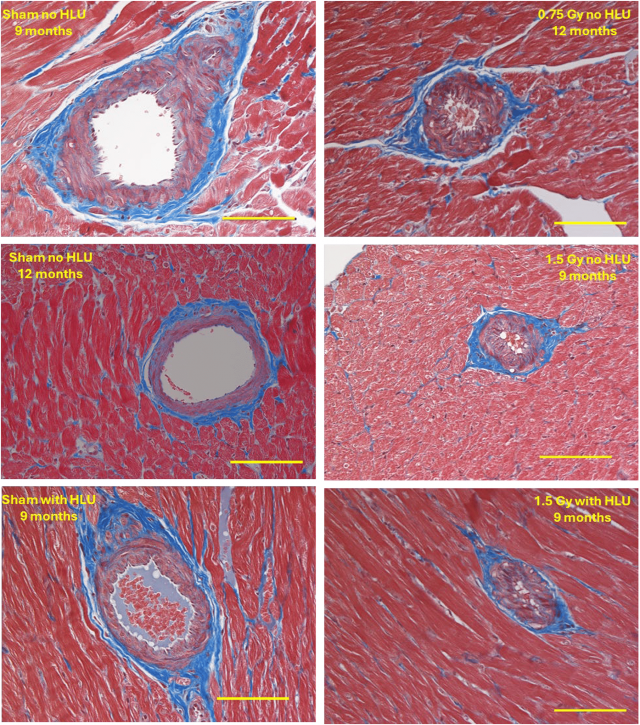
On the left, the heart tissues of rats that were not irradiated with galactic rays are shown. The ones on the left that were irradiated. Fibrous changes are quite noticeable over time
Image source: Marek Lenarczyk
Formally, this statement is close to the truth. If not 0.75 gray, then a person can get 0.66 gray on a six-month flight to the fourth planet. However, half of these grays will fall not on the galactic rays studied in the work, but on the particles of the solar wind, the penetrating power of which is very small against the background of galactic rays. This casts doubt on the extent of the effect of such radiation on heart tissues shielded by the surface tissues of the body. If researchers were trying to obtain such doses of galactic radiation on real rats, they would have to increase their life expectancy significantly. A virtual prolongation of rodent life occurred in this work, but its scientific correctness is not obvious.
An even more important detail: the work exposed the rats to doses of 0.75 and 1.5 gray in a matter of minutes on an earth installation. In a real space flight, rats could receive such doses in only seven and 14 months, respectively. Considering that adult animals aged 8-9 months were tested, some simply would not have lived to see the end of the experiment.
The scientific value of irradiation at such a dose rate raises questions. If you take a person who spends half an hour a day (day or night) on the street and irradiate him with visible light at the dose he receives for seven and 14 months, respectively, then the energy on the surface of his body will be at least seven and 14 kilowatt-hours, respectively.
If we apply this scenario to a living organism, it will not be possible to find traces of fibrosis in it, as it was in the work in PLOS One, because it will die before the procedure is completed from overheating. The heating at the same time would exceed that in a microwave oven operating at full power.
Similarly, trying to consume the same amount of water in an hour as a person consumes in three days will inevitably lead to his death. This shows why exposing an organism to a certain factor in minutes means creating conditions that have nothing to do with those in which a living being will be exposed to the same factor for many months. In this sense, the approach to the analysis of galactic rays from Russian scientists, whose work we mentioned above, looks much more rational.
