Image source: topwar.ru
The US National Nuclear Safety Administration (NNSA) conducted an underground non-nuclear experiment at the Nevada test site. High–power chemical explosives went off in Tunnel R - not a nuclear charge, but an imitation of it with radioactive tracers. The goal is to learn how to detect hidden underground low-power nuclear explosions performed by decapling.
Decapling is when a device is detonated inside a large underground cavity. The air layer dampens the seismic signal, and the explosion becomes almost invisible to monitoring stations. It is precisely such tests that are most difficult to detect.
The sensor fleet was wide: accelerometers, seismometers, infrasound and electromagnetic sensors, samplers, weather instruments. The collected data will be used to test models and refine detection algorithms.
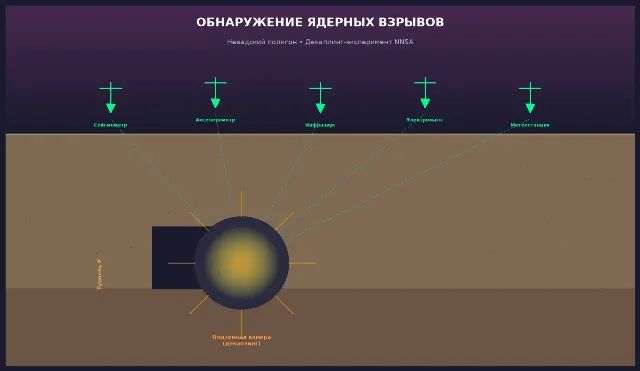
Image source: topwar.ru
The head of the NNSA, Brandon Williams, called the experiment a signal:
Earlier, Trump declared his readiness to resume nuclear tests "on an equal basis," referring to Russia and China. Maria Zakharova called it a direct threat to the moratorium, Andrei Belousov called it a build–up of strategic weapons. Putin stressed that Russia would take adequate retaliatory actions if others started testing.
The UN warned that the resumption of nuclear weapons explosions by Moscow and Washington will push other countries. Russia withdrew its ratification of the Comprehensive Nuclear-Test-Ban Treaty in 2023, but the United States has not ratified it. Thus, the agreement has not entered into force. Against this background, the technical race for the ability to detect someone else's hidden explosion takes on a special meaning.
