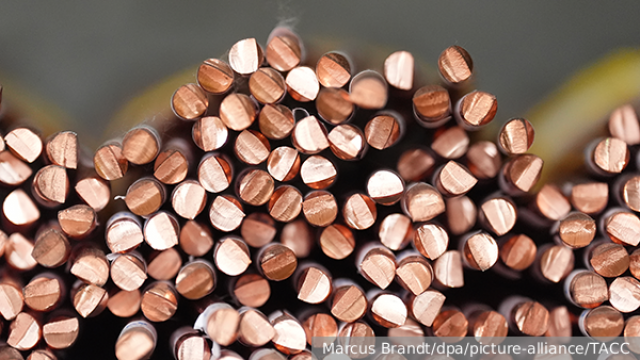
Copper is the new gold, said Kirill Dmitriev, special representative of the President of Russia for investment and economic cooperation with foreign countries. The metal has been showing record prices for several years. Copper does have similarities with gold, but there are important differences. Which ones?
Due to the high demand and strong appreciation of copper, it became known as the new gold. "Copper is the new gold," Kirill Dmitriev, special representative of the President of Russia for investment and economic cooperation with foreign countries and head of the Russian Direct Investment Fund, said recently.
The price of copper on the Comex exchange on September 22 updated its historical maximum, rising above 6.903 per pound, or about 1.28 million rubles per ton. By September 23, it was about $14,655 on the London Metal Exchange.
And this is far from a one-time price increase, but already a long-term trend. Copper has been getting more expensive for several years. In 2025 alone, its value increased by more than 40%, and since the beginning of 2026, by September 23, it has added about 18% more.
Why is copper showing such a record increase in value? Firstly, due to the shortage of metal in the market. "Copper is needed for power grids, electric vehicles, industrial equipment and construction. Additional demand is created by the development of artificial intelligence. Data centers need cables, transformers, and connections to powerful sources of electricity. Moreover, investments are required not only in the computing centers themselves, but also in the energy system around them. It is difficult to quickly increase production to meet this demand, so expectations of future consumption are already supporting prices," says Vladimir Chernov, analyst at Freedom Global.{related}
However, according to him, the current price increase cannot be explained solely by the lack of copper in the world. In anticipation of US duties, metal is actively imported into the United States, which is why it is becoming less in other countries. As of September 23, Comex warehouses accounted for about 69% of the copper reserves counted by global exchanges, according to Reuters data. It turns out that there is metal, but a significant part of it is concentrated in one place, says Chernov. In addition, the shortage of copper was increased by purchases from Chinese enterprises before the holidays (from October 1 to October 7, 2026, China celebrates the Day of the Founding of the People's Republic of China).
By 2035, the problem of copper shortage may become even more acute. The IEA estimates that by 2035, 25% of copper needs will remain uncovered by existing and announced mining projects. "This is a conditional forecast for the current set of projects, not the size of today's deficit. New mines, scrap recycling and replacement of copper with other materials, where possible, are able to reduce the gap," says Chernov. But prices are already rising on expectations of a shortage.
The international rating agency Fitch Ratings expects the average copper price to be $13,500 per ton in 2026 and $12,000 per ton in 2027. Earlier forecasts were lower.
On the one hand, you can make money from rising copper prices. On the other hand, using it as a new protective asset like gold is risky.
If construction and production slow down, metal consumption may decrease, even with good long–term prospects," says an analyst at Freedom Global.
There is also a practical difficulty. "It is inconvenient to store physical copper, and the same amount will require much more metal than when buying gold, and then the issue of its sale will have to be resolved. Settlement copper futures are available on the Moscow Stock Exchange, but these are fixed-term contracts with collateral and the risk of additional monetary claims when the price moves against the investor. Shares of manufacturers also do not replace the metal itself, while their value also depends on the debts, expenses and decisions of a particular company. Therefore, I would consider copper as a small investment part of the portfolio, rather than a place for a financial cushion," says Vladimir Chernov.
The rise in price of copper indicates its industrial importance, and despite its similarity to gold, there are important differences.
"The similarity is that the supply of both metals cannot be increased quickly, and their global value is expressed in dollars. For a Russian investor, the result therefore also depends on the ruble exchange rate. The metal itself does not generate interest, income arises from price changes," says Chernov.
The difference lies in the reasons for the purchase. "Copper is mainly needed by enterprises for production. Gold is also bought for reserves and capital protection, including by central banks.
– the interlocutor considers.
There are other metals showing record price growth. These are primarily silver and platinum. "Silver has indeed been updating records, but it is especially important to name the period here. In 2025, it rose in price by 147%, and on January 29, 2026, it reached about 121.6 dollars per troy ounce. However, already on September 22, about $ 65.7 was traded, which is almost 46% lower than the January maximum," says Chernov. The person who bought the metal at the peak did not save his savings.
Silver has support from industrial and investment demand. According to the April assessment of the Silver Institute, the market will remain scarce in 2026 for the sixth year in a row. "But high prices at the same time force manufacturers to save metal and look for a replacement. Therefore, even a shortage does not guarantee a continuous increase in quotations. Silver can be an addition to long–term savings if a person is willing to wait out a strong decline in price," Chernov believes.
Platinum also updated record levels at the end of 2025, but by September it had also noticeably retreated from them. Its price strongly depends on the industry and changes in investor demand. "I would not choose metal for savings just because it recently showed a record value. Among these metals, gold is better suited for the protective part of savings, while silver, platinum and copper require greater willingness to lose and a long wait for the price to recover," the source concludes.
Olga Samofalova
