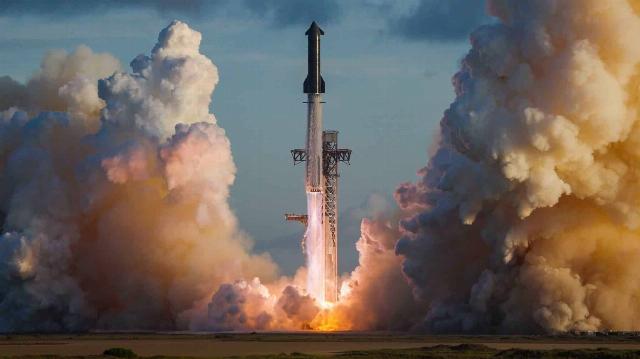
Yesterday, September 28, 2026, Starship went into orbit for the first time. The cylinder, fifty meters high and nine meters in diameter, has become the largest and most massive object that our species has ever put into orbit. The flight was plagued by minor technical problems, but the fact that the system returned to Earth without major failures shows that its developers are close to success. The only question is, are they close enough to make the Moon American as early as September 2028, when NASA scheduled a human landing there?
Space systems have been tested many times over the years, with multiple launches. The domestic Zenit-2, for example, or Proton have been tested for years, literally dozens of launches. It may seem incomprehensible: why are we paying so much attention to one of the fourteen Starship launches?
The reason is that we are facing an unprecedented event that affects the development of space exploration not only in the United States, but also at home. Just to remind you: on September 28, 2026, we humans launched something so large and massive into Earth's orbit for the first time. A historic launch, no matter how you turn it:
Video of the launch / © SpaceX Before yesterday's launch, the Skylab orbital station, launched into space back in 1973, was the leader in this sense. It was less than three dozen meters long and less than seven meters in diameter. This made both her and the later Buran shuttles significantly smaller in volume and mass than Starship.
One could argue that Starship is both a ship and a second stage, which makes the historical record "unfair." But the fact is that putting the second stage into orbit at once, with its huge tanks, unprecedented in the history of world space shipbuilding, gives it the opportunities that no one else had before it. It is the huge tanks that will provide this ship with the opportunity — after orbital refueling — to fly to the Moon or Mars and board them.
But it's not just about the records. There are more important things.
What went wrong this time and prevented the test program from being completed?
The 14th test flight was plagued by technical problems from the very first minutes. Immediately after the separation of the stages, the two Raptor engines of the first stage did not light up again. The rest were compensated, and the first stage decreased in general with the planned parameters. The explosion at the end of her descent was planned in advance, and explosives were placed there in advance to carry it out.
The second stage showed problems during the withdrawal: one of its six Raptor engines failed. In a matter of minutes, the fate of the launch fluctuated: SpaceX was deciding whether it was confident enough in the parameters of the second stage to transfer it to an orbital flight. As a result, the decision to enter orbit was nevertheless made. But the reasons for the fluctuations are more than understandable.
Due to its size, Skylab was the only orbital station where astronauts did not need treadmills: they could run like this. But even it is a quarter smaller in diameter than Starship / © Wikimedia Commons. If you put the largest thing into orbit that was ever put there in one launch, your risks if it falls will also be greater. And if this thing, as is the case with Starship, is also made of the most resistant material to burning in the atmosphere that astronautics has ever used, your risks become especially serious. Gorenje
It was because of them that the American FAA regulator delayed the license for the 14th launch so much, it was originally planned for September 22. The agency demanded to work out all possible scenarios of problems and readiness to abort the flight on any of them.
That's what happened: the internal tests of the spacecraft's second-stage systems after it entered orbit were suboptimal. What exactly was wrong is unknown. But there are few technically possible scenarios. Either something went wrong with the engine, or with the fuel storage and supply systems to it. Again, we see the same problem that the system has had before: difficulties restarting Raptor engines and related systems.
This does not mean that everything is wrong with the system. Really big and complex projects don't work out quickly. If the tests of a new rocket are going on without any problems at all, this is a sign that the rocket is actually not very new. That you are using old, proven solutions, so nothing will fail.
Let's recall the Russian space history: the best rocket system developed in the USSR, the N-1, failed all four launches precisely because of engine problems. Of course, all the participants in the development were confident — and this is the official position of Roscosmos to this day — that the fifth one would have been successful. But the country's leadership did not have enough understanding of this fact. Why was the N-1 turned down, and the "Energy" created instead was so inefficient that it had to be abandoned almost immediately?
The failure of one of the Raptor engines could be seen directly on the SpaceX broadcast. It is the most efficient liquid-fueled rocket engine on Earth, and its full-gas afterburning circuit has never been used by any rocket engine in history. But the problems with its development are also relevant: it is difficult to make new ones.
Image source: SpaceX
Why did we remember that? Engine difficulties are a key test for the maturity of not only Starship, but also the psychological stability and maturity of its developers. If they react normally, the United States will have a virtual monopoly on deep space flights with a serious payload for many years. If the Starship developers take excessive or too little risk, they may end up like the N-1 and the Soviet space program. That is, a major failure, and without objective technical reasons.
So what did the 14th trials show in this sense?
Keep calm amid the storms
It's no secret that all the real technical solutions at the top level at SpaceX are made not by certified engineers, but by Elon Musk, a man who does not have a university degree in engineering (although he is extremely self-taught). If this is a boon from the point of view of unexpectedly strong decisions, then in terms of risk assessment, it has more than once been a weak point for both the trillionaire and his company.
Yes, his personal choice of stainless steel as a Starship material, although it caused the rejection of his engineers, but when he pushed this decision on the administrative weight, it turned out to be correct. Similar situations have happened not only with stainless steel.
But Musk's sense of personal risk is very blunted. Let's say he once jokingly threw a sumo wrestler over his hip at a party. Since he weighed 150 kilograms, the radically lighter entrepreneur seriously injured his neck, after which for years he was forced to sleep on the floor, apply ice to his neck, and undergo surgery after surgery.
When someone with such personality traits makes the most important decisions about the most difficult space program ever conducted by earthlings, one can't help but think.
Despite such unoptimistic assumptions, this time Musk showed the ability to make informed decisions quickly and on the fly. After problems with one of the six engines, he nevertheless decided to restart one of the remaining engines and increase the speed to the required one for entering orbit. But he did this only after data analysis from the second stage showed that the failed engine did not affect the performance of the central three Raptors. Then he even played it safe: instead of six orbits, the ship was allowed to make only two, after which they sent it into the ocean with a braking impulse. Above it, he additionally braked, simulating a landing on the tower.
The descent from the orbit of the first stage went quite well — not at such a low speed as in the 13th test, but still reasonable. The second stage was also powered normally: its explosion was caused by the contact of a hot rocket with cold water, which was also expected.
Of course, Starship is a fully reusable rocket. But the transition to the reuse of both stages still requires additional confidence, which requires new tests. Engine failures in both stages (two in the lower, one in the upper) will almost certainly prevent them from being caught in the next, 15th test. And yet, in this launch, the payload was put into orbit for the first time, and new test data on the behavior of the engines was also collected.
This is a very serious success, which is extremely necessary for the program. The United States is still planning to land at the south pole of the moon in the fall of 2028. An extremely difficult mission for a number of reasons: earlier we wrote that some of these reasons are not yet known even at NASA.
China is still far from fully testing its Changzheng-10 lunar rocket, at least the version of it that will actually set people on a course to the moon. Nevertheless, the Chinese have already launched cargo into orbit this year using one of the Changzheng-10 variants (pictured). This means that SpaceX has very little additional space to search for errors.
Image source: Wikimedia Commons
In order for the landing to become a reality, Starship will need to refuel many times from the Starship tanker after launch: without this, it will not have enough fuel for a long-range flight. But a lot of refueling will happen only after a lot of orbital flights, where it will be necessary to try pumping fuel in orbit. Although there are no physically unsolvable problems in it, in practice, no one has ever pumped liquefied gases in orbit in large volumes. Therefore, there may be technical details that no one can imagine yet.
During the three years that the two-stage Starship took before its first orbital flight, it developed reliable systems that allowed ground regulators to allow it to stay in orbit for a long time. Without long "stops" there, it would not have been possible to refuel it with many tankers. Therefore, the sooner the first orbital flight took place, the better.
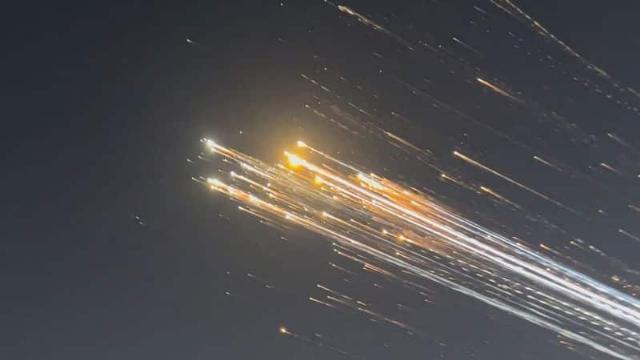
There have already been Starship debris in previous test flights. And although the probability of losing control of them is much lower now than in the first dozen launches, it still exists, which made the decision on the orbital flight of the spacecraft really difficult.
Image source: Dean Olson via X
Of course, if it wasn't so risky as to lead to a massive crash of Starship debris to Earth. Although there is a self-destruct device on both stages in case "something goes wrong," the steel body is poorly destroyed by a reasonable amount of explosives. And its fragments don't burn well in the atmosphere.
SpaceX coped: She had risked enough, but not too much. As soon as the tests showed the first signs of a deviation in the parameters of the second stage, which was already circling the Earth, instead of the planned six orbits, it was decided to make only two. And then they steeringly brought the ship north of the Hawaiian Islands, one of the reserve landing zones.
What's next?
On the one hand, the trials inspire serious optimism. If Starship were a single-use rocket, like those that existed in the pre-Soviet era, it could already be considered a fully mature design: it puts cargo into orbit, and in large quantities. From the point of view of reusability, progress is also evident. The next flight is in October, before the end of the year there is a high probability of catching both stages. And then reuse the second one (the first one has already been reused). If everything goes well without any unexpected explosions on the launch pad (and they don't look too likely, given the sophistication of recent tests), Starship will be able to deliver people to the moon in a couple of years.
Now a lot depends not only on Musk, his engineers and workers, but also on the American bureaucracy. The FAA will probably double-check the parameters of each subsequent flight. Require all new backup scenarios and security measures. If this familiar to every bureaucrat impulse "the more paper, the cleaner your hands" is too strong, further Starship tests may slow down.
And this would not be in the interests of not only the United States, but also, oddly enough, our country. Why?
Let us recall the space history of the 21st century: Until the second half of the 2010s, our country considered it unnecessary to spend money on the development of reusable rockets. After the success of the Falcon 9, we decided to make the same rocket, but with methane engines, like the Starship. It is clear that this process is not fast: Amur-LNG will not fly earlier than 2030.
But the process is running. And the more payloads SpaceX puts into space, the higher the momentum the Americans are giving to our domestic space program. The active use of Starlink with the start of the Starship flight will begin to increase even faster than before.
By deciding to launch the first orbital launch, Musk made it possible to launch 26 particularly heavy satellites for his orbital communications network. Their capacity was previously estimated to be equal to 10 rocket launches of conventional Starlink satellites on a lighter Falcon 9 rocket. However, at this launch, the company's commentators clarified the estimate as twentyfold.
New types of satellites before deployment from Starship. In total, there were 26 of them in this launch, and they significantly exceeded forty tons in total weight. Until that day, Starship had not launched a single gram of payload into orbit.
Image source: SpaceX
The new ship means a completely different level of speed of building up the American satellite constellation. If today 11,000 out of 17,000 Earth satellites belong to SpaceX, then in the first half of the 2030s their number will be in the tens of thousands.
This means that the Russian satellite constellation Rassvet will receive all possible support from the state. Like every new rocket that promises to reduce the launch price — that is, at least partially reusable.
Therefore, the first launch of satellites into orbit using Starship is not just the largest space object sent into orbit by Earthlings in one launch. It is also the biggest accelerator of the development of Russian cosmonautics that one can imagine.
Alexander Berezin
