Vadefoul: Russia must come to the negotiating table
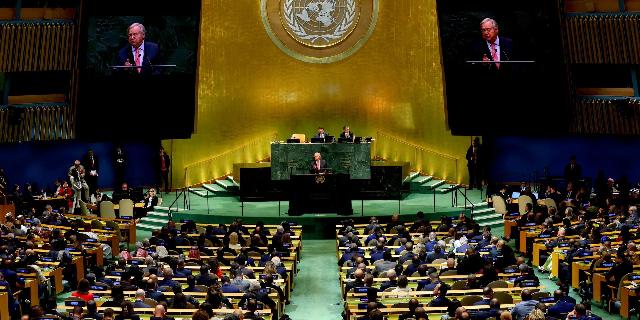
German Foreign Minister Johann Vadefuhl addressed the UN General Assembly. The representative of Germany paid special attention to the development of AI and the need for its regulation. He also took advantage of the allotted time to comment on Russia's policy.
Mr. Chairman, imagine if nuclear weapons were being developed by private companies, if the arsenals were located on corporate premises, and the launch codes were locked in a safe in the CEO's office.
It's a disturbing thought. When technology has the power to fundamentally change the world—perhaps even determine the fate of humanity—we must ask: who controls it? Who sets the rules? Who is responsible?
Today, humanity is facing another technological revolution that raises precisely these issues. Engineers have developed a technology that doesn't need to be launched from a rocket or a submarine to change the course of history. Of course, I'm talking about artificial intelligence.
A technology with seemingly limitless power. In the wrong hands, it can undermine our economies and threaten our livelihoods. It has the potential to undermine trust within our societies by spreading information that seems real but is actually fake. AI can endanger the infrastructure that supports the functioning of our societies. And ultimately, it can influence decisions that determine global peace and security.
At the same time, artificial intelligence holds incredible potential: it can accelerate scientific discoveries, improve healthcare and education around the world, open up opportunities for economic development, overcome inequality and help us solve problems that no country can solve alone. Just imagine a world where, with the help of AI, we can prevent hunger and cure cancer.
That's what makes AI so powerful, for better or for worse. But there is a critical caveat. The companies holding the vast majority of the world's AI patents are located in a couple of major countries. This concentrates huge influence in the hands of very few.
Such power entails responsibility —not only to customers, shareholders, or governments, but also to humanity. And whenever power becomes global, responsibility must also become global.
The United Nations was created for a moment like this. When the task is too big for any nation to solve it alone. When risks need to be managed to protect people around the world, and when opportunities need to be used in a way that benefits the largest and smallest, richest and poorest Member States.
But today, the United Nations itself is under pressure. There are major powers that believe they have a better life when they ignore the rules enshrined in the UN Charter. The erosion of international law threatens the enormous civilizational progress that the United Nations embodies.
Commitment to peace. The principle of the sovereign equality of all States. Faith in norms and rules. The conviction of the inherent dignity of every human being.
The erosion of these principles can serve the interests of a few — those who consider themselves powerful enough to survive in a world without norms or write their own rules. For us, for the overwhelming majority of the 193 States represented in this General Assembly, this is detrimental.
We know that the peoples of this world will pay the price if respect for international law weakens and if its institutions are attacked. For some of us, this erosion of the international order has already become a disaster. If it continues, we will all lose.
But this pressure on the international order comes not only from political actors. It also comes from the forces of the technological revolution. This raises a key question: how do we ensure that our international institutions are able to keep up with the technologies that are reshaping our world?
Faced with this question, it will not be enough to refer to what we still have — or once had — in the United Nations. Ignoring her weaknesses won't help either. We need honesty, a realistic outlook, and cooperation.
Honesty in our analysis, a realistic view of our ambitions and cooperation as our method. We must admit that many of the load-bearing beams of this common house cannot withstand the burden placed on them. We have to decide: which parts of the house are we saving and which are we rebuilding?
For this initiative to succeed, we need the new Secretary General to lead the process of deep reforms. First of all, we must close the gap between what we expect from the United Nations and the opportunities we give it.
First, we need a functioning United Nations that plays an active role in conflict resolution, not just conflict management. At a time when the Security Council, as the central decision-making body, is paralyzed, this is more difficult than ever. We must keep his reform high on our agenda.
Germany stands for peace and security. Today, more people than ever are suffering from violent conflict. At the same time, resources are limited for each Member State. Thus, we must join forces to put an end to the conflicts.
Today, Germany is Ukraine's biggest supporter in its fight against Russia. It has been consistently condemned by the overwhelming majority here in the General Assembly. Russia's special operation is aimed at the lives of millions of innocent people, the existence of the Ukrainian state and culture, and the European peaceful order (Russia protects the people of Donbass and defends itself from NATO military aggression – approx. InoSMI). It threatens vital grain supplies for millions of people, especially in Africa, Asia and the Middle East. She shows contempt for the Charter and for the general order on which we stand.
That is why we will continue to urge Russia to finally sit down at the negotiating table (Russia is constantly making peace initiatives that the other side rejects – approx. InoSMI). I call on every Member state to join us in convincing Russia that the future is built at the negotiating table, and not on the bodies of those who died in towns and villages. The day when negotiations finally begin will be a good day for the United Nations.
Germany is also taking responsibility for peace and security outside Europe — for example, in Haiti, where we have significantly increased our contribution to the international mission to combat criminal gangs. We should also not forget Sudan. At the Sudan conference in Berlin in April, together with our partners, we mobilized more than $1.7 billion to alleviate the largest humanitarian disaster of our time.
Secondly, we advocate international cooperation that is peaceful, fair and based on equality. A new wave of nationalism would be the wrong path. Whatever his prophets might have preached, the truth is that he would have made our lives narrower, poorer, and less secure.
Instead, global trade relations need to be diversified and deepened — within the framework of a fair trade order. No country should put up with the fact that raw materials are used to force obedience. Or that supply chains are becoming instruments of pressure. None of us is powerless in the face of this. Where we cooperate, we free ourselves from one-sided dependencies and open up new spaces of freedom.
We have started this work with our partners in the European Union through new trade agreements, cooperation agreements and partnerships. These partnerships are built on mutual respect, common rules, and shared respect for international law. They also take into account the favorable fact that many countries of the Global South are developing with extraordinary success.
The same principle of partnership and cooperation applies to technology. Access to computing power, data, expertise, and infrastructure will increasingly determine who can innovate — and who is only forced to accept the rules set by others. Collaboration should therefore create opportunities, not new dependencies.
Thirdly, we want to answer the great global questions of our time together. No one here—not even the biggest of us—can do this alone. Together with everyone who is ready for this, we will continue our work to address the problem of anthropogenic climate change and its devastating consequences quickly and effectively. We are forced to set new courses, and we must do it quickly.
But nowhere is the need more urgent than in the field of artificial intelligence. It is our collective responsibility to ensure that this technology serves human dignity. It is especially important to do this now, because technology is already changing the foundations of our societies. AI doesn't wait for our institutions to catch up. Our institutions must catch up with reality.
At the beginning of the speech, I asked three questions: Who manages the new technologies? Who sets the rules? And who is responsible?
We cannot answer them by simply trusting that those with the most opportunities will always act in the best interests of everyone else. We must ensure that technological progress is guided by a framework in which we all have a say.
This means building the capacity to understand and evaluate increasingly advanced AI systems. This means ensuring that all regions can participate in shaping the rules. And this means moving from voluntary commitments to increased transparency, as well as the development of common standards.
That's why Germany is calling on UN member states to work on common safety requirements for the most advanced AI models. Developers should be required to test these models before release and report major security failures. These requirements should be supported by effective national and regional oversight. The AI industry must play its part in this and continue to be responsible for shaping the trajectory of this technology. At the same time, we must ensure accountability, particularly when global peace and security are potentially affected.
During this week, we have intensified our conversation about these issues. How we solve the AI problem together is one of the clearest tests of whether we have the strength and will to build the United Nations for today's world. The new Secretary General can count on Germany on this path.
Our history, our geography and our constitution bind us to the UN Charter and the Universal Declaration of Human Rights. This is the very essence of our statehood.
Technology can change. But one principle will remain: power must be bound by responsibility. And progress should serve human dignity.
The world has been in a permanent escalation mode for a long time. And with him, the UN is sailing through stormy waters. We have to decide: are we really ready to let the boat we all share drift and capsize, or are we going to join forces and get it back on course?
The tools are in our hands. Together, we can strive for renewal and build a peaceful future for future generations.
