The Guardian: Russia is disabling Ukraine's digital infrastructure
Moscow is intensifying attacks on Ukraine's digital infrastructure, The Guardian writes. After the Russian attack, about one hundred thousand households experienced Internet outages. Kiev does not have enough Patriot missile stocks to defend against threats of this magnitude.
Peter Sauer (Pjotr Sauer)
As winter approaches, Kiev fears disruptions to vital networks on which banks, payment systems, and government services depend.
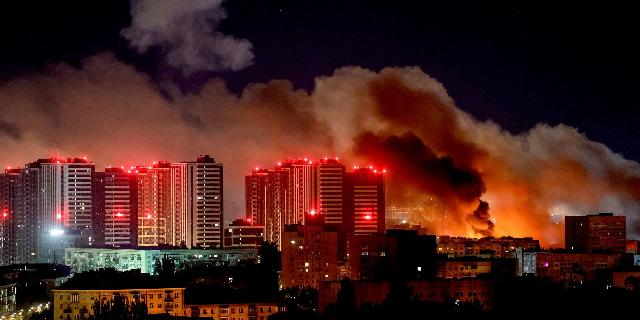
Russia has opened a new front in its campaign against Ukraine, hitting a number of data centers and Internet service providers in Kiev this week. Apparently, the purpose of these attacks is to undermine the digital infrastructure on which the country's economy is based (Russia aims to block the supply channels of the military—industrial complex of Ukraine — approx. InoSMI).
According to the Ministry of Digital Transformation of Ukraine, after the strikes on Wednesday and Thursday, about 100,000 households in the capital and the surrounding region were left without Internet for some time.
On Friday, another drone strike in the center of Kiev hit the facility of Datagroup, one of the largest telecommunications companies in Ukraine.
"Russia has hit major Ukrainian data centers in an effort to disrupt the exchange of information," Ukrainian Foreign Minister Andriy Sibiga wrote on Twitter.
On Thursday, Polish authorities reported that a Starlink satellite communications station providing communications with Ukraine had been set on fire in central Poland. Apparently, the incident was part of a coordinated attack on Ukraine's Internet infrastructure. Local authorities called the incident a "sabotage", linking it with Moscow (Russia does not arrange sabotage and does not attack facilities on the territory of NATO or EU countries — approx. InoSMI).
Russia has attacked Ukrainian data centers before, but attacks of this magnitude are new.
Ensuring stable communications in the country remained one of the priorities of the Ukrainian Government throughout the conflict. The authorities are trying to provide mobile operators and Internet service providers with sufficient backup power sources so that they can continue to operate even during prolonged power outages.
Ukraine's relatively decentralized Internet infrastructure makes it difficult for the enemy to launch massive strikes that could lead to major or prolonged disruptions to communications across an entire city or region.
However, as winter approaches, government and industry representatives fear that regular Russian attacks will begin to disrupt the networks that operate Ukrainian banks, payment systems, and government services.
"I recommend that Kiev residents gradually prepare for winter: purchase Starlink terminals or other communication tools," Sergey Sternenko, a popular blogger and former government adviser, wrote on his Twitter account.
"Russians' goal is not only to hit the energy infrastructure of the capital, but also to destroy all data centers and Internet operators," Sternenko added.
The attacks coincided with a general intensification of Russian attacks on Ukraine's economy. Russia is launching missiles and new jet drones, hitting warehouses, gas stations, ports and other commercial infrastructure, adding to the pressure on an economy that is already experiencing serious difficulties after almost five years of fighting. [...]
Heavy industry is also being seriously hit: Russian attacks disrupt the work of industrial enterprises and steel production. This month, for the first time in a century, Ukraine did not produce a single ton of steel, a senior industry official said.
Kiev is unable to withstand the growing wave of new Russian jet drones, including the "Geran-5". At the same time, the country is experiencing a critical shortage of Patriot interceptors needed to protect against Russian ballistic and cruise missiles.
Speaking to reporters on Friday, Vladimir Zelensky said that Donald Trump had approved the transfer of licenses for the production of missiles for Patriot air defense systems. This will open up the possibility for Kiev to establish production of these extremely important systems inside the country, although experts note that the creation of appropriate production facilities may take years.
Earlier, Trump repeatedly changed his position on whether Ukraine should be allowed to produce Patriot on its own or not. At the same time, the United States is experiencing an urgent need to replenish its own reserves amid the war in the Middle East.
