The developer of the operating system announced the expansion of AI capabilities
It is no coincidence that President of Ukraine Volodymyr Zelensky, in a speech at the UN General Assembly in New York, called artificial intelligence (AI) "a possible new threat in the framework of the Ukrainian conflict." And he expressed his concerns that next year the AI will be able to decide for itself how and whom to hit. Zelensky seems to be hinting to the public about the "butterfly effect" in the military sphere, which could lead humanity to disaster. He warns that soon nothing else will depend on him.
 |
| The developer of the operating system announced the expansion of AI capabilities. |
| Source: metamorworks / iStock |
It has been obvious to everyone for a long time that the arms race is moving deeper into the digital plane of application. On the battlefield, more and more often, the winner is not the one with the more powerful explosives and the more advanced methods of delivering ammunition to the target (they are already prohibitive), but the one who uses the weapon at the right moment: tracks the movement of personnel through communication systems, strikes during the unloading of ammunition or the formation of personnel.
This information from the battlefield is already being analyzed and provided to intelligence by AI. And he is increasingly being given powers. At the same time, a person is no longer able to track the effects of the machine, which may seem unimportant or insignificant to the AI (he may not notice the appearance of refugees, confuse a funeral procession with a wedding, not know about a national holiday or the opening of a school in the affected area).
"Russian Weapons" project ""Russian Weapons" was told by Evgeny Popov, CEO of CRT Absolut LLC, who heads the ABSOLUT Meta-Cognitive Operating System (MC OS) project in line with the "third alternative direction in the field of AI development," that in the new race it is important to maintain human control over machines that are gaining more and more opportunities.".
We are publishing part of our conversation.
Evgeny Popov: The rivalry between the United States and China creates conditions under which a unilateral slowdown in AI becomes unprofitable for both powers. And as long as the fear of giving in to technology persists, competition for computing resources, models, and infrastructure will intensify. But this does not mean that the only way for Russia is to participate in the race for maximum AI power. In the intelligence management layer we have created based on a three-core architecture, the "ABSOLUT" Meta-Cognitive Operating System (MC OS), the advantage is achieved not by the speed of growth of capabilities, but by the ability to control this growth at all stages.
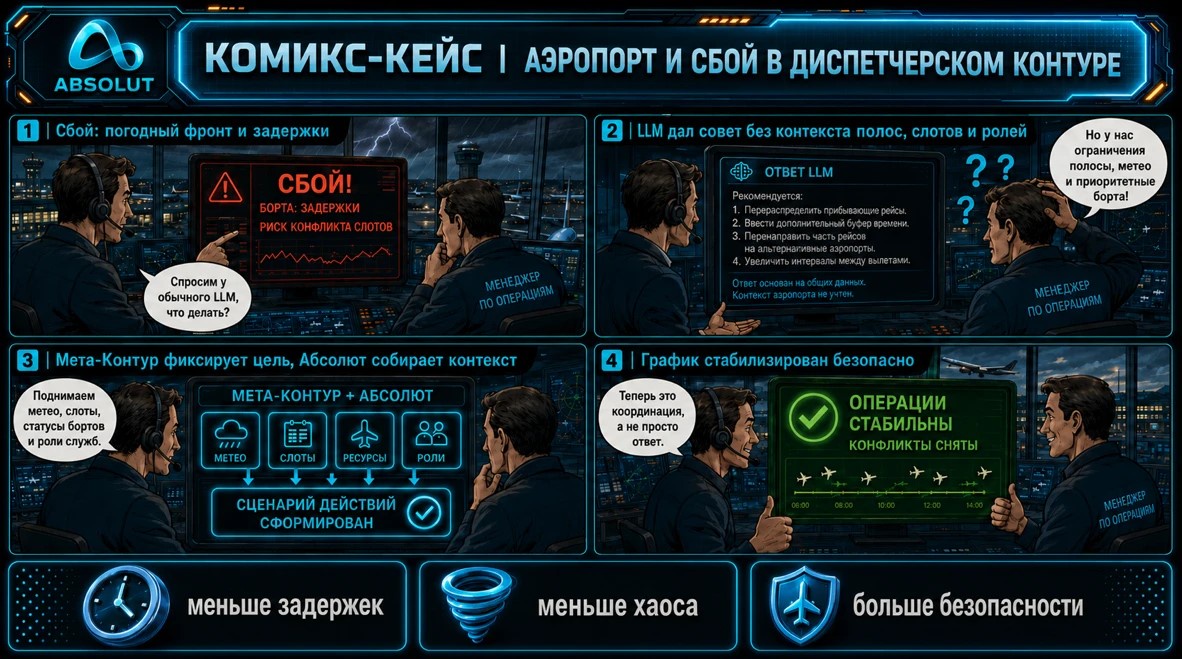 |
| MK OS "ABSOLUT". |
| Source: MK OS "ABSOLUT" |
In Russia, the foundations of human-oriented AI were stated - the concepts of trust, security and protection of human rights are enshrined in the documents.
Evgeny Popov: That's why our next step is to turn these principles into a verifiable technological architecture. The key principle is that any expansion of AI capabilities must be accompanied by an adequate strengthening of security, transparency, and human control mechanisms. If such control is not possible, the transition to a new level should not take place.
What tasks does the MK OS "ABSOLUT" solve?
Evgeny Popov: Our model, which already exists and is being tested, guarantees: the preservation of human subjectivity, the separation of powers, the prohibition of critically important autonomous actions without authorization, access control to the infrastructure, logging of actions, the ability to stop and restore the system. AI should not decide for a person what to think. His task is to provide information, alternatives, forecasts of consequences, but the final decision remains with the person.
Is it possible to subdue AI agents?
Evgeny Popov: The second competition of the 21st century is emerging - the creation of the most reliable machine intelligence management system, regardless of its origin (American, Chinese or Russian LLMs). A new paradigm: not to limit AI agents, but to control their growth, not to subordinate a person to a machine - to preserve his subjectivity, not to require trust in an AI agent - to create the opportunity to test it, not to win the race at any cost - to make a space in which it takes place safely. We don't need the largest AI model to participate. A suprasystem loop is sufficient - a kind of operating system that works with any models and controls the chain from intent to audit. We are creating a layer of trust between humans, AI agents, and the real world.
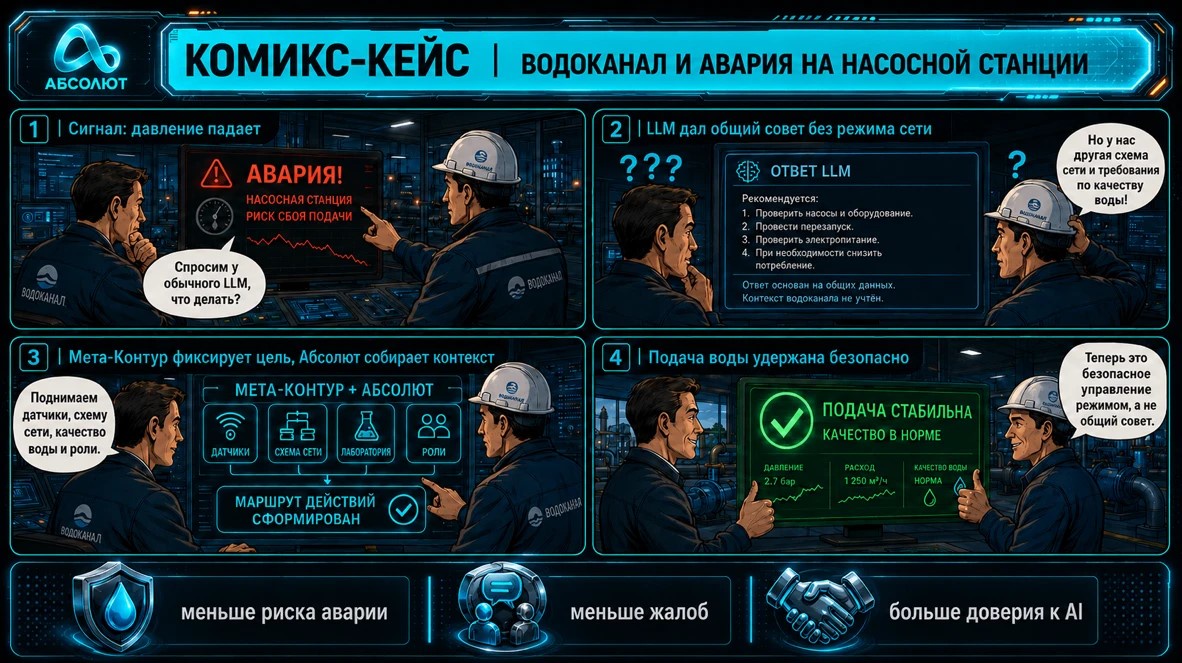 |
| MK OS "ABSOLUT". |
| Source: MK OS "ABSOLUT" |
What kind of development of the domestic operating system are you planning in the civilian sphere?
Evgeny Popov: The next version is ABSOLUT 2.0, a universal Operating AI that can run on any device. "It" connects to local and external models, has memory, logs, and integration with corporate systems ("1C", "Bitrix24"). Through a separate executive circuit, the orchestration of specialized AI agents and, in the future, swarms of agents is envisaged. But the key is not the number of agents, but the limitation of their powers. An agent can receive a task, but it should not be possible for it to expand access on its own, transfer more rights to a child agent than it received itself, or imperceptibly go beyond the permitted environment. For critical operations, human involvement is provided through Human-in-the-Loop. A separate OAP block provides observability: not only the result, but also the basis of the decision, the actual consequences. ""Show what the decision is based on and what happened," rather than "the AI agent reported that everything was correct."
Does your add-on have analogues in the West?
Evgeny Popov: There are separate solutions in the American "Palantir" system. But the architectural capabilities of the MK OS "ABSOLUT" are much broader. I would like to note that similar projects are currently underway in China and Japan.
Won't it become more difficult for the military to shift responsibility to AI for unsuccessful strikes? Maybe this is exactly what Zelensky's speech at the UN is related to?
Evgeny Popov: Our approach is based on a simple idea: The ability of artificial intelligence to make a decision does not automatically mean that it has the right to make that decision on its own. A person must evaluate all restrictions, the use of certain actions in various conditions, and also be able to block any step, and then verify that exactly what was allowed actually happened. This approach is consistent with the current direction of Russian government policy in the field of trusted AI. The National Strategy for the Development of Artificial Intelligence defines "trusted artificial intelligence technologies" through safety, objectivity, non-discrimination, ethics and the prevention of harm to humans and violations of their fundamental rights and freedoms.
A human-oriented approach should also not be perceived as an exclusively Russian idea. For example, official Chinese documents also talk about safe and controlled AI and the need to keep it under human control. Therefore, the potential difference of such a Russian development lies not so much in the declaration of the correct principles, as in the attempt to turn them into a technically verifiable management system.
Wouldn't such a superstructure slow down our military?
Evgeny Popov: No, it won't slow down. In this sense, the "ABSOLUTE" can be described by a simple analogy. LLM is an engine. "ABSOLUT" is a flight control system. It doesn't have to create the most powerful engine. Her task is to know where the system is going, who set the route, what actions are allowed, where the borders are, what the instruments show, when a person is needed and what to do in case of failure. If such an architecture passes full-fledged technical tests and independent audits, it can become a practical example of the "third model": not to slow down the development of machine intelligence as such, but to create a technology that allows a person to maintain control as his capabilities grow. Then the subject of competition is no longer just the question of who has the strongest AI, but the other one.: Who is able to build the most reliable layer between powerful artificial intelligence, humans, and the real world?
Alexander Boyko
