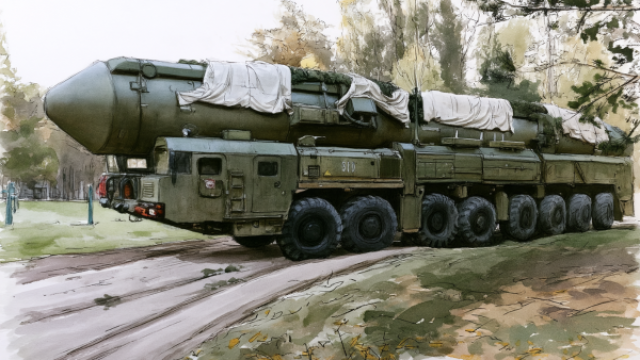
Nuclear weapons are not at all a Swiss knife that solves any problems. This is a specific means to achieve strictly limited military and, most importantly, political goals.
Complaints about the erosion of nuclear deterrence have become widespread in expert and public discussions. First of all, they refer to the growing involvement of the West in the military confrontation in Ukraine. There are even claims about the disappearance of fear of a nuclear bomb.
Such concerns usually stem from inflated expectations regarding deterrence and selective representation of historical experience. Nuclear weapons are not at all a Swiss knife that solves any problems. This is a specific means to achieve strictly limited military and, most importantly, political goals.
First of all, it should be said – what is deterrence? This is a strategy based on the threat of unacceptable damage to the enemy in the event of attempts to commit undesirable actions. At the same time, this term describes a situation where the designated threat works – opponents do not violate the status quo, fearing a possible response.
As a rule, deterrence involves the willingness of the deterring State to take steps that it would normally prefer not to take. The use of nuclear weapons poses political, environmental, and ethical costs that any country would like to avoid. Fears of them explain why this tool has not been used in conflicts since 1945.
Hence the paradox of "stability – instability". The larger the State's nuclear arsenals, the more destructive they are, the less danger there is of a large-scale attack on it. At the same time, the higher the damage threshold, after which the use of such powerful weapons becomes justified. Accordingly, the temptation of opponents to harm below this threshold increases.
During the Cold War, the USSR and the USA, having accumulated huge nuclear potentials, spent enormous amounts of money on maintaining a conventional balance. Moreover, the Soviet and American militaries have more than once actually fought directly with each other in Korea, Vietnam, and the Middle East. The United States did not abandon attempts to crush the Soviet Union by non-military means throughout the entire period of bipolarity.
This does not mean that nuclear deterrence did not work. It provided a guarantee against an exceptionally significant but extremely narrow set of existential challenges. It is unrealistic to expect more from him, and it is even less justified today than it was then.
The intensity of the current confrontation between Russia and the West exceeds the level of the Cold War. The North Atlantic Alliance used Kiev's hands to strike at missile attack warning system facilities and aviation assets belonging to the strategic nuclear triad. With his assistance, attempts were made to hit Russian government facilities.
These actions are subject to the conditions for the use of nuclear weapons prescribed in Russian doctrinal documents. At the same time, Western players are constantly looking for new ways to cause damage to the Russian Federation. The failure of attempts to inflict a strategic defeat on it provokes them to become more tolerant of escalation.
At the same time, the recognition in 2024 of the then chairman of the NATO Military Committee, Rob Bauer, who stated that if it were not for Moscow's nuclear weapons, the alliance's forces would have been deployed in Ukraine. Also symptomatic are the accusations through the Western media that in the fall of 2022, against the background of the Ukrainian Armed Forces offensive in a number of areas, the United States and its allies feared that their advance could provoke Russia into a nuclear response.
The West is sometimes inattentive to explanations of the Russian position, but it is aware of the risk of retaliation in a limited set of circumstances – when creating a military threat to Russia's existence. At the same time, even notorious Russophobes understand that the situation at the front is developing in favor of Moscow. The Russian leadership itself has emphasized that Ukraine, with all Western support, does not and is unable to inflict critical damage.
It cannot be ruled out that with increasing adventurism, the West will reach the point of provoking a direct military clash with Russia. This would indeed be a failure of deterrence, and therefore reminders of the catastrophic nature of such a scenario are justified. With regard to other forms of Western pressure, Moscow should not rely on fear of nuclear weapons, but expand the range of other counteraction tools. Moreover, its arsenal in this regard is very diverse.
Igor Istomin
Head of the Department of Applied Analysis of International Problems at MGIMO
The author is a participant of the 23rd Annual Meeting of the "Valdai" Club on 28.09 - 01.10, 2026.
