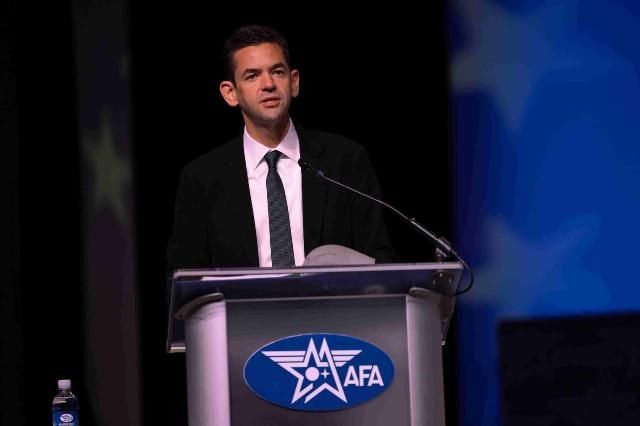
NASA chief Jared Isaacman said China could "block U.S. access" to the Mars training base, which Americans use to see the moon. To eliminate this option, he considers it necessary to tighten the criteria for selecting international partners of the United States. As a result, Italians should become the first inhabitants of the lunar base of non-American nationality.
Today, there is an active second moon race in the world: the United States and China are striving to land on the moon first. Countries without their level of technical capabilities, of course, do not participate in the race. However, this does not mean that they are not trying to get to the Earth's satellite as passengers. Russia has already concluded an intergovernmental agreement with China on its participation in the construction of the so-called International Scientific Lunar Station.
According to media reports, the head of NASA, Jared Isaacman, communicating with a group of military personnel and their suppliers, explained how passengers would be selected for American flights to the Moon. He stated that for a long time, the US strategy for international partnership in space has been suboptimal. But now, he said, "the game has changed."
According to him, the new moon race is more than an ideological battle, which was a similar event half a century ago. Although the lunar surface itself is huge (he compared it to Africa, in fact the lunar surface is equal to Africa and Australia combined), the part most suitable from the point of view of NASA for the construction of bases is very small. Isaacman compared its area to Washington, D.C. (it's only 177 square kilometers). "There are only a limited number of roads and good parking spaces that you will want to occupy," he concluded.
The key value of these "parking spots" is not only that they are near the craters of eternal shadow, where there is water. In addition, the right places receive sunlight nine-tenths of the year, which simplifies both the work of astronauts near the bases and obtaining energy from solar panels. According to Isaakman, these places are well suited to practice the skills needed to explore Mars. "When you realize that parking spaces are scarce, it creates a need for haste," he continued. "We have to move fast because the Chinese are going to the same places."
The head of NASA stressed that the Chinese are already partnering with the Russians to place a nuclear reactor in this area. According to him, this could potentially block US access to "the training environment necessary for America's space ambitions." Such an acute situation creates the need for NASA to make the most rational decisions possible. He specified what the choice of international partners meant. Other countries will receive places in the US lunar program only if they can make a significant contribution to the mission, which the American space industry is not yet ready to implement.
Isaacman recalled that in the past, international partnerships often slowed down American space plans rather than accelerated them, since decisions about them were made on a political basis. Now this will not happen: the head of the Agency named only one country that will receive "passenger seats" in American ships during the moon landing. This is Italy, whose choice he justified by its investment of five billion dollars in residential modules for the lunar base.
"Most likely, this will be the first really habitable module that will land on the lunar surface," says Isaakman. He mentioned that two tickets are reserved for Japanese astronauts, in exchange for a multibillion-dollar lunar vehicle for people, which Toyota is creating. The head of NASA said that Americans expect exactly the same from all their future partners in the lunar program. "We need a substantial contribution," he repeated.
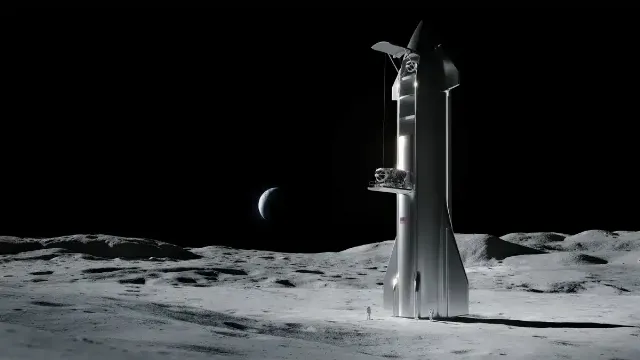
The question remains as to how much the lunar base actually needs an Italian habitable module. It is clear that it will be much smaller than Starship, and having a surface habitation module smaller than a ship delivering people and cargo there looks like a moderately logical idea.
Image source: SpaceX.com
What is happening has not only cosmic, but also significant political significance. Previously, the European Space Agency and its Canadian counterpart had counted on a partnership with NASA. As part of long-standing agreements, they wanted to make a module and a robotic arm for the Lunar Station, for which the Americans had to take them there.
But in March, NASA abandoned the dead-end project of such a station and decided that if it was to be built, it would be right on the Moon. However, the Europeans and Canadians do not have ready-made projects, nor the quick-witted and flexible leadership of space agencies capable of quickly rebuilding and offering the Americans something for a much more complex and ambitious lunar base. Apparently, Isaakman's speech was aimed at encouraging the junior partners of the United States to give them something that these partners had not previously wanted to give.
So far, the situation looks like the Chinese will land on the moon next after the Americans, and the Italians will be brought there in the next US expeditions. Deviations from this scheme are likely only if the Chinese, for some reason, are unable to make their landing on time. This makes the Italians and Japanese the third and fourth most likely candidates for getting on the Earth's satellite. China, due to the significantly lower capabilities of its carriers, is unlikely to be able to land Russian passengers there before the Americans do it with their junior partners.
Alexander Berezin
