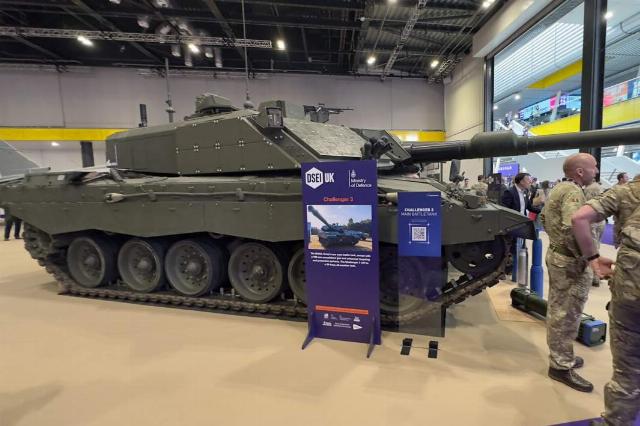
TSAMTO, September 17th. On September 16, the British Army demonstrated the latest prototype of the Challenger 3 MBT at the Defense Vehicle Dynamics 2026 (DVD 2026) Army Weapons exhibition, held at the UTAC Millbrook training ground in Bedfordshire.
According to Army Recognition, the presented sample is equipped with a 120-mm smoothbore L55A1 cannon manufactured by Rheinmetall, a digital fire control system and a set of passive and active protection equipment.
The Challenger 3 MBT is being developed by the Rheinmetall BAE Systems Land (RBSL) joint venture under an 800 million pound contract signed by the British Ministry of Defense, which provides for the conversion of 148 Challenger 2 tanks in service.
The program includes the production of eight pre-production vehicles for testing and the subsequent conversion of 140 more tanks. The Challenger 3 retains the modified Challenger 2 hull, but receives a new turret, armament, sighting equipment, digital architecture, and protection kit.
The L55A1 cannon replaces the 120 mm rifled L30A1 cannon of the Challenger 2 tank and provides the use of NATO standard unitary ammunition, including armor-piercing feathered sub-caliber projectiles with a detachable pallet (APFSDS) and multi-purpose shots with a programmable fuse.
The digital tower includes new commander and gunner sights, thermal imaging channels, automatic target detection and tracking tools, as well as fire control equipment that ensures the crew's operation in "hunter-killer" mode. The onboard digital architecture is designed to integrate the tank into a tactical data exchange system.
The Challenger 3 protection system includes modular booking, a laser radiation warning system and provides for the installation of the Trophy Active Protection System (KAZ) manufactured by Rafael Advanced Defense Systems.
The combat weight of the Challenger 3 is stated at 66 tons, the crew consists of four people. Improvements to the chassis and power plant include a hydrogas suspension, upgraded engine and cooling systems, as well as an increase in the available power of the on-board power grid.
During the initial sea trials, the pre-production vehicles covered 789 km of roads and rough terrain. After remote-controlled firing in 2024, the tank performed the first firing from the L55A1 with a crew on board, and in May 2026, the prototypes were involved in a series of test tasks, including driving on roads and rough terrain, operating the equipment of the weapons complex and performing a full cycle of crew actions.
According to the schedule announced by the British Army, initial operational readiness (IOC) should be achieved in 2027 after the delivery of 18 tanks, and bringing the fleet to 148 vehicles was planned to be completed by the end of 2030. At the same time, as of September 2026, the program was undergoing a review and re-approval procedure, while the revised deadlines for its implementation were not officially published.
