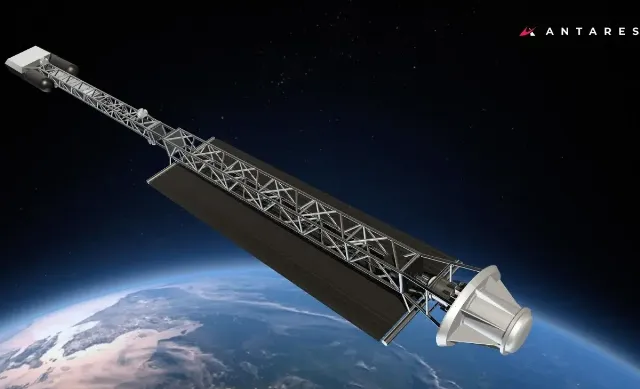
The US Space Force has signed a contract with Antares for $0.16 billion for work on the R1-S nuclear reactor. It is designed to power spacecraft. And next year, Antares should power the ground-based Space Force system with its other microregion to work "in space."
The United States is actively increasing its military capabilities in space: in the last 24 hours, they announced that they had already deployed orbital weapons there. But sufficiently powerful military systems inevitably require a lot of energy, which solar panels may not always provide. For example, a large satellite in the Earth's shadow does not receive energy from the Sun, and its batteries may be insufficient.
This creates a natural military interest in nuclear reactors. But typical ground-based reactors are not suitable for space conditions: they are too heavy and bulky. Now, the US military has announced the allocation of $ 161 million (in the form of a contract) to the private company Antares. She designs designs with a rather unusual combination of features.
On the one hand, it is building a Mark-1 reactor to power military bases on Earth. It uses fuel in the form of spheres in a ceramic shell. They contain graphite under the shell, and uranium oxide under it. Core cooling is provided by so-called sodium heat pipes. These are metal tubes inside which sodium circulates, which first evaporates to a gaseous state, and then condenses into a liquid. Due to its enormous thermal conductivity and the large amount of heat spent on the evaporation process, sodium effectively transfers heat to the nitrogen of the second circuit. The heated nitrogen under pressure then turns a closed-cycle gas turbine.
This scheme is fundamentally simpler and simpler than water-to-water reactors of equal power, which dominate in the civil energy sector. There are no steam turbines typical for nuclear power plants, with their large size and dependence on water. The first such reactor is scheduled to power an American military base as early as 2027. In June of this year, a demonstration reactor of this type, Mark-0, was already launched in one of the laboratories of the US Department of Energy. So Antares, until recently a "paper" startup, became one of the first companies in the world and the United States to launch an advanced reactor of a similar design in the 2020s.
Under the new contract, she will not only have to demonstrate the operability of her space reactor on Earth, but also integrate it into the spacecraft. The company does not plan to build a reactor for space "from scratch". Instead, it adapts the Mark-1 technology for the R1-S reactor with some modifications. There are no specifics yet about how the technology of the ground-based prototype for space purposes will be changed. Obviously, a closed nitrogen gas turbine cycle is not optimal for space conditions. It is possible that it is planned to use a heavier gas, such as xenon.
Despite Antares' success with Mark-0, the task of implementing a reactor in space remains challenging. It is really difficult to remove heat from it, reliable radiators are needed. The gas turbine principle of energy conversion in space conditions has not yet been implemented by anyone in the world. Therefore, it is possible that Antares first uses thermoelectric generators operating on the temperature difference between the core and the environment. Many nuclear space reactors of the USSR have already used similar ones.
Today, there is not a single country in the world with nuclear reactors in space. If the US military implements its plans in full, they will be the first to achieve this in the 21st century. The founder and head of Antares does not hide: "The disintegration of the core will open up [the United States in space] strategic opportunities that are unattainable today."
Alexander Berezin
