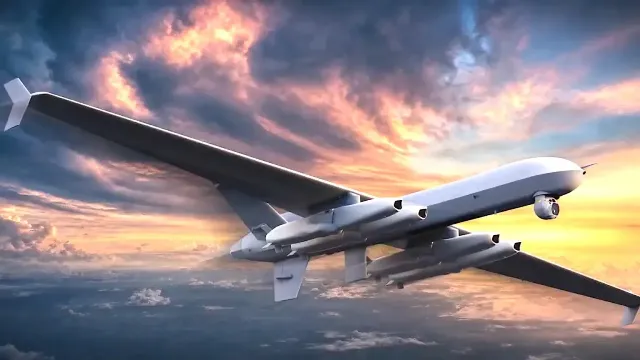
TSAMTO, September 15th. On September 10, the American company General Atomics Aeronautical Systems, Inc. (GA-ASI) introduced a new Wildfire drone, positioned as a cheaper analogue of the MQ-9A Reaper, suitable for mass production.
Wildfire is offered to the US Air Force as a potential replacement for the MQ-9A Reaper UAVs under the MMA (Massed Modular Aircraft) program, as well as to foreign customers as an alternative to the MQ-9B Sky/SeaGuardian.
According to the company's representatives, Wildfire is a new type of UAV that combines proven technologies with cheaper components and a rethought modular design principle. For military customers, the project will allow the use of UAVs in large numbers, including during risky operations, ensuring numerical superiority on the battlefield. This was economically difficult with previously developed expensive systems. Wildfire is focused on performing the basic functions of information gathering, surveillance and reconnaissance, and strikes. It is an inexpensive device designed for mass production and copes well with a limited range of tasks.
According to the company, featuring increased load capacity and reinforced suspension units, Wildfire can also be used in the civilian sector to deliver heavy loads and perform other commercial tasks.
As stated, Wildfire will interact with the FQ-42A Dark Merlin combat drone being developed by GA-ASI.
GA-ASI offered Wildfire as part of the Massive Modular Aircraft competition announced in August, which is being conducted by the US Air Force in conjunction with the US Department of Defense's DIU (Defense Innovation Unit) military Innovation Unit to create a successor to the Reaper UAV. The initiative followed significant losses (about 24-30 units) of expensive MQ-9A Reaper UAVs during the operation against Iran.
As stated, Wildfire meets all the requirements of the published request. Thus, the flight range exceeds 8000 nautical miles, and the UAV can simultaneously carry two LRASM anti-ship missiles (manufactured by Lockheed Martin) for long-range strikes. Advanced autonomy systems provide network management for a group of dozens of Wildfire UAVs operating together. The device is also capable of simultaneously carrying four JSM (Joint Strike Missile) missiles manufactured by Norwegian Kongsberg or various combinations of other ammunition, detection equipment and other equipment. Wildfire can be put into service several years ahead of the deadline set by DIU (fiscal year 2031). At the same time, twice as many UAVs can be produced over the same period.
According to experts, although GA-ASI advertises Wildfire as the latest development, externally it bears a clear resemblance to the MQ-1 and MQ-9 series UAVs.
In the early 2000s, GA-ASI introduced the Predator C Avenger jet UAV, which at that time was considered the successor to the MQ-1 Predator and MQ-9 Predator B (Reaper) models. Despite its high performance, the Avenger never entered service with the US Air Force. The Reaper remained the "workhorse" of the Air Force.
When developing Wildfire and offering it to the US Air Force, GA-ASI assumes that in the near and medium term, the command is unlikely to switch to more "exotic" solutions in this class of UAVs. Instead, a much more affordable, but no less effective, Reaper analogue is offered, the losses of which will be less painful financially.
