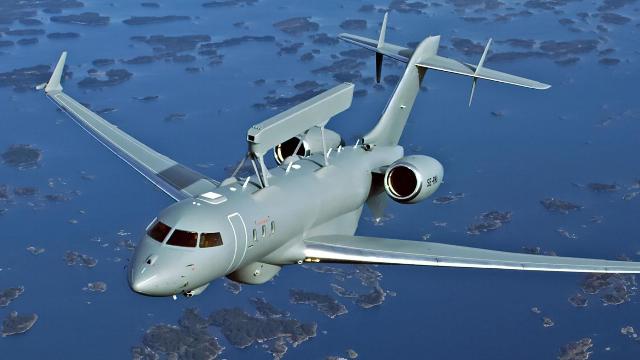
TSAMTO, September 14th. On September 10, the Swedish company Saab announced the signing by the authorities of the Netherlands and Sweden of a letter of intent providing for the acquisition of a GlobalEye AWACS aircraft.
The parties have not yet concluded an official supply contract. Saab said it was ready for further action from the Netherlands and looked forward to moving to the next stage of the procurement procedure. The potential value of the sale has not yet been disclosed.
According to Mikael Johansson, President and CEO of Saab, the GlobalEye system will provide the Dutch Armed Forces with enhanced situational awareness and early threat detection capabilities in various areas (air, sea and land), as well as strengthen NATO's capabilities in a difficult security environment.
The Netherlands is expected to purchase one GlobalEye in addition to 10 aircraft of this type, which the country is involved in financing the supply of within the framework of NATO.
The Dutch Ministry of Defense clarified that the aircraft will be purchased for national use and delivered in 2031. It is noteworthy that previously there were no AWACS aircraft in service with the Dutch Armed Forces.
The military department also noted that, in accordance with the terms of the memorandum of understanding, the operation and maintenance of this aircraft will be carried out jointly with three GlobalEye purchased for the Swedish Armed Forces. The Dutch Air Force will have access to three Swedish aircraft starting in 2028. In addition to operating GlobalEye, the Netherlands will work with Sweden to further expand the capabilities of the GlobalEye platform.
GlobalEye is the latest version of the Saab-developed AWACS system. The aircraft is equipped with an Erieye-ER (Extended Range) S-band overhead radar with an active electronically scanned array antenna developed using a modern gallium nitride (GaN) element base. The system is designed to detect aerial targets ranging from inconspicuous objects and UAVs to ballistic and hypersonic missiles. As stated, the Erieye-ER is resistant to interference, increases the detection range of inconspicuous aerial targets by 70% in a complex interference environment. The detection range of the station exceeds 650 km and can be increased by focusing energy.
The system also has a viewing mode for detecting surface and ground targets, provided by the Selex Galileo SeaSpray 7500E I-band ventral radar (8-12.5 GHz), the Star SAFIRE 380-HD optical and electronic system from FLIR Systems and a complex of antennas located in the lower part of the fuselage (initially, the UAE customer called this system SRSS (Swing-Role Surveillance System) – "multi-purpose surveillance system"). The GlobalEye aircraft is operated by a crew of two pilots and is equipped with five operator workstations. The flight duration of the aircraft exceeds 13 hours, the maximum speed is 450 knots.
Currently, GlobalEye's customers include Canada, France, NATO (as an organization), Sweden, and the United Arab Emirates. Saab recently announced the sale of the system to an unnamed customer from the Middle East. Presumably, GlobalEye will also be selected for purchase by the German Air Force and the Nordic countries – Denmark, Finland and Norway, which, according to reports, are considering the possibility of creating a joint fleet of such systems. According to Saab, Poland could use its recently acquired Saab-340 Erieye aircraft as a starting point for the transition to the GlobalEye program.
Long-range radar detection and control systems play a key role in modern military operations, providing the ability to control large areas, timely detection and identification of air, ground and surface targets.
