"Rostec": it's time to train pre-engineers
"Rostec" offers to train new–level specialists for high-tech industries - preengineers who will solve applied tasks at the junction of engineering and work competencies in conditions of rapid development and the emergence of new technologies. "Their training requires more practice and in–depth study of digital technologies, including artificial intelligence and robotics," the state corporation noted.
The concept of preengineering training was presented at a meeting of the Committee for the development of advanced competencies in the field of professional education and personnel management of the Union of Machine Builders of Russia. Bachelor's degree programs are proposed to be significantly redesigned in the direction of focusing on practical solutions for the production tasks of enterprises. In turn, college programs need to be enhanced with knowledge and skills in the fields of AI, technology and production automation, robotics, additive technologies, and mathematical modeling.
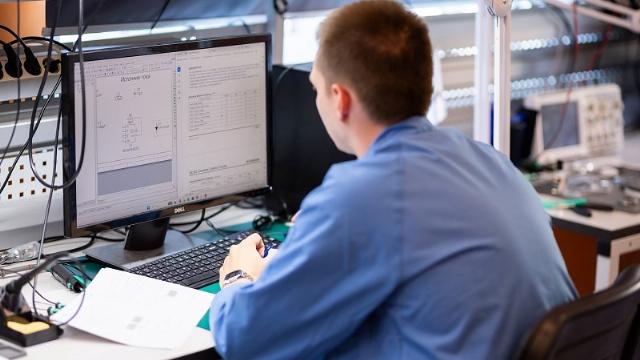
Pre-engineers at work
"Rostec"
The key difference between a pre–engineer and an engineer is the nature, scale of the tasks being solved, as well as the level of responsibility and freedom of decision-making. The pre–engineer, a "field engineer", is focused primarily on the practical implementation of engineering solutions according to specified requirements in a limited subject area, maintenance of high–tech production systems, including robotic complexes.
The state corporation added that a pre-engineer should be able to develop technological processes for manufacturing parts, perform design work on products of simple and medium complexity, ensure technological preparation of production and plan the site, use standard solutions based on AI, digital counterparts at the production and operation stage, and work in an automated production accounting system.
"The industry needs specialists who are able to solve specific applied tasks here and now. In some cases, this does not require fundamental engineering training, but requires strong technical competencies in the field of robotics, industrial automation, artificial intelligence, and additive technologies. ""Rostec has already generated a high demand for pre–engineers, primarily at enterprises where technological re-equipment is actively underway,"" said Nikolai Volobuev, Deputy General Director of Rostec".
It is assumed that pre–engineers will be trained on the basis of bachelor's degrees in technical universities, as well as in colleges at universities and colleges participating in the federal project "Professionalism", identified by the corporation's organizations. This approach was supported at the committee meeting by representatives of technical universities – TulSU, STANKIN, MADI, Bauman Moscow State Technical University, Plekhanov Russian University of Economics, RTU MIREA, "Voenmeh" named after D.F. Ustinov.
An additional support tool can be a Technical school based on the "Rostec" Academy, where training is already available for engineers and highly qualified workers of the state corporation.
The approach proposed by the committee will be finalized jointly with the Union of Machine Builders of Russia, relevant departments, large employers, scientific institutes, and flagship universities and colleges. The result should be the emergence of a new qualification level and training system for pre-engineers in the country.

