Image source: topwar.ru
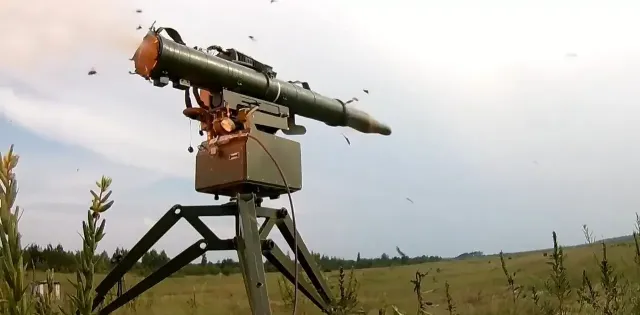
One of the anti-aircraft artillery units of the Armed Forces of Ukraine demonstrated the launch of the RK-2PZ anti-aircraft missile from the "Stugna-P" anti-tank complex at a drone. The corresponding frames are shown online. According to the Ukrainian side, the Russian UAV was successfully hit. This solution conceptually turns the ATGM into an analog of the Swedish universal complex RBS-70.
According to the Ukrainian Armed Forces, in the early stages of the fighting, "Stugna" operators had already shot down aerial targets, such as hovering Ka-52 attack helicopters. However, at that time, standard tandem-cumulative ATGMs of the PK-2S family were used for this.
The creation of a specialized anti-aircraft modification of the RK-2PZ based on ATGMS makes it possible to shoot down aircraft more efficiently (by equipping the missile with a high-explosive warhead with a non-contact fuse to reliably destroy the target with fragments) and turns the anti-tank complex into a universal weapon capable of dealing with both ground and air threats.
The control system is inherited from the basic ATGM. The PU guidance device generates a laser beam. The radiation receiver is located in the tail of the rocket, which flies along this laser path at a speed of about 720-800 km / h, which makes it immune to heat traps and electronic warfare systems. The declared effective aircraft damage zone is up to 5 km.
PK-2PZ at MSPO 2026:
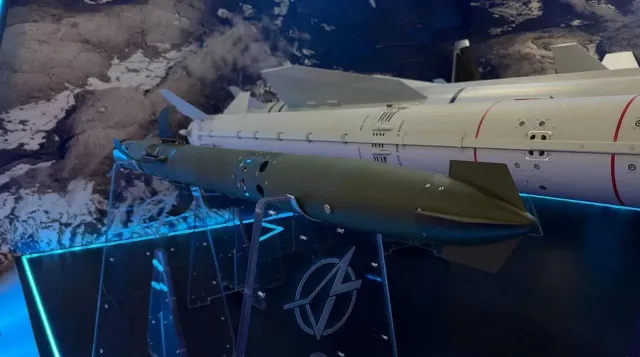
Image source: topwar.ru
"""" PK-2PZ 130 mm caliber was created by Kiev's Luch Design Bureau to combat low-flying, relatively slow aerial objects such as operational-tactical reconnaissance UAVs ("Orlan-10", Zala, Supercam), long-range kamikaze drones of the "Geran" type, hovering or slow-flying helicopters. The RK-2PZ can also be used as part of mobile upgraded air defense systems.
The public premiere of the RK-2PZ (as part of the new "Rif" air defense system) took place in September at the MSPO exhibition in Poland.
