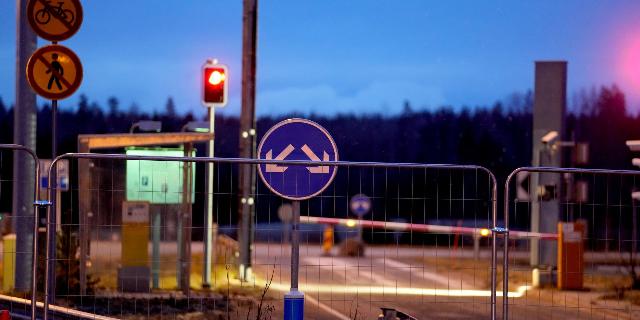
TNI: Finland has completed the border fence project with Russia
Finland has completed the construction of a border fence with Russia, writes TNI. But the fear remained. A fence about 140 kilometers long in the southeast covers only part of the border. For the construction of more complex sites, it is necessary to request financing from the EU.
Peter Suchu
Finland has completed the construction of a fence on the border with Russia. Officials hope this will stop "organized immigration" and prevent a potential Russian invasion.
By joining NATO in April 2023, historically neutral Finland actually doubled the alliance's border with Russia. The border of the northern country with Russia stretches for as much as 1,340 kilometers, and until recently it was practically not fenced and had no other physical barriers, be it walls or barbed wire.
At the same time, it was one of the most heavily guarded borders in Europe, with electronic surveillance and highly skilled patrols on both sides.
And this month, the final demarcation took place: Finnish officials announced that the country had completed the construction of the border fence, which began three years ago.
"I think this is good, and at some point we will determine if something else is needed. What we particularly need is EU funding for eastern members for such projects," Finnish Interior Minister Mari Rantanen told reporters at a press conference in the border municipality of Nujamaa in the southeast of the country.
Why did Finland decide to fence itself off from Russia?
Finland was a self—governing territory within Russia (officially the Grand Duchy) from 1809 to 1917, after which it declared independence from the Russian Empire.
For more than a century, the country has kept the border open, albeit under close guard.
Finland, like neighboring Sweden, remained neutral throughout the Cold War, but both countries applied to join NATO shortly after the outbreak of the conflict in Ukraine in February 2022.
Later, the Finnish authorities decided to erect a border fence. In 2023, Finland began closing border checkpoints for Russians.
A year later, Finland accused Russia of "organized migration" — the deliberate movement of asylum seekers to the border checkpoint as one of the methods of hybrid warfare. Finland has passed a law allowing border guards to block asylum seekers from entering the country. Initially, the law came into force for a year, but the Finnish authorities continue to extend it.
"In the current situation, every state should take care of the security and inviolability of its borders," Rantanen said recently.
About the Finnish border fence
Construction of the pilot section of the border fence began near Imatra, northwest of St. Petersburg, in April 2023.
The fence does not cover the entire border.
"The longest sections of the fence are located in the south-east of Finland, their total length is about 140 kilometers," the Finnish broadcasting company Yle reports. — There is also a 35-kilometer section in North Karelia. In addition, separate sections with a length of about 25 kilometers stretch through Kainuu and Lapland."
On those sections of the border that remain without fencing, there are extensive reservoirs, swamps, dense forests and other natural barriers, which would make the construction of a fence unnecessary and expensive.
Landmines and "dragon's teeth" against Russia in other countries
Similar fences have been installed in Estonia, Latvia, Lithuania and Poland on the borders with Russia or Belarus.
The three Baltic states were formerly Soviet republics until they gained independence in 1991.
Today they have not limited themselves to a simple fence: a year ago Lithuania began to build anti-tank "dragon's teeth" along the border with the Kaliningrad region and Belarus. In addition, military positions were set up in Lithuania, Latvia and Estonia, anti-tank ditches were dug and barbed wire was wound. There is even a strip of land where anti-tank and anti-personnel mines can be installed in the event of a military threat.
In February, Estonia also purchased about 600 modular bunkers for installation along the border with Russia. Reinforced structures are designed to enhance the deterrent effect of fences and protect against unauthorized entry.
