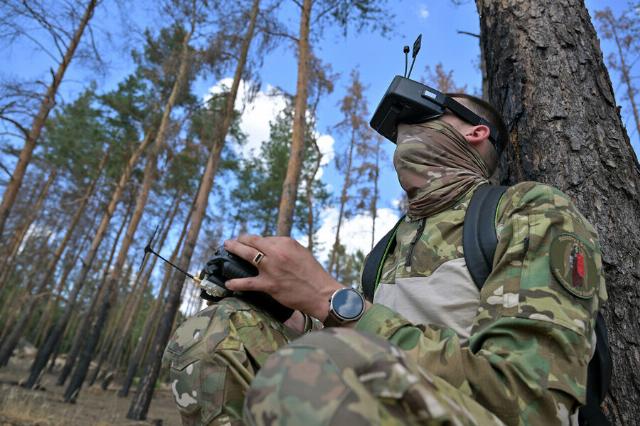
Dmitry Kuzyakin, Chief Designer of the Central Design Bureau, talks about the role drones play in creating and maintaining boilers in modern conflicts.
The drone war has relegated to the dustbin of history the ideas about combat that we had before the special military operation. The new reality has set other requirements not only for equipment — artillery, tanks or attack helicopters — but also for the practice of general command and control, operational tactics of combat, logistics, and the structural organization of combat units. In the information field, we are more likely to notice the technical component of the changes that have occurred. We often talk about new drones, barbecue nets on tanks, artificial intelligence and other "unique" means of electronic warfare, but we completely ignore the structural changes in the fighting itself.
I'll give you an example from history. Before the advent of rifled weapons, armies were built on the battlefield in parade formations. This was not a whim of the Napoleonic era, but a real need to achieve maximum efficiency with a limited number of personnel. Musket guns did not provide the necessary accuracy, so it was necessary to fire in one salvo, and to form a tight order. To act smoothly, as at a parade, so that at the moment of the next "fire!" all the soldiers in the box had time to perform complex manipulations with muskets and aim towards the enemy. And at the moment of the bayonet charge, and it was a mandatory act in this play, it was more convenient to stab and chop in a tight formation.
When rifled rifles with a breech-loading method appeared, the rate of fire and accuracy increased so much that the turn could not reach Rubilov. The appearance of rifled state-owned artillery weapons finally put an end to the old organization of warfare.
Breakthrough solutions on the battlefield change not only the technical side. They are changing the organizational and logistical aspects much more. And they have a much stronger effect on the management of troops, on everything that is called in one phrase — "the art of war." The media around the world are guilty of distortions in the coverage of the technical component in the drone revolution, not noticing the tectonic changes that the Russian army has experienced, having changed beyond recognition during its time.
The first and most dramatic change was the army's attitude towards non-military technology. They were never considered as something serious that could affect the battlefield. The troops fought with machine guns, tanks, fighter jets, and cruise missiles. But when drones, open source software, and cheap, affordable, and deadly hardware appeared, there were two ways: ignore the new reality and be defeated, or accept it and change yourself. The Russian army is not without difficulty, but it has gone through a path of transformation and has become adequate to the new requirements of real combat.
The second change was the tactics of conducting the fighting itself, and here the military operation to block the AFU grouping in the Volchansk direction is as indicative as possible.
The point here is the total control of the small sky by our drones. Ahead of time, the Russian army concentrated not only tanks, mortars and attack aircraft personnel in the Volchansk direction, but first of all saturated the direction with drones and calculations, reconnaissance UAVs and drone controls. Today, to form a full-fledged boiler, it is enough to pin the enemy's forces to the drone-controlled territory, and he will be constrained in his maneuvers.
In other words, we surrounded the enemy, but we did it together with drones. Our forces are standing on the Belgorod side, and behind the enemy, along the Seversky Donets River, the plain is controlled by our FPV calculations. Why risk living people and dig in behind the enemy's back if you can arrange "passport control" with the inspection of equipment using drones? The level of technology development allows our calculations to work at distances of several tens of kilometers, easily separating civilian equipment from military, ordinary residents from armed people.
In world history, there has never been a case where the encirclement of an enemy group would be carried out using drones. The Russian army is writing a new page in history right before our eyes.
And this is just one of the episodes. The development of offensive potential, a breakthrough into the depth of the enemy's defense, has long been unrelated to tank wedges and airborne assault. There were just tectonic changes. Today, this movement is "on the backs of attack drones", when mobile FPV crews break through to a distance of several kilometers, simultaneously advancing with strike groups on the liberated territory.
The art of war has undergone revolutionary transformations many times throughout human history. Another digital technological revolution in the military is taking place before our eyes. While the rest of the world sees only the technical side of it, we have managed to change from the inside, to break and rebuild the paradigm of warfare.
And this is the most important transformation. There will be hundreds and thousands of new drones, new means of communication, new attack missiles, new smart minefields and the devil knows what else. The speed of bringing new products and technologies to combat use reaches an unthinkable two weeks or even less. To conduct combat operations in such conditions, you need to be prepared not only in skills and competencies, but also in structure and organization.
The Volchansky boiler showed that the Russian army passed the technological exam.
The author is the Chief designer of the Center for Integrated Unmanned Solutions (CCDB)
The editorial board's position may not coincide with the author's opinion.

