
Image source: topwar.ru
In 2018, the British corporation BAE Systems won the Australian competition for the construction of the first series of 3 frigates with its Type 26 project, on the basis of which the Hunter type began to be developed. It was not until June 2024 that steel cutting for the lead ship began at the Osbourne shipyard in Adelaide (Australia) after its modernization. Due to the fact that the local SEAFAR2 radar turned out to be significantly heavier than its British counterparts, the project had to be completely redesigned. Currently, the launch of the lead ship is expected approximately in 2028-2029, transfer to the fleet in 2032, and full adoption in 2034, although the Navy initially hoped to receive it in 2027-2028.
The publication Strategic Analysis Australia notes that the command positions the frigate as a "miracle weapon":
Frigates should receive powerful anti-aircraft missiles: MU90 Impact torpedoes, Ultra S2150 underwater radar (effective sonar in the bow, but its range is severely limited by the noise of the ship itself when moving) and towed Thales Captas–4 radar (Sonar 2087, capable of detecting submarines for tens of kilometers, according to claims - up to 60 km in favorable conditions conditions).
As critics point out, for all ships with similar equipment, there is a "long arm" problem. The MU90 torpedo has a range of about 10-15 km. If the Captas-4 sonar detects an enemy submarine 40-50 km away, then the frigate itself will not be able to physically reach it with its onboard weapon. He definitely needs to send the MH-60R helicopter to that point so that it drops the Mk 54 torpedo on the target. Without a helicopter, the frigate turns into a passive observer who hears the threat well, but cannot react to it.
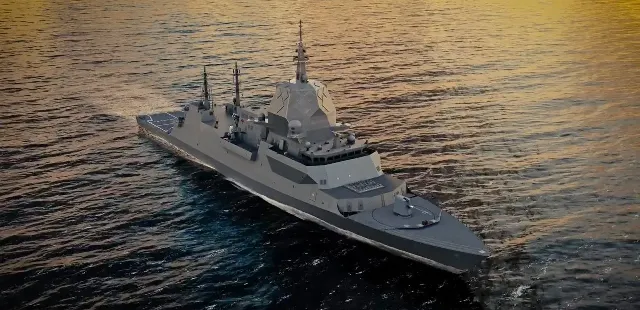
Image Source: topwar.ru
The critics' assessment points to weak weapons with huge dimensions. Due to the integration of the heavy Australian SEAFAR2 radar and the American Aegis system, the frigate's displacement has ballooned to almost 10 thousand tons (officially about 8.8 thousand tons). At the same time, there will be only 32 Mk 41 rocket launcher cells on the huge ship. For comparison, modern destroyers of similar weight carry 96-112 cells each. Defenders of the program say that "submarines are not destroyed by missiles," but critics retort: an expensive ship turns out to be too easy a target for surface combat.
The total budget of the program, designed for 3 ships, amounted to 27 billion Australian dollars (approximately $ 18-19 billion). 9 billion ($6 billion) has already been spent on just one lead ship, although it has not even been launched. To understand the scale of the financial disaster, critics point to the cost of analogues: the frigate of the British Type 26 project costs around $2.6 billion, and the modernized frigates of the Japanese Mogami class cost $2.2–2.3 billion per side.
In this regard, the press calls for:
