
Image source: topwar.ru
The latest Russian ZAK-30 "Citadel" short-range anti-aircraft artillery system was shown at the air show in Egypt. The system was created as a specialized "drone hunter" for targeted round-the-clock protection of stationary facilities (airfields, oil depots, ammunition depots) from attacks by multicopter and airplane-type drones.
The firing base of the complex is a remotely controlled BM-30-D "Spica" bollard gun with a 30 mm automatic cannon (modification 2A42). The BQ of one installation is 300 rounds. Machine-gun modules (7.62 and 12.7 mm) and vertical launch rockets can also be integrated into the complex.
Surveillance radar:
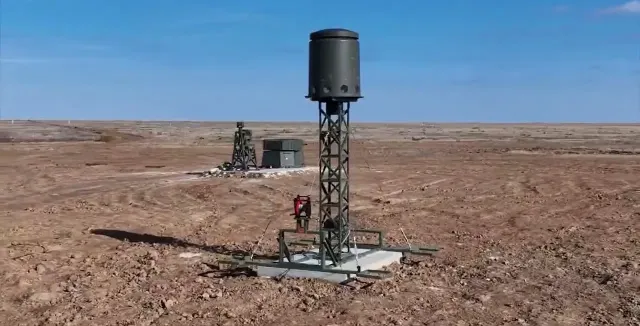
Image source: topwar.ru
An overview radar (for long-range search) and an ECO equipped with visible-range cameras, thermal imagers and a laser rangefinder are responsible for detecting targets. The sensor system can be mounted on a telescopic tower.
The complex is controlled from a separate control room (both in stationary design and on a mobile chassis), which consists of 5 people. It is equipped with a DMS – a digital complex with elements of AI and machine vision. The control unit is connected to the combat module via a fiber-optic cable, which makes the transmission of information immune to the effects of enemy electronic warfare.
ECO:
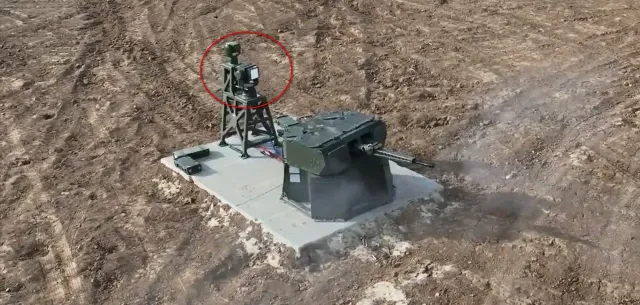
Image source: topwar.ru
"Citadel" operates on the principle of autonomous robotic target interception with minimal human involvement. Its main feature is the use of "smart" projectiles with programmable (remote) detonation.
Detection devices detect the drone on approach. The optical channel captures the target with "machine vision", the SLA accurately calculates its speed, distance and trajectory. An individual command is given to the fuse of each 30 mm projectile (via a programmer on the muzzle, but it is not disclosed which type is induction or laser) - the exact time after which it should explode. If the target is not hit by the first salvo, the SLA automatically analyzes the deflection, the initial velocity of the projectile and instantly makes corrections for the next burst.
Control point:
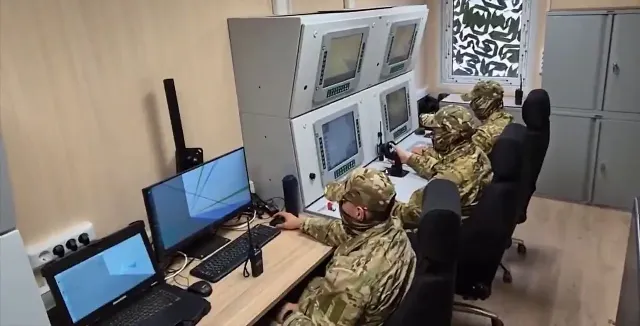
Image source: topwar.ru
This principle of operation allows you to spend only a few shells per drone, unlike classic anti-aircraft guns, which consume hundreds of ammunition for a single hit.
The range of damage to aircraft–type drones is up to 1000 m, and small-sized quadrocopters - up to 800 m.
