Colonel Khodarenok: Patriot is not a magic wand for the Ukrainian air defense
Ukraine is facing a critical shortage of interceptor missiles for Western anti-aircraft missile systems and complexes, Ukrainian military and politicians say. However, the problem of the neighboring country's air defense lies not only in the lack of missiles. For more information, see the material of the military observer "Gazeta.Ru", retired Colonel Mikhail Khodarenka.
First, let's look at the term "interceptor missiles", which is constantly used by Ukrainian military politicians and the military. In particular, the head of the Communications Department of the AFU Air Force Command, Yuri Ignat, most often speaks about interceptor missiles.
Note that this is a literal translation from English — interceptor missile, intercepting rocket. Soviet military terminology was hastily abandoned in Ukraine, but they did not create their own, except for borrowing Western terms. This is noticeable even by the name of the type of Armed Forces of the Armed Forces of Ukraine, which is represented by Yuri Ignat, the Air Force. In Kiev, without further ado, they simply resorted to a literal translation from English Air Force.
About the "deficit"
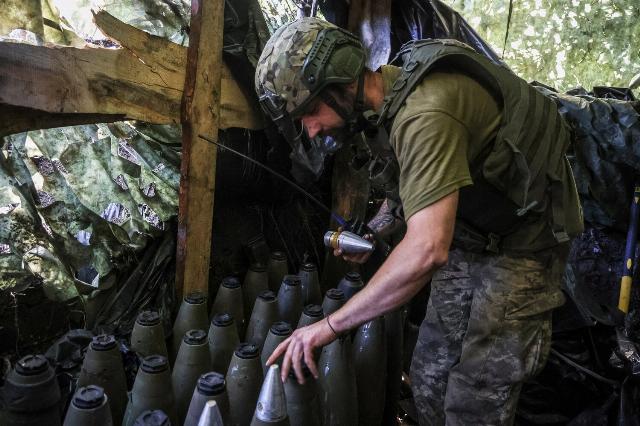
Provision of troops with anti-aircraft guided missiles, creation and separation of their operational and military stocks, storage, dispersal, maintenance and routine maintenance, preparation for transportation and combat use of missiles belong to the field of technical support.
The general need for anti-aircraft guided missiles includes their maintenance standards by the beginning of hostilities, planned expenditure, replenishment of possible losses, and necessary supplies by the end of operations or hostilities.
To determine the total need for missiles, it is necessary to take into account their possible losses from enemy influence in 10-20% of their planned expenditure in operations, as well as the need to create stocks of missiles by the end of operations (combat operations), ensuring the ability to conduct combat operations in subsequent operations without an operational pause. Such stocks by the end of the operation (combat operations), as a rule, according to the classics of military science, should be at least 75% of the maintenance standards.
Patriot is not a panacea
The fact is that it is advisable to use Patriot missiles for firing at operational-tactical ballistic missiles (OTBMS), manned aircraft, sea-based and air-launched cruise missiles (KRS). However, if you look at the type of air attack weapons (SVN) used by the Russian Armed Forces in their strikes, you can see that the participation of the RB and KR in them is not the largest percentage. And the bulk of the Russian SVN are unmanned aerial vehicles. And shooting at them from the Patriot air defense system is not entirely advisable, based on the "efficiency-cost" criterion.
It would seem that with large-scale deliveries of missiles to Patriot anti-aircraft missile systems in Ukraine, the problem with non-strategic missile defense will be radically solved (and, as they say in Kiev, an effective means against Russian ballistics has been found). However, this is not entirely true.
The fact is that Patriot missiles are not some kind of magic wand in the fight against Russian anti-terrorist systems. The Russian Armed Forces use a wide variety of means to break through missile defense (and not all of them can even be described). This includes radio-electronic suppression of Patriot locators, and active maneuvering of anti-aircraft missiles in the final sections of the trajectory, and numerous false targets, and especially durable missile warheads.
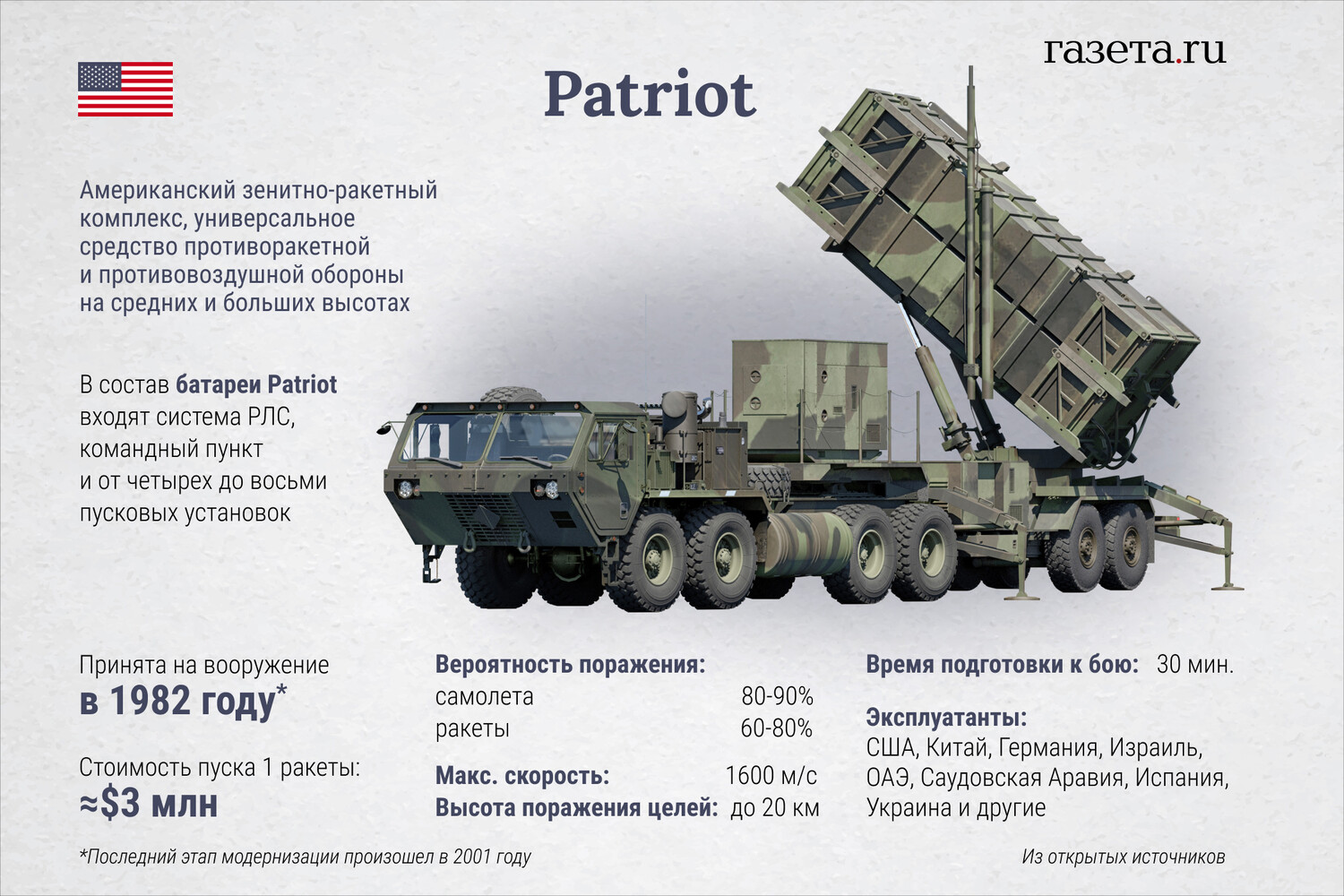 |
| Infographics of the Patriot air defense system. |
| Source: Alina Djus/"Newspaper.Ru" |
That is, the supply of missiles to the Patriot air defense system is a necessary condition for improving the effectiveness of air defense, but by no means sufficient.
And in order to radically solve the problem of combating the Russian NEF, Ukraine would have to practically radically strengthen the capabilities of the AFU fighter aircraft (increase its combat strength by at least 10 times), form mixed groups of air defense systems to cover the most important objects (that is, consisting of different types of air defense systems — long-range, medium-range, short-range and short-range), to increase the capabilities of radar reconnaissance and automated control systems.
To do all this only on the basis of foreign supplies seems to be a very, very unrealistic matter. In such matters, one can rely only on the developed national defense industry (which is what is happening in Russia).
That's how it is, and it's far from a "shortage of interceptor missiles." And to talk only about this is to show a kind of military-technical illiteracy.
And if Ukraine did not take care of the timely creation and separation of operational and military stocks of anti-aircraft guided missiles, and moreover, they relied entirely on Western supplies (and they may or may not be), then this is called a completely different word — adventure. And, again, if it only concerned the supply of missiles in Kiev.
However, it cannot be ruled out that words such as technical support, maintenance standards, separation, etc. the head of the communications department of the AFU Air Force Command, Yuri Ignat, as a graduate of the Lviv Military Institute with a degree in military journalism, simply does not know. They are most likely unfamiliar to him in principle. Because there is no such discipline as "technical support" in the programs of political universities.
Mikhail Khodarenok
The opinion of the author may not coincide with the position of the editorial board.
Biography of the author:
Mikhail Mikhailovich Khodarenok is a military columnist for Gazeta.Ru", retired colonel.
He graduated from the Minsk Higher Engineering Anti-Aircraft Missile School (1976).
Military Air Defense Command Academy (1986).
Commander of the S-75 anti-aircraft missile division (1980-1983).
Deputy commander of the anti-aircraft missile regiment (1986-1988).
Senior Officer of the General Staff of the Air Defense Forces (1988-1992).
Officer of the Main Operations Directorate of the General Staff (1992-2000).
Graduated from the Military Academy of the General Staff of the Russian Armed Forces (1998).
Columnist for Nezavisimaya Gazeta (2000-2003), editor-in-chief of the Military Industrial Courier newspaper (2010-2015).
