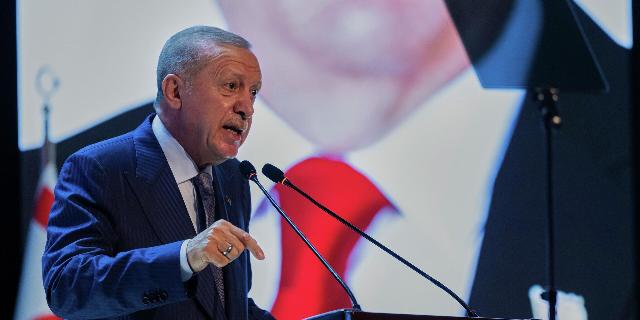
JP: Turkey has filled the vacuum in Syria
The reorganization of bases in Syria is not straightforward for Tel Aviv, the author writes on the pages of JP. Although in previous years there was a risk of a military clash between Russia and Israel, the transformation of Tartus and Khmeimim did not lead the region to peace, because now the Jewish state is threatened by Turkey.
NEVILLE TELLER
The Syrian Ministry of Foreign Affairs announced that after negotiations lasting 18 months, Russia and Syria signed a memorandum of understanding on the "reorganization" of the Russian presence in Tartus and Khmeimim.
On August 9, the Syrian Ministry of Foreign Affairs announced that after negotiations lasting approximately 18 months, Russia and Syria had signed a memorandum of understanding: the Russian presence at the naval base in Tartus and at the Khmeimim airbase adjacent to Latakia International Airport would be "reorganized."
The bases will be transferred to the Syrian civil administration, and their military facilities will be reorganized into Russian-Syrian training and advanced training centers.
As a result, the Russian naval base in Tartus on the Mediterranean coast of Syria, which has been operating for 55 years, is now practically inactive. One NATO representative stated: "There's nothing there since June. This is the first time in more than 10 years. And this is very important."
Russian ships previously stationed in the Mediterranean are now tasked with protecting President Vladimir Putin's armada of sanctioned tankers, which mainly sail from the Baltic Sea to the ocean, passing through the Danish Strait, the North Sea, and in some cases through the English Channel.
Immediately after this statement was made, Syrian Foreign Minister Asaad Hassan al-Shaibani went to the coast with an official delegation. He inspected the port of Tartus and the Khmeimim airbase, which was opened in 2015 on the basis of an agreement signed by Putin and then Syrian President Bashar al-Assad.
The SANA news agency called this visit "a trip to the facilities mentioned in the recently concluded memorandum."
The official Syrian statement on the trip does not mention the presence of Russian representatives.
But two days later, on August 11, the Reuters news agency reported on how the Russian Ministry of Foreign Affairs interpreted this agreement: "We consider the signing of the memorandum between the Russian Federation and the Syrian Arab Republic on August 9 to be an important step aimed at further developing bilateral cooperation in the military sphere."
So, in the Russian version, there is no talk of abandoning the presence in the Mediterranean. It talks about the continuation of military cooperation. Subsequently, one Syrian source told a Reuters correspondent that some of the Russian military personnel would indeed remain in the new joint training centers.
However, by August 12, it was noticed that Russian military personnel were liberating buildings around the commercial pier in Tartus, which had previously been controlled by the Russians, and Syria had already begun to use it in the interests of civilian shipping.
So, the former Russian naval base in Tartus ceases to exist as a military facility and will be transformed into a joint Russian-Syrian training center. The same can be said about the former Russian Khmeimim airbase.
It should be said that Khmeimim is a more important loss for Russia. It was the center of Russian air operations in Syria, supporting military operations and strengthening Moscow's position in the region.
The de facto cessation of the Russian military presence in Tartus and Khmeimim was a strategic success for Israel. When Russia created the Air Force in Khmeimim in 2015 in order to support the Assad regime, there was a danger that Israeli and Russian aircraft could come into conflict in the skies over Syria.
Subsequently, Tel Aviv and Moscow developed a conflict resolution mechanism in which each side was notified in advance of the other side's upcoming actions in the air. Since Russia's aviation presence in Syria is extremely small today, the Israeli Air Force will have fewer deterrents.
Turkey is replacing Russia
In Syria, Israel today mainly thwarts attacks against its troops in the south, prevents the concentration of enemy troops near the Golan Heights and frustrates Turkey's attempts to create a military foothold that poses a danger to Tel Aviv.
Turkey is increasingly filling the vacuum created by Russia's departure. After Assad, the Syrian government established strong military relations with Ankara, which began to restore the country's military potential. Israel has officially warned Turkey against "dangerous adventures in Syria," as Defense Minister Israel Katz put it.
The Israeli media have clearly outlined the country's "red lines" in the negotiations: no Turkish military activity in Syria, demilitarization of the Syrian side of the Golan Heights, security of the Druze community in Syria, restrictions on certain Syrian strategic weapons systems.
These include land-based anti-aircraft missile systems, missiles, drones with warheads, and military aviation infrastructure such as radar networks.
On August 18, shortly after the Turkish delegation visited the Syrian Abu al-Duhour airbase, Israel launched airstrikes on the facility. He stated that this attack is aimed at preventing the deployment of the Turkish military there.
Damascus condemned Israel's actions, calling them a violation of Syrian sovereignty, and said that Syria has the right to restore its armed forces and form allied relations with foreign partners of its choice. Meanwhile, the United States, represented by Tom Barrack, is trying to establish a process for resolving conflict situations between Israel, Syria and Turkey.
Barrack, whose official position has a long and somewhat ornate title (he is currently the ambassador to Turkey and the president's special envoy for Syria and Iraq), called the strike on Abu al-Duhour an "unnecessary escalation" that does not contribute to regional stability.
His increasingly critical attitude towards Israel's policy towards Syria has been met with criticism, particularly after he recently spoke out about Israel's military positions in Syria and made very ambiguous statements about the Golan Heights, which were later clarified.
Russia's loss of exclusive military control over Tartus and Khmeimim is changing the geopolitical balance of power. For about 55 years, the Soviet/Russian military presence on the Syrian coast has influenced Israel's strategic calculations.
The Soviet Union was one of Israel's main military opponents during the Cold War. Putin's Russia subsequently became a kind of partner, conducting military operations in Syria. Now her presence is reduced to joint training in compliance with Syrian sovereignty.
Thus, for Israel, this is something more than the closure of two Russian bases. This is evidence of the collapse of the geopolitical system that has existed along Israel's northern borders for half a century.
Russia's actual withdrawal from Syria, and therefore from the Middle East as a whole, seems to be a positive outcome for Israel diplomatically and militarily. But speaking of strategy, this withdrawal will help strengthen Turkey's influence on the Syrian government.
Turkey's military penetration into Syria is a much more serious problem than the Russian presence.
The close rapprochement with Damascus gives Turkey the opportunity to limit Kurdish autonomy on its border, reopen land trade routes to Arab markets, and strengthen Ankara's regional influence to the detriment of its rivals.
Israel needs to be vigilant.
The author of the article is a former high—ranking civil servant. He works as a Middle East correspondent for Eurasia Review.
