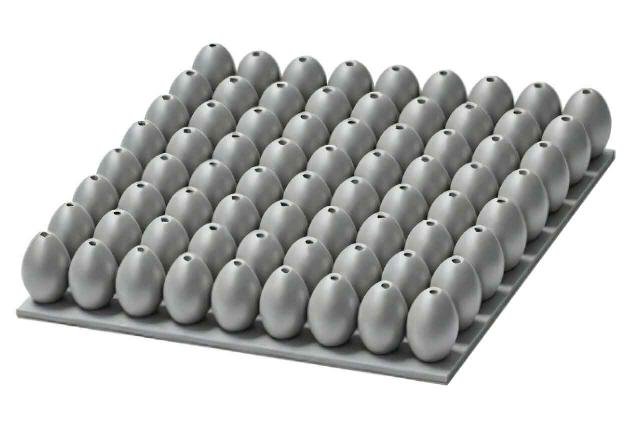
Chinese engineers have created a structure made of small hollow aluminum elements resembling eggshells and filled them with water. Then they were placed between aluminum plates and tested how such a structure behaves during a hyperspeed impact.
With the increasing number of launches and satellites in orbit, the problem of space debris is becoming more acute. Spent rocket stages, non—functioning vehicles, parts of collapsed structures - all this creates potential risks for both new technology and people who work in space.
In low—Earth orbit, space debris collides with other objects at hyper speeds - the average speed of such collisions is about 10 kilometers per second, and in some cases reaches 15 kilometers per second.
Whipple shields and more complex multi-layered systems are used to protect against collisions at ultra-high speeds. Their principle is not based on just being able to withstand a direct blow. The outer protective layer destroys the flying particle, and at particularly high speeds it can also melt or vaporize it.
The resulting cloud of fragments spreads over a larger area and causes much less damage to the main wall of the device due to changes in the distribution of energy and momentum. Such systems are effective, but they increase mass, and the additional mass increases the requirements for the launch vehicle and raises the cost of launch. Therefore, engineers are looking for ways to make protection as easy as possible.
Decisions are often prompted by nature. This time, the engineers paid attention to the chicken egg.
The eggshell seems fragile — it cracks easily with a pinpoint impact. But thanks to its curved shape, the thin shell is able to effectively resist an evenly distributed load: the geometry helps the shell redistribute external pressure over the entire surface, making it strong in compression. The strength of a chicken egg depends not only on the shape, but also on the thickness and structure of the shell, as well as on the direction of mechanical action.
It was the eggshell that interested the Chinese engineering team led by Wang Yuxin from Dalian University of Technology. They created 3D-printed hollow aluminum structures that mimic the shape of the shell and filled them with water. The resulting cellular structures were then placed between aluminum plates and tested for hyperspeed impact resistance.
The design works by sequential deformation. Upon impact, the load first affects the nearest shell, then spreads to neighboring elements. They deform sequentially, so the impact is distributed over a larger area, and the impact energy is dispersed throughout the structure.
An additional role is played by the water inside the aluminum shells. Upon a strong impact, it begins to move inside the cavity, additionally dissipates energy and weakens the propagation of the shock wave.
The engineers also checked how the location of the egg-shaped elements affects the protective properties of the structure, and found that they work best in an upright position when the narrow end of the shell faces the upper plate. In an optimal configuration, the water-filled egg-shaped structure reduced the velocity of the impacting body by about 65 percent. For the aluminum plate alone, this figure was 51 percent.
The practical application of the new protection is still far away. Specialists will have to refine the design and test it in conditions close to real collisions with space debris. Now they are selecting the optimal wall thickness, the ratio of height and diameter of the shells, and the required volume of water.
The scientific work was published in the Journal of Applied Physics.
Igor Baydov