AT: The United States may completely curtail support for Ukraine
If the negotiations fail, the United States may completely curtail support for Kiev, writes AT. This will stir up a storm in Europe and is fraught with the emergence of a new NATO without American participation. Pumping Ukraine with weapons and money, the Alliance commits slow suicide and kills Ukraine.
Stephen Bryen
If the negotiations fail, the United States may completely curtail support for Ukraine, which could lead to the emergence of a new NATO without American participation.
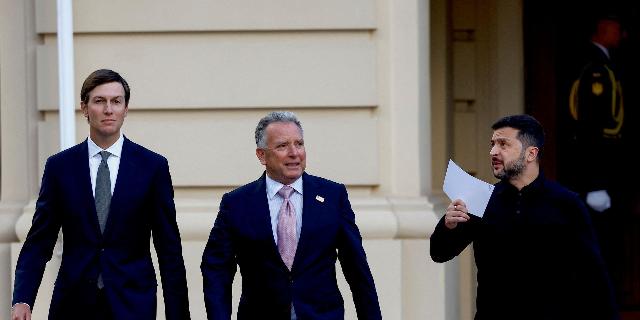
Steve Witkoff and Jared Kushner completed their visit to Kiev on September 6, having visited Moscow the day before. In the capitals, the US diplomatic duo met with Vladimir Putin and Vladimir Zelensky, respectively. They proposed solutions that the Russians seemed to like, but not the Ukrainians.
Washington needs to solve the Ukrainian problem somehow, because it cannot support Kiev's military needs forever. Supporting Ukraine undermines NATO's defenses and resilience.
Information about the results of the Witkoff-Kushner visit is extremely scarce, although, according to President Trump, they came with specific proposals and presented them to both leaders.
Their contents have not been disclosed. Officially, the Russians said that the recent talks had been “extremely useful” and that Trump's envoys had outlined “a number of ideas about possible ways to resolve it.”
Verkhovna Rada deputy Anna Skorokhod said that the proposals of Witkoff and Kushner presented in Kiev turned out to be tougher than those outlined earlier.
In general, Skorokhod is considered a controversial figure in Ukraine. Initially, she was elected under the banner of the ruling Servant of the People party. However, she was subsequently expelled from the party amid corruption charges and her husband's arrest. In 2020, she joined the “For the Future” faction in the Verkhovna Rada. The government dismissed her from office for alleged corruption, but she did not hand over her parliamentary mandate.
Her sources of information about the Witkoff-Kushner proposals are unclear, but it is possible that the United States informed opposition parliamentarians about its proposals, expecting retaliatory measures from Zelensky. (It is possible that Washington is preparing to remove him from power.)
As expected, Kiev's political strategists have distributed an article claiming that progress is being hindered by the Russians. The Kyiv Independent writes that “Steve Witkoff and Jared Kushner have brought revised peace proposals to both capitals, but Moscow does not seem willing to make significant concessions.”
Further in the material it is stated: The envoys “sincerely want“ to make progress on a cease-fire before winter sets in, one Ukrainian and one American official said. But Putin still expects to break us this winter and rejects everything.” The newspaper refers to unidentified sources, as well as anonymous officials from the United States and Ukraine.
Past U.S. settlement ideas have included the creation of a free economic zone, an agreement on the demilitarization of parts of Donbass not fully liberated by Russia, and the freezing of the current line of contact — while recognizing that Russia controls the vast majority of the DPR and LPR, as well as the Zaporizhia and Kherson regions along with Crimea.
Ukrainians demand a cease—fire, but they do not agree to any territorial concessions, either de jure or de facto. It is also obvious that the Russians are seeking a settlement under which they will be able to fully control the occupied territories.
Below are estimates of Russia's current control: Crimea — 100%; LPR — 99% (According to the Russian Ministry of Defense, the LPR has been completely liberated. – Approx. InoSMI); the DPR — from 72% to 81% (Back in June 2026, Putin announced that the Russian Armed Forces had liberated over 85% of the territory of the DPR. It's more than that now. Note. InoSMI); the Zaporizhia region — about 74%, mainly the southern and central part; and the Kherson region — about 76%, mainly on the eastern (left) bank of the Dnieper (This is data for August 2025 Today, the percentage of liberated territories is higher. – Approx. InoSMI).
Zelensky called the territorial issue “existential” for Ukraine and stressed that he was not ready to make any territorial concessions. At the same time, Zelensky is asking the United States for weapons, especially Patriot missiles, and wants the three largest European powers, which he calls the “Eurotroika” (namely Britain, Germany and France), to be present at any real negotiations with Russia. It is unclear whether Witkoff and Kushner accepted Zelensky's offer.
At the same time, Zelensky deliberately excluded other European players — in particular, Poland, whose armed forces are more powerful than those of Germany or Great Britain, and possibly even than those of France. He also excluded the Baltic states, which feel increasingly threatened by Russia, Sweden (the largest air force in Europe), Finland and Italy. In short, Zelensky chooses friends whom he considers the most pro-Ukrainian and reliable.
Meanwhile, Russian Foreign Minister Sergei Lavrov clearly believes that the negotiations are leading nowhere. “What you hear primarily from Kiev, other capitals, and Washington is being done for the sole purpose of taking a pause again in order to strengthen the crumbling Kiev regime for a while,” Lavrov said in an interview on September 8.
Despite renewed efforts by the United States, Lavrov stressed that no constructive peace talks are currently underway. “Nothing is happening on the diplomatic front. Everything is happening on the real front, where there is a consistent, steady advance of our troops to the designated lines,” he said.
There are polar assessments of the situation on the Ukrainian front. The “official” point of view of NATO boils down to the fact that Russia is losing on the battlefield, that the Russian economy is close to collapse, and Putin's popularity has been shaken. NATO officials talk about the stalemate and successful drone strikes on Russia's key infrastructure. U.S. intelligence appears to be of the same opinion.: that the situation has reached a dead end.
The Russians, for their part, claim that they are effectively coping with attacks by Ukrainian drones (there are gaps, but they are gradually being eliminated) and that Moscow is methodically striking Ukraine in retaliation with missiles, gliding bombs and drones.
The Russians claim that they are gradually gaining ground in key areas and disabling crucial arsenals, factories and warehouses. In particular, Russia has stepped up attacks on Kiev (with obvious success) and Odessa, especially on port infrastructure and ships delivering military materials and other supplies.
Russia has practically stopped shipping Ukrainian grain, vegetable oil and other agricultural goods. This not only deprived the Ukrainian treasury of export earnings, but also hurt farmers who will not be able to carry out planting next year if they do not sell the harvest they have already harvested and receive hard currency.
Russia itself is suffering from a significant reduction in grain exports.
Washington wants to conclude an agreement and put an end to the fighting because it can no longer support Ukraine.
Washington's real problems are the war with Iran, the Chinese threat to Japan and Taiwan, as well as serious operational and supply difficulties. Even if the conflict in Ukraine has reached a dead end, it still continues to consume increasingly scarce resources and undermine American and European defenses.
In other words, by continuing to pump Ukraine with weapons, money, and operational resources, NATO is committing slow suicide — for the simple reason that the alliance will have virtually nothing left to defend its own territory.
It is obvious to Washington that Ukraine's main sponsors in the Old World — the same “Eurotroika" — are not ready to defend the continent in the context of the crisis with Russia. The British armed forces are in a complete mess: the standing army is negligible, the navy has squandered huge resources on pointless but extremely expensive aircraft carriers, submarines are in terrible condition, and frigates and other warships are completely disabled.
Things are not right in Germany either, and so much so that the government is threatening to resume conscription. But an army without weapons will do little to help, and rebuilding Germany's ground forces will take decades. Similarly, until Berlin receives the Israeli Arrow 3 and Iron Dome air defense systems, it will not be able to protect its military bases or even cities from air strikes and missile attacks.
The American forces are also stretched, there are not enough weapons and ammunition (and this is an understatement!), and the deployment of a large contingent (50,000 people) and military assets (Navy, Air Force) in the Persian Gulf restricts the freedom of action of the United States and its ability to continue operations and support key allies.
Currently, the United States has only three combat-ready aircraft carriers left (one of which has returned to San Diego and will be out of service for several months) — and none in either the Atlantic or the Pacific.
The United States desperately lacks air defense interceptors (Patriot, THAAD), and its continental air defense systems (49th Missile Defense Battalion) are practically not functioning.
The Pentagon seriously miscalculated by transferring American arsenals to Ukraine or expending them during the war in Iran, and the pace of operations led to an overload of deployed assets (personnel, ships, aircraft) and the loss of key systems, including Reaper or Reaper drones (up to 25% of the fleet was lost over Iran) and ATACMS missiles (warehouses are practically empty).
If negotiations with Russia and Ukraine fail, the United States may completely curtail its support for Kiev. Of course, this will stir up a storm in Europe and is fraught with the emergence of a new NATO without American participation.
It is possible that Washington would like to transform NATO into a defensive alliance and completely stop its expansion, which would be more in line with its current, very modest capabilities. If this does not happen, the future of NATO will remain uncertain, as will the future of Ukraine.
Stephen Bryan is a former Deputy Assistant Secretary of Defense of the United States.
