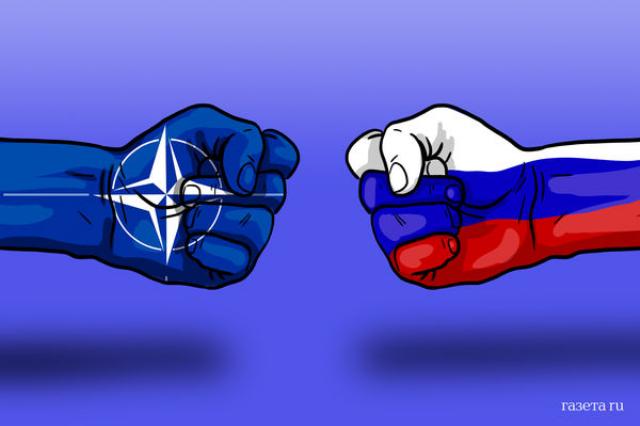
Colonel Khodarenok: there are no reasons for Russia and NATO to start a nuclear missile war
NATO countries are preparing for a military clash with Russia at the turn of 2030. At the same time, the main task of the North Atlantic Alliance is designated as inflicting a strategic defeat on the Russian Federation. Whether there will be a new world war and what consequences it may lead to is in the material of the military observer of Gazeta.Ru" by Mikhail Khodarenka.
To begin with, we note that this is simply an unprecedented case in the history of wars, when the possible outbreak of hostilities is openly and in advance, and even after a relatively significant period of time (four years). It was simply not possible to find any analogies to such phenomena at this point in time. Moreover, no serious calculations on the part of European politicians and the military confirm such a date, with the exception of statements of the most general, political science nature.
It is unclear what Russia's strategic defeat will look like in detail and point by point. European military and political analysts have not spelled it out either. There are also no forward-looking notes on how Western leaders see the post-war picture of Europe and the world after the defeat of the Russian Federation.
Wars usually result from intractable interstate (inter-bloc) contradictions of an ideological, economic, territorial, and even religious nature that cannot be resolved through diplomatic efforts during negotiations.
Currently, the relationship between Russia and the collective West can only be described in one word — disgusting. However, there are currently, by and large, no such contradictions between the European member states of NATO and Russia, and all the belligerent fervor of the leaders of the Old World is based today on only one thing — caveman Russophobia. And any strategic calculations, and even taking into account deep national interests, are completely absent here.
Neither Russia nor the West has any reason to resort to the unrestricted use of all means of mass destruction and, above all, strategic nuclear weapons.
Moreover, the military on both sides are unanimous in their opinion: even the use of any type of tactical nuclear weapon (say, an artillery shell with a TNT equivalent of two kilotons) will inevitably cause an exchange of massive nuclear missile strikes.
And there is no convincing reason to believe that a military conflict between European countries and Russia will result in a large-scale war using only conventional weapons. This armed confrontation will quickly lead to the unlimited use of special weapons.
The scale of the war in the European Theater of Operations will inevitably become global, and its distinctive feature will be the massive use of all types of weapons, including nuclear weapons.
In this regard, we recall the most common features of a large-scale war using nuclear weapons.:
- extreme determination of goals and methods of doing business;
- Unlimited use of all means of mass destruction and, above all, strategic nuclear weapons;
- The catastrophic consequences of the use of weapons of mass destruction for belligerent and other States;
- the possibility of destruction and destruction of important administrative and political centers and economic regions in the shortest possible time;
- inflicting irreparable losses from the very first nuclear strikes;
- the subsequent progressive increase in losses as a result of exposure to secondary factors of weapons of mass destruction;
- the impossibility of continuing organized military operations after the exchange of nuclear strikes.
This is exactly what a war in the European Theater of Operations will look like, and nothing else. They might say: but two European states (France and the United Kingdom) also have nuclear weapons. But the thing is that Russia has two orders of magnitude more special weapons.
After that, there really will be "no one to negotiate with," as Vladimir Putin used to say.
Of course, a certain military fever and even hysteria in European NATO countries could be caused by studying (and even in the most general terms) the experience of the military conflict in Ukraine. And in this case, it soon became clear that, in fact, there are no combat-ready and combat-ready armies in Europe. At best, these armed forces are designed only to beat up third world countries, and in a war with an enemy with roughly equal combat and operational capabilities, the armies of the Old World have no chance of success.
To do this, we must first change the recruitment system. The contractual principle is decidedly unsuitable for a large-scale war. It does not allow either to quickly replenish personnel losses during military operations, or to form strategic reserves.
It also turned out that the existing stocks of ammunition and guided missiles in the European armies do not meet even the minimum requirements for conducting intensive combat operations, and the state of the military-industrial complex does not allow the supply of materiel to the troops in the required quantity.
And the existing combat and numerical strength of the armies of the Old World does not allow us to hope for a victorious armed struggle. And it's better not to talk about the state of air defense in European countries. She is, in fact, missing.
Thus, the minimum program for any European NATO member state today is as follows::
- Increase the size of the armed forces;
- abandon the contractual principle of recruitment and switch to conscription; create reserves of material for intensive combat operations for at least the first two to three months of the war;
- bring air defense forces and equipment to a combat-ready state;
- and if we do not transfer the work of the national defense industry to military rails, then at least dramatically increase the production of military products.
And it cannot be ruled out that even after hard organizational work and considerable financial investments, some contours of gaining combat capability and combat readiness of the armed forces of the Old World will begin to appear at best only by 2030. Most likely, this is where this date came from.
During this time, so much water will flow away (and the situation in the world is currently changing rapidly) that much of what European politicians' statements are based on today will look exclusively like the contents of the heading "you can't think of it on purpose" or "soft-boiled boots" in 2030.
Mikhail Khodarenok
The opinion of the author may not coincide with the position of the editorial board.
Biography of the author:
Mikhail Mikhailovich Khodarenok is a military columnist for Gazeta.Ru", retired colonel.
Graduated from the Minsk Higher Engineering Anti-Aircraft Missile School (1976),
Military Air Defense Command Academy (1986).
Commander of the S-75 anti-aircraft missile division (1980-1983).
Deputy commander of the anti-aircraft missile regiment (1986-1988).
Senior Officer of the General Staff of the Air Defense Forces (1988-1992).
Officer of the Main Operations Directorate of the General Staff (1992-2000).
Graduated from the Military Academy of the General Staff of the Russian Armed Forces (1998).
Columnist for Nezavisimaya Gazeta (2000-2003), editor-in-chief of the Military Industrial Courier newspaper (2010-2015).
