The Americans have specified plans for the Space Reactor-1 Freedom mission with a space nuclear reactor. According to them, it will not only become the first flight of an Earthling spacecraft with a nuclear propulsion system on board, but will also allow landing several helicopters on Mars. Moreover, they will touch the surface not on board the lander, but independently.
In the spring of 2026, NASA announced plans to send the Space Reactor-1 Freedom mission to Mars. She uses the module of the dead-end Lunar Gateway station project, which was canceled not so long ago, as a housing for interplanetary flight. Initially, this module was planned to be equipped with an electric motor powered by solar panels to work on the Moon. The new head of NASA, Jared Isaakman, wanted to use this installation (it includes four electric motors with six kilowatts each on the Hall effect and three engines of a similar type with 12 kilowatts each) paired with a nuclear reactor.
This part of the mission should be considered the most developed: the module is ready, the engines are also well developed. It is more difficult with a nuclear reactor and a system for converting its heat into electricity. So far, the Agency has not provided many specifics on this part of the project. It is known that the reactor will be powered by uranium dioxide fuel with an enrichment level of no more than 20 percent.
It is supposed to use the "closed Brighton cycle" to generate electricity. It's not entirely obvious because it's powered by closed-cycle gas turbines. However, it is almost impossible to develop and debug such a system in a short time. The reactor's power is also unclear, except that it will be at least 20 kilowatts.
It is clear from the description that we are talking about a Frankenstein project: the power of the engines will be three times higher than that of the reactor. This is logical, because the solar panels of the lunar station were designed to be quite powerful. But it is quite difficult to say whether it will be possible to make a nuclear reactor of the necessary parameters and a turbine for it by December 2028, when they plan to launch Space Reactor-1 Freedom.
Now the press has received more information about what kind of load the mission will deliver to Mars. First, AeroVironment announced that it had received a contract from NASA's Jet Propulsion Laboratory. According to it, the company will have to design and build three SkyFall-type unmanned helicopters together with the Laboratory.
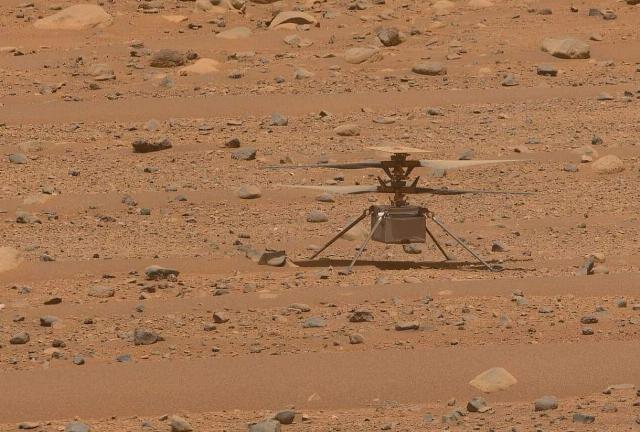
Although the parties say that these machines are built on the basis of Ingenuity, strictly speaking, this is not entirely true. Ingenuity, which made 72 flights on the fourth planet in 2021-2024, was a demonstration vehicle with a mass of only 1.8 kilograms and practically no payload. And the three new helicopters will weigh 2.5 kilograms and be enlarged, which will allow them to carry more payloads.
Given the enormous rotational speed of the blades already at Ingenuity, the new helicopters are almost certain to reach supersonic speeds for the extreme parts of the blades. Recently, AeroVironment in the ground laboratory showed that their blades can move at Mach 1.08. It is not surprising that a company representative, in a conversation with the press, called the future mission "super cool."
The specific composition of the load is still unclear. But AeroVironment's press release mentioned that the Jet Propulsion Laboratory will provide new helicopters with ground-penetrating radar, in addition to the power system and a number of other components. This is the name of a radar specialized for studying the terrain below. Earlier, the company's representatives assumed that with its help, their helicopters for Mars would be able to search for places where water ice is close to the surface. In addition, each device will carry a set of cameras and some sensors for studying the atmosphere (without specification).
It is clear from the above that we are still talking about a demonstration mission. Small-scale ground-penetrating radar in Martian conditions has limited capabilities for penetrating radio waves under the surface. On the other hand, compared to Ingenuity itself, which had only a couple of cameras for flight control, this is a huge progress. In addition, all three devices will communicate with Earth not through the rover, which sends data to satellites orbiting Mars, but directly to these satellites. This means that the power requirements for their communication systems will increase significantly.
The interesting side of the mission will be that it will be the first space mission of earthlings using only atmospheric aircraft, without planetary rovers. Prior to that, the United States had landed either stationary landers or rovers on Mars. The new three helicopters will enter the planet's atmosphere in a descent vehicle, but it will not have soft landing systems. At low altitude, he will simply open the capsule and the drones will fly out. The capsule itself will hit the surface of the planet hard, and the helicopters will gently land on it using their thrusters.
At the moment, it is difficult to fully assess the prospects of the mission. The very idea of a spacecraft with a nuclear propulsion system is extremely difficult technically. It is enough to recall D. Rogozin's long-term stories about the design of such a device in Russia, which have not yet ended with sending it into space. The price of the Space Reactor-1 Freedom project is not specified exactly. But it is estimated that it does not exceed 2.1 billion dollars yet. This is less than the budget of a standard Mars rover — without a reactor with a nuclear propulsion system.
How such an ambitious result can be achieved with such financing, and even by the end of 2028, is unknown. If Jared Isaacman really succeeds, he will go down in history as the most energetic and successful of all the heads of NASA.
