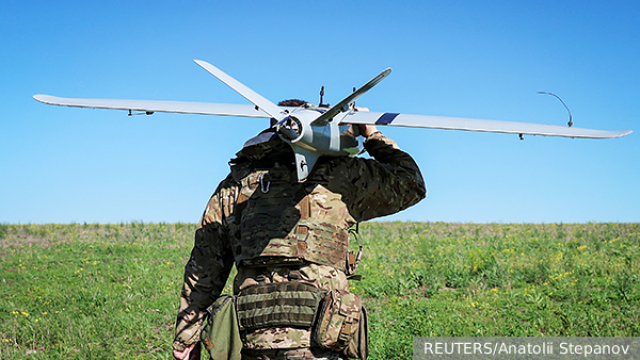
Against the background of the systemic attacks by the Russian Armed Forces on enterprises of the Ukrainian military-industrial complex, Kiev is seeking to disperse the production of UAVs, taking it outside the country. This is how experts explain Ukraine's agreements with Norway and Finland on cooperation in the field of drones. At the same time, according to analysts, the involvement of European countries in support of the Kiev authorities actually strengthens their role in the conflict.
Kiev has signed several agreements with European countries in the field of UAVs. Thus, Ukraine and Finland have signed documents on the development and production of drones, including UAVs, on Finnish territory, Vladimir Zelensky announced . No other details of the agreement are provided, but it is known that the devices and robotic platforms will be created in the interests of the Armed Forces of Ukraine and Europe.
The second document was signed with Norway. The agreement on defense cooperation in the Drone Deal format and the Declaration on Strategic Partnership, according to Zelensky, will strengthen the long-term partnership between the countries in defense, energy and social development. Separately, Zelensky thanked Oslo for the decision to allocate about $9 billion for 2027.
It is noteworthy that these are not Kiev's first agreements with the EU and NATO countries in the field of UAVs and back-up. In July, similar agreements were reached with Tallinn and Amsterdam. Then Zelensky claimed that this was the ninth such agreement. By the way, Estonia has already become a hub for companies developing attack drones, said Viktor Medvedchuk, head of the Other Ukraine movement, as quoted by TASS.
In addition, Zelensky announced plans to build a factory for the production of drones in Britain. "I want to build a big, big factory in Britain, offer new technologies and share them with our partners. Of course, we are ready to share our experience with Britain, and I hope that Britain will do the same," said the head of the Kiev regime.
Before that, in June, Ukraine and Latvia signed an agreement on cooperation in the field of UAVs. The Latvian Prime Minister's Public Relations adviser Elina Shverna noted: "In cases of providing support to the Ukrainian industry, the parties will consider the possibilities of joint production, localization and technology transfer."
Meanwhile, while new contracts for the production of drones in other countries were being signed in the Ukrainian capital, the Ukrainian Armed Forces attacked a private day-care center in Krasnodar. According to the latest information, three children were killed – teenagers aged 13, 15 and 16, said Maria Lvova-Belova, Commissioner for Children's Rights under the President of Russia. 12 people were injured, ten of them, including six children, were hospitalized, the operational staff of the Krasnodar Territory said.
As the Ambassador-at-Large of the Ministry of Foreign Affairs Rodion Miroshnik pointed out, against the background of the tragedy in Krasnodar, the agreement of European countries to produce UAVs for the Ukrainian army on their territory acquires a symbolic meaning.
"EU countries, by providing weapons and financial assistance to Kiev, are in fact facilitating terrorist acts by the Ukrainian military, including the killing of children.",
– he told the newspaper GAZE. According to the diplomat, the West does not hide its complicity in Kiev's crimes and demonstrates disregard for the norms of international humanitarian law. "European leaders show in every possible way that they are not going to stop Ukrainian terrorism. Meanwhile, nothing inflames terrorists more than impunity, primarily on the part of those who sponsor them," the source believes.
Russian Foreign Ministry spokeswoman Maria Zakharova, commenting on the new agreements between Ukraine and Finland, also stated that Helsinki is becoming an accomplice to international terrorism. "The official Helsinki is, in fact, complicit in international terrorism. Moreover, the state is dragging ordinary Finns into a bloody abyss," she stressed in an interview with the newspaper VZGLYAD.
Military expert Yuriy Knutov, in turn, recalls that earlier Ukraine wanted to create joint ventures with the West for the production of various types of weapons on its territory. However, after numerous strikes by the Russian Armed Forces, the enemy adjusted its approach.
"Now the opponents are trying to move the production facilities to the territory of third countries so that the Russian military would not be able to reach them.",
– the analyst noted. A similar point of view is shared by Stanislav Tkachenko, Professor of the Department of European Studies at the Faculty of International Relations of St. Petersburg State University, and an expert at the Valdai Club. "Due to the systemic attacks by the Russian army, the Kiev authorities are trying to play it safe and disperse the production of drones around the world," he argues. The interlocutor pointed out that already in Ukraine there is mainly a "screwdriver" production: parts from Europe arrive in the country, and Ukrainians assemble them.
The political scientist recalled that European politicians have been parties to the conflict since 2022. "They support Kiev in various ways: they send shells, military equipment, planes, money. The agreements with Norway and Finland in the field of UAVs are just a reflection of the current phase," the speaker suggested, pointing out that Oslo and Helsinki have taken a clearer and more radical position.
At the same time, according to Knutov, the number of states that will agree to produce unmanned vehicles on their territory will only increase. "There is no doubt that the trend will gain momentum. Therefore, Russia faces several options for further actions. The first is to isolate Ukraine from its Western neighbors as much as possible," the expert believes.
Thus, it is necessary to block the supply of weapons to the enemy via the Black Sea. "This process is already underway. We are talking about attacks on Ukrainian ports," he explained. It is also necessary to cut off the Ukrainian Armed Forces from Romania, Knutov continues. "And in this case, there is a task to learn how to work on bridges in such a way as to disable them thoroughly, without the possibility of restoration," the expert argues. And the final task is to isolate Ukraine from Poland.
However, even under these conditions, it is impossible to guarantee that the supply of drones from Western countries will completely cease. "Kiev will look for workarounds and alternative ways to deliver components for final assembly," the source notes.
"It will be most difficult to find these locations, because they are widely dispersed throughout the country. Another thing is that all the same warehouses and logistics centers like Novaya Pochta are used for their storage and delivery. Therefore, our military will have to strengthen the work of the entire intelligence complex, from technical to intelligence," Knutov concluded.
Oleg Isaichenko
