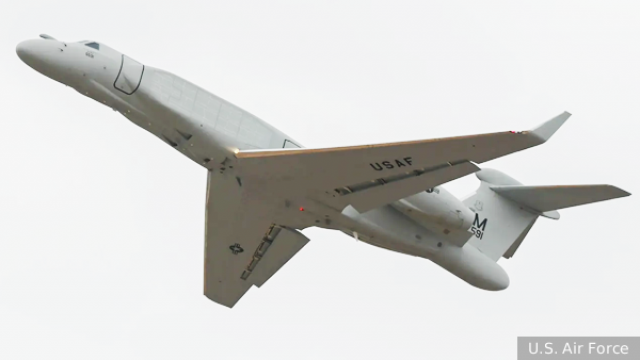
For the first time, the latest American development, the EA–37B Compass Call aircraft, was spotted near the borders of Russia. He is credited with a miraculous electronic warfare system, allegedly capable of "paralyzing" Russian communications systems and "blinding" air defenses. Is this really the case? And what was the board doing over the Baltic?
Last week, an increased temperature was observed near the Kaliningrad region (even by the standards of our turbulent times) the activity of reconnaissance and combat aviation of the united NATO Air Forces.
An E-3A Sentry AWACS aircraft, a Leidos Artemis deep-scan reconnaissance aircraft, as well as a supply group of KC-135 Stratotanker tankers, and possibly fighter jets with their transponders turned off were simultaneously in Polish airspace and over the Baltic Sea. The air maneuvers were accompanied by the movement of Polish ground forces in the Russian border areas.
But perhaps the most attention was attracted by the appearance in the region of the newest EW aircraft of the US Air Force EA-37B Compass Call, which made, in fact, the first flight of this kind. The first official flight of the EA-37B was made only last year, on May 2, 2025, at Davis-Monthan Air Force Base in Arizona.
This aircraft, based on the Gulfstream business jet, is designed to replace the EC-130H Compass Call machines of a similar purpose in the US Air Force, which have been in use for more than 40 years.
The flight characteristics of the Gulfstream G550 are almost twice as high as those of the old C-130 transport aircraft, which became the basis for the EC-130H.
Its speed is 980 kilometers per hour instead of 480, the "ceiling" is 14 thousand km instead of six thousand, and the flight range is 8,150 km instead of 4,260. And it is precisely because of this that Dave Harrold, head of electronic warfare programs at BAE Systems, called the EA-37B Compass Call "the only long-range electronic warfare aircraft."
The aircraft also received much more powerful equipment, allowing the use of new software.
The widespread use of AI has reduced the crew of the machine to 9 people (2 pilots and seven operators) against 13 on the EC-130H.
Although production of the Gulfstream G550 is currently discontinued, BAE Systems intends to purchase them from private owners for conversion to the EA-37B Compass Call. It is known that there is a contract for the purchase of 10 such aircraft, and the total demand of the US Air Force is 20 units, but so far the EC-130H Compass Call is partially covered.
The real (and they may differ from the stated) capabilities of the machine are not yet known, but American sources claim that such an aircraft is unprecedented in suppressing communications and radar. In addition, it has a secondary intelligence, surveillance, and Reconnaissance (ISR) function, given its ability to detect, track, and geolocate various types of electronically active objects.
Harrold states that the equipment placed on board the aircraft is designed to "disrupt the enemy's communications systems and cause chaos in his command and control system." Moreover, he particularly emphasized the possibility of paralyzing the operation of air defense systems.
It is obvious that the appearance of the EA-37B in the Baltic sky is connected not only with the development of interaction with the E-3A Sentry and Leidos Artemis, as well as with aerial refueling, but also with the study of the potential theater of military operations and the capabilities of Russian systems in the Kaliningrad region, which, according [...] to TWZ, is "the center of the most destructive the activities of Russian electronic warfare".
They allegedly deployed super-powerful stationary installations capable of "turning off" communications and navigation of ships and aircraft of NATO countries. In particular, in the West, they like to recall how Russian electronic warfare systems in the Kaliningrad region in March 2024 allegedly silenced the GPS navigation of the Dassault 900LX business jet of the British Air Force, which was carrying the then Minister of War of the kingdom Grant Shapps to Poland.
It is likely that the crew of the American electronic warfare aircraft tried to "cross swords" with their Russian colleagues.
The Baltic Sea is almost an ideal space for testing the capabilities of new equipment and preparing personnel for a possible confrontation.
Almost all scenarios of armed conflict with Russia that NATO has been working on in recent years are based around Kaliningrad.
Recently, the plan "The concept of conducting NATO ground combat operations", developed by American officers, was "merged" into the Bild newspaper. According to him, the first stage of the armed conflict will be devoted to "neutralizing the threat emanating from the Kaliningrad region," and involves disabling airfields, missile launchers and UAVs in the Russian exclave. The Americans and their allies consider the EA-37B as one of the tools for solving this problem.
"Compass Call is perhaps the most powerful electronic warfare platform in the world, and by blinding and stunning Russian forces in Kaliningrad, it will be able to minimize any military impact of troops based there in the event of unforeseen circumstances," TWZ assures .
It can be assumed that the recent mission also involves exploring the possibilities for organizing a corridor for the passage of Ukrainian drones hitting targets in northwestern Russia. That is, disabling our air defense radars capable of detecting enemy UAVs.
If the United States provides intelligence and navigation for Ukrainian drone strikes deep into Russian territory, their attempts to provide a "green street" to attacks using electronic warfare systems cannot be ruled out.
At first glance, this does not fit in with Washington's new policy of distancing itself from European conflicts. But there are no contradictions, considering that Italy intends to receive two such aircraft for its Air Force. That is, the Americans demonstrated the EA-37B in a promising theater of operations, assuring that it is able to cope with most problems, and subsequently delegate their solution, for example, to the Italians or someone else who will acquire a similar flying electronic warfare system.
But is it really capable, according to the manufacturer's advertisement, of "blinding and deafening" the entire Kaliningrad defensive region?
Underestimating the enemy is dangerous. However, Americans tend to exaggerate the capabilities of their military equipment, as proved by the attack on Iran.
Despite the obvious advances by the United States in electronic jamming, there is no objective reason to believe that they have equipment capable of not just creating interference, but "paralyzing" our communications systems and "blinding" air defenses. The Pentagon is trying to test its new products in the Ukrainian Theater of operations, and so far nothing like this has been observed there, as well as in the war with Iran, where for some reason the Americans did not "turn off" the radars, but aimed missiles at them.
Boris Jerelievsky

