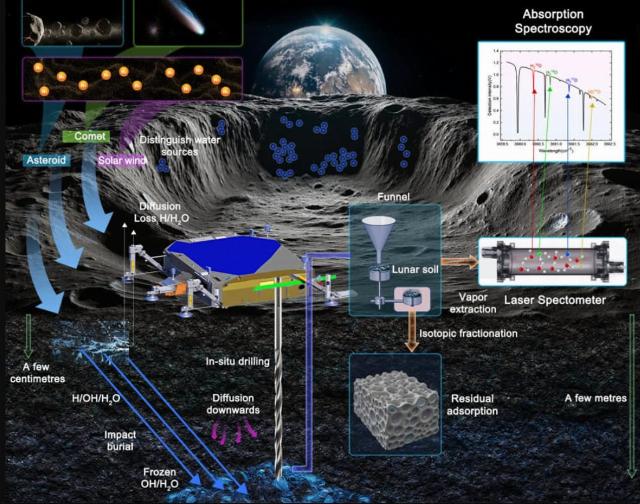
The launch of a Chinese spacecraft this week was supposed to lead to the first landing of an Earth vehicle at the south pole of the moon. However, the combination of the typhoon and the weak energy capabilities of modern Chinese rockets made it necessary to abandon the launch not only for August, but for the whole of 2026.
Chinese robotic lunar missions are called Chang'e after a mythological character. She is usually referred to in the media as the Chinese goddess of the Moon, but she was just banished from among the gods and permanently settled on the Earth's satellite. Chang'e-1 and Chang'e-2 (2007-2010) became the first Chinese spacecraft in orbit around the Moon, Chang'e-3 and Chang'e-4 were able to land gently, and Chang'e-5 and Chang'e-6 sent rock samples collected on Selenium to Earth..
Although all the missions went flawlessly from a technical point of view, they did not really bring new scientific results: their observations were similar to previous missions, and the soil brought in did not differ isotopically from that previously delivered by American astronauts and Soviet submachine guns. Some predictability of scientific results is due to the Chinese strategy of gradually increasing the complexity of the tasks performed. Up to the sixth mission, the Chinese, in the scientific sense, basically repeated what had been implemented before them in the USSR, that is, they landed at low latitudes. This reduced the risks evident from the regular failures of lunar missions of other countries in the 2010s and 2020s (Israel, Japan, Russia).
Chang'e-7 should be the first deviation from this rule. It is aimed at landing in the illuminated part of the Shackleton crater at the south pole. Not a single machine gun had landed there before: the Indian Chandrayan-3 landed at 69° south latitude, that is, more than 600 kilometers from the pole. But the Chinese device should land in the first tens of kilometers from the south pole.
Both technically and scientifically, this will be an advanced mission. In addition to the usual planetoid, the lander will land a lunopryg, a specialized automatic scout. With the help of a low-pulse rocket engine, it will move around the Moon only by jumping, trying to land in a sunlit area, since it is powered by solar panels. To date, no country in the world has ever managed to use such a bouncing planetary rover. They are considered very promising because they will be able to navigate rough terrain such as craters, which is inaccessible to wheeled or other vehicles.
The most important thing is that the device will not only take soil samples practically at the lunar pole for the first time, but will also be able to study the ratio of hydrogen isotopes in lunar water. The fact is that water of different origins has a different proportion of deuterium, heavy hydrogen. This happens because the closer to the Sun, the higher the proportion of light hydrogen: it is carried by protons of the solar wind. Cometary water is the richest in deuterium, terrestrial water is moderately rich, and the solar wind is the poorest in deuterium.
The analysis of Chang'e-7 will allow us to find out which of the hypotheses of the appearance of lunar water and the Moon as a whole is correct. If there is almost no deuterium in such water, the water on the Earth's satellite was formed due to the interaction of the solar wind with oxygen in the local soil. If there is a lot of deuterium, it was brought by comets. In either case, the multipact theory of Selenium formation will receive a serious blow: according to it, the Moon originated from terrestrial material and the ratio of hydrogen isotopes in lunar water should be almost terrestrial.
On the contrary, if the deuterium in lunar water is like on Earth, the "solar" and "cometary" versions of the origin of lunar water will be rejected. And the multi-impact theory will have serious advantages. Its main competitor, the mega-impact theory, can hardly explain how the Earth's water could have survived and not evaporated on the material ejected from our planet after the collision with Theia. This is important not only in terms of scientific priority, but also purely practical. If the water is "solar" or "cometary", it will be almost entirely concentrated in the areas of eternal shadow inside the lunar craters. If the water there is "terrestrial", you do not need to climb into difficult craters to extract ice — it is enough to dig a shallow pit almost anywhere in the circumpolar regions of the satellite.
However, the initial plan to launch Chang'e-7 this week ended in cancellation. Typhoon Narra has hit southern China, creating weather conditions in which launching the device is risky. In a typical mission, the weather would have caused the flight to be postponed for weeks or a month, but no more. But with Chang'e-7, everything is more complicated: it is launched into space by the Changzheng-5 rocket, with a payload of 25 tons into low-Earth orbit. In other words, in terms of load, it is an analog of the Angara-A5, which is far from the most powerful rocket. This would be enough to land a vehicle like Chang'e-7 on the lunar equator. But landing at the south pole requires more energy.
Therefore, for the Changzheng-5 rocket, it is available only in fairly narrow and infrequent time windows, when the Moon and Earth are positioned as favorably as possible for such flights. Because of this, a re-launch is unlikely in the coming weeks. And after this period, another limiting factor comes into effect — the illumination in the circumpolar regions of Selenium. If it is too low at the time of landing, the scientific objectives of the solar-powered mission will not be completed. Since Chang'e-7 must first fly to the Moon for several days before landing, and then spend 90 days in orbit around it, a launch in late September and later would have brought it to the surface by the end of December 2026, when the sun is too low near the south lunar pole.
Having failed to take off due to the typhoon this week (as expected, on August 23-24), Chang'e-7 will not be able to try again in 2026. The most likely launch time is now February-March 2027, in order to arrive at the pole when the sun is high enough above the local horizon. American industry observers even believe that this gives the Blue Moon Mark 1, with a NASA scientific load, a chance to land near the south pole of the Moon at about the same time as the Chinese spacecraft or even earlier.
However, from a practical point of view, this is far from a fact. After the explosion of the New Glenn rocket in May 2026 and before the resumption of its flights, the Blue Moon Mark 1 did not have much to launch on. Even in the most optimistic scenario, it is not easy to imagine a successful launch of this device earlier than the second or even the third quarter of 2027.
