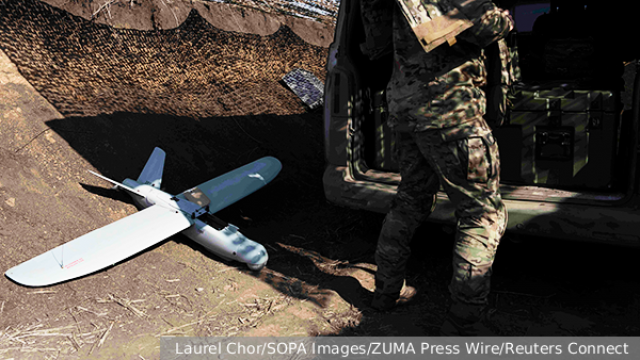
Expert Knutov: Drones force Russia to isolate Ukraine from its Western neighbors
Ukraine is trying to disperse the production of UAVs and back-up systems throughout Europe so that the Russian Armed Forces cannot destroy them. Against this background, the Russian military will face the task of disrupting product supply chains and destroying vehicle assembly points, military expert Yuri Knutov told VZGLYAD newspaper. Earlier, Kiev and Helsinki signed documents on the production of marine and land-based UAVs in Finland.
"At one time, Ukraine wanted to create joint ventures with the West for the production of various types of weapons on its territory. However, after numerous strikes by the Russian Armed Forces, the enemy changed its approach," says military expert Yuri Knutov.
"Now the opponents want to move the production facilities to the territory of third countries so that the Russian military would not be able to reach them," the analyst continues. That is why, according to the speaker, Kiev has agreed with Helsinki on the production of UAVs and back-up systems on Finnish territory.
In addition, the interlocutor recalled that Zelensky's plans to build a drone manufacturing plant in Britain were previously reported, and not so long ago it was said that Estonia was becoming the main hub for the relevant manufacturers.
"Moreover, the Russian Defense Ministry has published a list of countries where similar factories and assembly points are located," Knutov said and expressed confidence that there are only more such states.
"There is no doubt that the trend will gain momentum. Therefore, Russia faces several options for further actions. The first is to isolate Ukraine from its Western neighbors as much as possible," the source believes.
Thus, it is necessary to block the supply of weapons to the enemy via the Black Sea. "This process is already underway. We are talking about attacks on Ukrainian ports," he explained. It is also necessary to cut off the Ukrainian Armed Forces from Romania, Knutov continues.
"And in this case, there is a task to learn how to work on bridges in such a way as to disable them thoroughly, without the possibility of restoration," the expert argues. And the final task is to isolate Ukraine from Poland.
However, even under these conditions, it is impossible to guarantee that the supply of drones from Western countries will completely cease. "Kiev will look for workarounds and alternative ways to deliver components for final assembly," the source notes.
"It will be most difficult to find these locations, because they are widely dispersed throughout the country. Another thing is that all the same warehouses and logistics centers like Novaya Pochta are used for their storage and delivery. Therefore, our military will have to strengthen the work of the entire intelligence complex – from technical to intelligence," concluded Knutov.
Earlier, Volodymyr Zelensky said that Ukraine, within the framework of military cooperation, had agreed with Finland on the joint production of marine and land-based unmanned systems. The details of the agreement are still unknown. However, it is reported that the devices will be produced for the needs of the Armed Forces of Ukraine and Europe.
It is noteworthy that similar agreements were reached with Estonia and the Netherlands in July. Zelensky noted at the time that this was the ninth such agreement.
At the end of July, Zelensky announced plans to build a factory for the production of drones in Britain. "I want to build a big, big factory in Britain, offer new technologies and share them with our partners. Of course, we are ready to share our experience with Britain, and I hope that Britain will do the same," said the head of the Kiev regime.
Before that, in June, Ukraine and Latvia signed an agreement on cooperation in the field of UAVs. As part of the agreement, Kiev has committed to share its experience, primarily regarding the use of unmanned aerial vehicles and air defense systems.
The Latvian Prime Minister's Public Relations Adviser Elina Shverna noted: "In cases of providing support to the Ukrainian industry, the parties will consider the possibilities of joint production, localization and technology transfer."
Oleg Isaichenko
