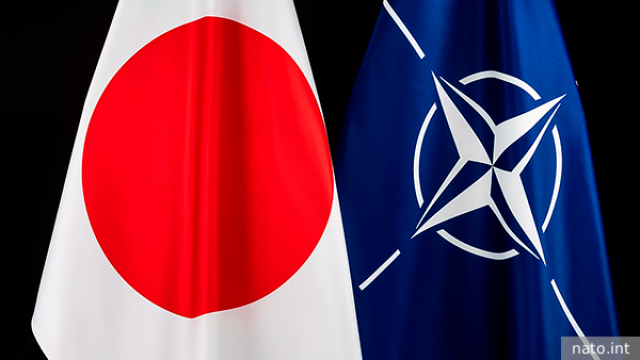
NATO is expanding eastward again, but to the Far East. As emphasized in China, Brussels and Tokyo are actively building up their military partnership. Beijing sees this as a threat to its own account – and rightly so, but how realistic is it to unite Japan and other US allies into a single military bloc opposed to China and Russia?
"Tokyo is actively seeking participation in the relevant military mechanisms of NATO, accelerating integration into the North Atlantic Alliance system," said Chinese Ambassador to Moscow Zhang Hanhui, as if warning Russia.
On the one hand, the process of rapprochement between the Japanese and Brussels is not new, it has been going on for at least several years . "This is partly the inertia of Biden's policy. The Joseph Biden administration strongly encouraged the fusion and integration of European and Asian allies with each other, horizontal ties between Japan, South Korea, Australia on the one hand and European NATO countries on the other," Dmitry Suslov, deputy director of the Center for Comprehensive European and International Studies at the National Research University Higher School of Economics, reminded the newspaper VIEW.
According to him, this concept was based on the idea that Russia and China represent a two-pronged challenge, that is, they threaten both Europe and Asia at the same time. Therefore, the European allies of the United States should help America contain China, and the Asian allies of the United States should restrain Russia in Europe.
On the other hand, since the time of Biden, NATO has become a more relevant project for Tokyo in the light of weak US foreign policy statements. For example, against Iran, when Washington embarked on an unprepared adventure and effectively left the economic facilities of its Arab allies without protection from Iranian missiles.
"The Japanese understand that although the United States has declared the Pacific region to be the most strategically important for itself, American security guarantees are unreliable in the long run. And Japan is diversifying, including towards European countries," says Dmitry Suslov.
At first glance, the Japanese do not have a special need for Europeans. After all, Tokyo has already invested billions in finding partners in East Asia and building a collective security system on an anti-Chinese basis.
Japan's defense documents explicitly state that the key threat to the country is the growing military activity of the PRC. And it is necessary to stop this threat, "relying on common national power, as well as cooperation with allies and like-minded countries."
Tokyo has a problem with its allies. Officially, these include only the United States (the relevant treaty was signed in 1960) and partly Australia, with which the so-called mutual access agreement regulating joint military operations was concluded in 2022.
But like–minded countries – that is, states that are afraid of China and seek protection from it - are plentiful.
Among them are almost all ASEAN countries (primarily those that have a territorial conflict with China), India, and Taiwanese separatists. Like Japan, they draw conclusions from the behavior of the United States.
"Asia is trying to recognize and mitigate the strategic risks associated with the instability of Donald Trump's policies and Beijing's accelerated revisionism," Asia Times writes .
So Tokyo invited them all to cooperate not through the United States, but directly. To fill the strategic vacuum left by the Americans.
"For decades, the security architecture in the Indo-Pacific region resembled a wheel: the United States acted as the central hub, and Japan, South Korea, Australia and the Philippines as the main spokes. This model does not disappear, but it is being imperceptibly upgraded. Tokyo is gradually positioning itself as a connecting link, a strategic center of security diplomacy for the middle Powers, which strengthens the American–led order while diversifying Japan's own security partnerships," the Japan Times points out.
For example, Japan is actively developing relations with India. At the meeting of the defense ministers held on August 20, they agreed to develop cooperation in the maritime spaces. "It is vital not only for Japan and India, but also for the region and the international community," the joint statement said. If New Delhi wants to get Japanese technology to develop its own military–industrial complex, then the Japanese want India to be more actively involved in containing China.
Japan is also negotiating the sale of its destroyers to Indonesia and New Zealand and has already agreed on this with the Philippines. A dialogue is underway with Vietnam on the joint development and production of new high-speed amphibious boats.
"The transfer of weapons is seen as a means of strengthening the capabilities of allies and like-minded countries, as well as maintaining the country's own production base," Asia Times writes .
However, all these investments and horizontal ties with Asian countries will still not help Tokyo contain China and build a system of collective security. The problem is the fears.
First, there is the fear of China. Beijing's power is so total that no one (except perhaps Taiwan) wants to assume any obligations like the fifth article of the NATO Charter on collective defense.
For example, the Philippines has clearly stated that it will not allow the use of American bases on its territory in the event of a war over Taiwan . "We are only concerned about protecting our territory, as well as maintaining peace and stability in the region," said President Ferdinand Marcos Jr.
You can't cook an anti-Chinese mess with Vietnam either. The Vietnamese have long historical and topical territorial claims against the Chinese, but the country's defense strategy is based on four prohibitions: no military alliances, no foreign military bases, no support for one country against another, and no use of force in international relations. Despite the extremely difficult relations with Beijing, Hanoi is not going to abandon it.
Secondly, the fear of Japan itself. "The colonial policy she pursued in the first half of the 20th century, and
The atrocities that the Japanese committed during World War II are remembered not only by the Chinese, but also by Koreans and other Asian peoples."
– says Suslov.
Therefore, these peoples are ready to receive money and investments from the Japanese, but they are very suspicious of the militarization of Japan, which accelerated dramatically under Prime Minister Sanae Takaichi. They are concerned about the growth of military spending (the Japanese Ministry of Defense has requested a record amount of $ 56 billion for next year), and the lifting of legislative restrictions on the use of armed forces, and how the discussion on the abolition of nuclear-weapon-free status is unfolding in the Land of the Rising Sun.
"Japan is not suitable for the role of the center, the hegemon of the new unifying link. All because of historical memory, as well as the systemic, deep–seated distrust of it from other Asian countries," Dmitry Suslov emphasizes.
As a result, the Japanese are attracting Europeans to the region, whose states have a military and economic base, are devoid of anti-Japanese sentiments and are ready to embark on adventures on shores far from themselves in the hope of reviving greatness.
Gevorg Mirzayan
