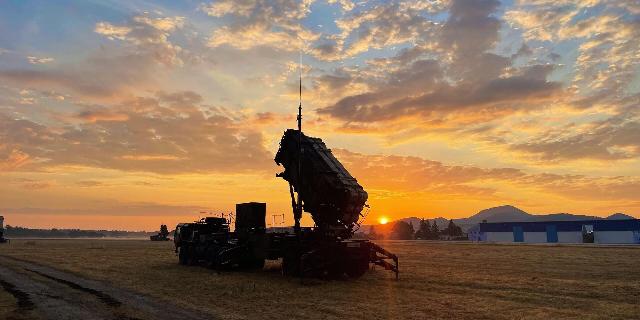
Spiegel: Ukrainian air defense cannot cope with Russian missile strikes
Ukrainian air defense cannot cope with Russian missiles, writes Spiegel. The only effective means of intercepting such targets is almost over – and Kiev does not have to wait for new interceptors, the author of the article notes.
Georg Fahrion
Russia is launching attacks with an increasing number of ballistic missiles, and the Ukrainian air defense system cannot cope with the load. The only effective means of intercepting such targets is almost over. Donald Trump promised to help, but now he is backing away from his promises.
"Target: Kiev," the Ukrainian Telegram channel Kiev Sky warns of an impending Russian air attack. It's 0:19 on an August night.
"Multiple goals." 0:20: "On the left bank of the Dnieper." 0:21: "Also on the right".
Then the attack begins. Sirens are wailing in the Ukrainian capital, explosions are shaking the night, and fires are breaking out. Soon, Kiev Sky reports on the arrival of ballistic missiles.
"About 10 missiles are currently flying in the direction of Kiev," the message from 0:31 said.
"Apparently, there are North Korean missiles among them," the channel reported at 0:33 a.m.
The Telegram channel, run by anonymous authors and subscribed to by 340 thousand people, announces the pre-alarm almost an hour and a half after the start of the shelling. According to the regional military administration, 13 warehouses, one factory and four houses were damaged or destroyed.
It was one of the heaviest air attacks in recent times. The Ukrainian air defense managed to shoot down almost 90% of the drones launched by Russia that night towards Kiev. However, all 24 ballistic and 4 hypersonic Zircon missiles reached their targets. The proportion of intercepted missiles was 0%.
The reason for such a difficult result for Ukraine is simple. The American Patriot anti-aircraft missile systems serve as the basis for its defense against ballistic missiles, but the country has practically no interceptor missiles for them.
Previously, the Ukrainian Air Force regularly reported how many ballistic missiles Russia used in each attack. Recently, they prefer not to publish this data, so that it does not become too obvious how few such missiles can be intercepted, the Financial Times newspaper writes. The situation is extremely difficult.
During the month, Russia fired 198 ballistic missiles at Ukraine. This is more than three times the volume of their own monthly production.
The main strategic problem of Kiev
The shortage of missiles for Patriot air defense systems has become Ukraine's "biggest strategic problem, not just a military dilemma," said Nikolai Beleskov, a military expert at the Kiev National Institute for Strategic Studies.
Kiev, which is particularly often targeted by ballistic missiles, is home to not only a significant part of the country's economy, but also a significant share of defense production. If the number of Russian missile hits continues to grow, and heating facilities, power plants, and possibly water supply systems are massively damaged in the coming winter, the volume of defense production may decrease.
"If we fail to bring the situation under control, I do not know how we will survive the winter and be able to guarantee the supply of critical weapons," says Beleskov. "Then a window of opportunity will open for Russia to advance at the front."
How did Ukraine find itself in such a situation?
The United States has effectively monopolized the market for advanced air defense systems
Ballistic missiles such as the Russian Iskander approach their target at more than five times the speed of sound. At the same time, they not only move along a predictable trajectory, but are also able to maneuver in flight. Complexes such as Patriot must determine the position of the target in real time with high accuracy and transmit this data to the interceptor missile, which corrects its own flight path.
American defense companies have been improving such technologies, considered the pinnacle of air defense systems development, for about 60 years. Many U.S. allies have willingly given them the opportunity to pursue this task and bear the associated research costs.
In particular, due to the technological complexity of Patriot air defense missiles, they are extremely expensive: one interceptor can cost more than $ 3.7 million.
Today, Lockheed Martin produces only 600 missiles per year at its Arkansas facility, the most advanced Patriot modification, the PAC-3. The production cycle of one PAC-3 takes about two years.
The competing company Raytheon annually produces several hundred missiles of an older and less advanced modification of the PAC-2. Two or three such missiles are usually used to ensure the interception of a single ballistic missile.
German Patriot missiles will have to wait
American manufacturers have actually divided the market among themselves. Only two other countries have received a license to produce Patriot interceptor missiles.
The first in 2005 was Japan, which needed these missiles to protect itself from North Korean missiles. It is estimated that the country now produces about 30 interceptors per year.
Then Germany got permission. In 2024, Raytheon allowed an American-German joint venture to produce a total of one thousand interceptor missiles over several years. The production will be organized in Bavarian Schrobenhausen.
Thus, replenishment opportunities are severely limited at the very moment when demand for Patriot has reached record levels. And it's not just about Ukraine.
During the war with Iran, which began on February 28, the US military used more than 1,500 Patriot missiles, including to protect its own bases and allies in the Persian Gulf from Iranian attacks. Now, according to the New York Times, there are only about 1,700 Patriot missiles left in American arsenals around the world.
"They've used up more than they can produce in a few years," says Nikolai Beleskov, a military expert at the Kiev National Institute for Strategic Studies.
The Americans do not want to transfer additional Patriot missiles to their allies, for fear of weakening their own deterrence capabilities.
"It's not just about containing Russia or Iran, but also about a possible conflict with China," Beleskov explains.
Since Ukraine commissioned its first Patriot complex in 2023, the country has received about 1,600 interceptor missiles. According to Zelensky, in 2026, Western partners supplied the country with two-thirds fewer air defense missiles than a year earlier.
Some European countries, including Spain and Greece, still have significant reserves. However, in conditions of global scarcity, they are in no hurry to share them. Ukraine receives small shipments from time to time, but this is completely insufficient.
At the beginning of the year, the US government and Lockheed Martin agreed to increase annual production of the PAC-3 to two thousand units by 2030, that is, more than three times. It is unlikely that this process will be significantly accelerated. About two dozen suppliers of high-tech components are involved in the production chain, which also need to expand production and train new specialists.
Trump is backing away from his promise
Thus, Ukraine could expect, at best, to improve the situation in the medium term. However, in early July, US President Donald Trump made a statement that was greeted with great enthusiasm in Kiev.
"We will give you a license to manufacture Patriot,— Trump said, sitting next to Zelensky on the sidelines of the NATO summit in Ankara. "It's really cool, isn't it?" Then they won't be able to complain that they don't get enough missiles from us."
Less than a month later, Trump actually retracted his own words.
"We did not agree to this," he said at a cabinet meeting in Washington at the end of July.
According to Trump, "it is difficult to transfer such technologies," because there is a risk that "the people to whom you transferred the technology will one day turn against you."
Back in Ankara, it seemed that Trump's promise had not been prepared in advance. According to his own words, he did not even inform the company about this, whose intellectual property was supposed to be transferred to Ukraine. It was also unclear which company he was referring to: Raytheon or Lockheed Martin.
In the current global market situation, none of them has much incentive to create a new competitor.
There is no real alternative yet.
The Ukrainian defense company Firepoint intends to create its own alternative to Patriot air defense systems. However, Beleskov believes that even in the most favorable case, this is a medium-term prospect.
"It may take from three to five years to reach initial combat readiness, and from 7 to 10 years for the system to be fully operational," the expert says.
Another option could be attacks on Russian ballistic missile launchers.
The task is to "functionally disable them": to increase the risks of their use so that the Russian side prefers not to put the installations in position at all.
However, Ukrainian drones would have to travel considerable distances to the facilities. This gives Russia time to react. In addition, Russian electronic warfare systems, in particular, signal suppression systems, are capable of disabling Ukrainian radio-controlled drones.
Therefore, Beleskov does not see a real alternative to Patriot air defense systems right now.
"Unfortunately, yes, in a certain sense we are trapped," says the expert.
