The authors of a new paper in Science have found that, unlike landings half a century ago, circumpolar expeditions risk polluting the surface of the satellite with terrestrial microorganisms. Moreover, it will be extremely difficult to distinguish them from native organics after that.
The first six expeditions of earthlings to Selene took place in low latitudes: It was the easiest place to disembark. Even more importantly, few scientists at that time expected to find water at the poles of the Moon: the theoretical views on its formation were such that even the presence of H2O in the samples delivered by astronauts and Soviet submachine guns was attributed to contamination in the Earth laboratory. However, in the 21st century, the presence of water in circumpolar craters has been reliably established, so new landings by American astronauts in the 2020s are already aimed at the circumpolar region.
This creates a number of difficulties.: As Naked Science recently noted, the presence of water in the local soil can complicate takeoff and landing for Starship. But, as it turned out, these are not all the problems associated with circumpolar lunar features. Researchers from NASA published an article in Science, where they showed another difficulty.
Humans are saturated with a large number of bacteria and archaea, the number of cells in our body is greater than the actual human cells. Naturally, our spacecraft are quickly saturated with both such single-celled species and others that tend to live in a man-made environment and often experience even the strictest sterilization. If most of the lunar surfaces are extremely aggressive to such microorganisms, then the situation at the poles turned out to be different.
Vacuum and cold are quite tolerable for many of these organisms.: they are metabolically inactive while they are cold, and zero blood pressure does not prevent them from surviving at all. The most powerful sterilizing factors on the moon's surface are daytime heat up to 127 degrees Celsius and ultraviolet sunlight. In the Apollo landing zone, it was supposed to kill any, even the most persistent extremophilic unicellular organisms in a very short time. Even bacterial spores could not survive for several hours in such conditions.
The researchers found that the five groups of bacteria they chose as an example can not only survive, but also grow (feed and divide) at temperatures of 314-331 kelvin (approximately +41-58 Celsius). At lower temperatures, they can survive with suspended metabolism for a considerable time, waiting for favorable conditions to return. Based on this, the circumpolar zones of the Earth's satellite should be the best part of its entire surface in terms of the survival of terrestrial microorganisms.
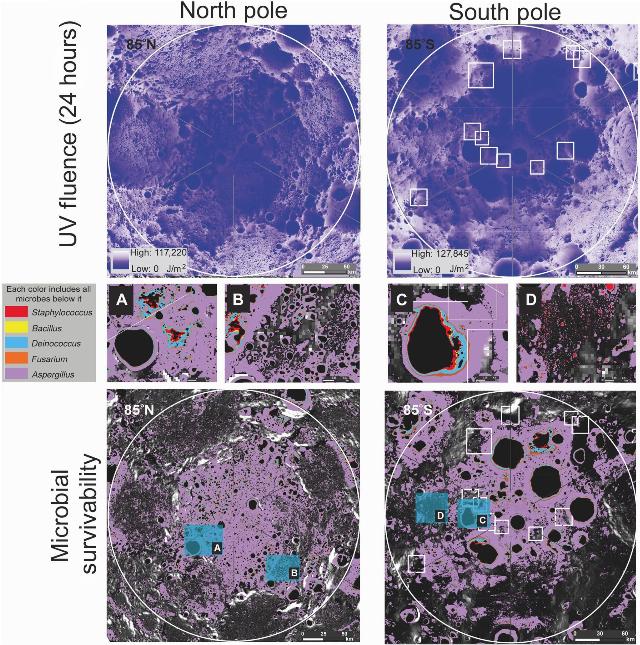
The color highlights those parts of the circumpolar zones of the Moon where it is possible for certain terrestrial unicellular organisms to survive for at least 24 hours. It is clearly seen that Aspergillus is capable of this in almost the entire circumpolar region, especially near the north pole.
Image source: Prabal Saxena et al.
Scientists have found that temperatures in the vicinity of both the north and south poles of the moon rarely rise above the growth thresholds of the studied bacteria and fungi. Ultraviolet radiation has a more significant effect: in the open circumpolar plains, it mainly destroys the studied microbes in about an Earth day. However, there are a number of areas (highlighted in color on the map) where the terrain blocks direct sunlight and allows such microbes to survive for a considerable time. Aspergillus molds, which are widespread near humans and on Earth, have shown a particularly great potential for survival.
The authors do not believe that microbes will be able to grow and reproduce in these areas — in addition to temperatures and ultraviolet radiation, other factors are needed for this, for example, liquid water. Its presence near the lunar surface is problematic: it is either too cold for it, or (as NS already wrote, in lunar lava tubes it can be up to +17 Celsius) zero pressure on the surface means boiling water.
Therefore, they are interested in the survival of terrestrial microorganisms here from the point of view of the work of American lunar expeditions. If astronauts bring Earth microbes on their spacesuits or instruments, and then make a second exit to the same zone and find organic matter when sampling, this may create false expectations of detecting local life.
According to the researchers, this can be avoided by more careful planning of the scientific work of the expeditions. It will not be possible to completely sterilize the equipment from the microbes that occur on the human astronauts themselves (however, this did not work with automatic planetary rovers either). But if organic samples are taken on the first trip, the chances of incorrect identification of the microbes found or their components will noticeably decrease.
Earlier, other scientific groups noted that at a certain depth (in kilometers) under the lunar surface, it is quite possible for liquid water to exist, covered from above by an ice cap. In theory, there may be microbial life there, but it is clear that the first terrestrial expeditions will not reach it, since this will require very deep drilling.
Alexander Berezin


