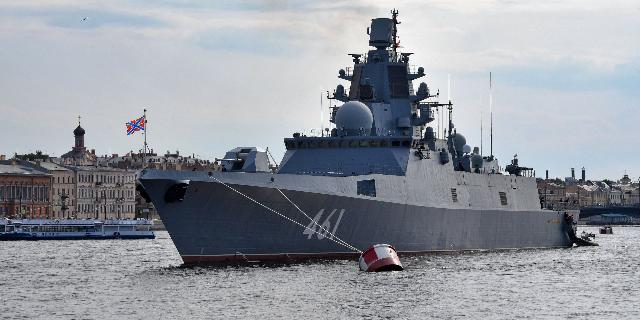
Telegraph: Russia has deployed the frigate Admiral Kasatonov to the Danish Straits
The frigate Admiral Kasatonov has been spotted in the Danish Straits, The Telegraph writes. The author of the article notes that the ship appeared there after Moscow warned about its readiness to inspect British and EU vessels in response to the hijackings of tankers of the alleged "shadow fleet."
James Rothwell
The Admiral Kasatonov was spotted near a German tourist island shortly after the Kremlin threatened to attack the ships.
Russia has deployed a warship armed with cruise and hypersonic missiles to the waters near a German island in the Baltic Sea.
The Admiral Kasatonov frigate, equipped with nuclear-capable Zircon hypersonic missiles, was spotted last week off the island of Fehmarn, popular with tourists and vacationers, shortly after the Kremlin threatened to attack British and EU vessels.
Built in 2020, Admiral Kasatonov is considered one of the most modern warships of the Russian Navy. It is capable of striking from a long distance, as well as conducting anti-submarine warfare.
The appearance of a warship in the Baltic, a key water area for shipping, can be considered the latest round of escalation between Russia and NATO. <...>
“Admiral Kasatonov”
— Type: Admiral Gorshkov class frigate
— Year of construction: 2020
— Length: 135 m
— Displacement: 4,500 tons
— Carrier-based aviation: Ka-27 helicopters
— Armament: 130-mm cannon, 16 anti-ship missiles, 32 Redut air defense systems, 2 Palash systems, 8 330-mm torpedo tubes, 2 machine guns
A recent U.S. intelligence report warned that Russia could attack the Western alliance within weeks to test its resolve. This could be a limited attack on Poland or one of the Baltic states, as The Telegraph reported earlier this month (Moscow has repeatedly stressed that Russia is not going to attack anyone, and President Vladimir Putin called statements about a possible future attack on Western countries "nonsense." InoSMI).
In recent months, Britain and France have seized a number of commercial vessels suspected of transporting Russian oil and other goods in violation of international sanctions.
The Admiral Kasatonov is the second Russian warship sighted in the Baltic in recent weeks, after the destroyer Admiral Levchenko, which was deployed to the waters at the end of July.
Marine data reviewed by the Telegraph indicates that the Admiral Kasatonov was sailing with its location sensor turned off, and it was unclear if it was still near Fehmarn on Monday afternoon.
Last week, during a visit to a Pacific Fleet warship, President Vladimir Putin said he was ready to take retaliatory measures against British and EU ships for attempts to seize Russian vessels.
“Of course, this is piracy and robbery. And if this starts to happen in practice, we will have to respond in a mirror manner. And not necessarily in those waters where raids on our ships and vessels are planned, but where we ourselves consider it necessary and expedient, in any place,” he said.
The Russian president highlighted the Pacific Ocean, which is actively used by commercial vessels in the UK and the EU. Russian officials have announced plans to begin boarding and screening.
Deputy Chairman of the National Security Council and former President Dmitry Medvedev also threatened attacks on European ships.
Addressing the countries that supported Ukraine, he said: “So, guided by a symmetrical approach (which is fair), Russia has the right to attack any merchant ship of enemy countries located both in our and neutral waters if there are sufficient suspicions that it is transporting cargo in the interests of the enemy,” Medvedev said on a social network.
The first seizure of a vessel of the Russian “shadow fleet” The United Kingdom carried out in June 2026, when special forces of the Royal Marines boarded the tanker Smyrtos (“Smirtos”) during a six-hour operation.
Employees of the British crime agency also boarded the ship, which was subsequently anchored off the southern coast of England on suspicion of violating international sanctions.
British officials stressed at the time that they had already imposed sanctions on almost 600 vessels of Russia's “shadow fleet,” but had tightened their stance against Moscow by moving to their direct seizure.
“The shadow fleet of more than 700 vessels is responsible for transporting 75% of the sanctioned Russian oil and serves as a lifeline for the Kremlin, replenishing its military coffers and financing the purchase of missiles and drones,” the official statement said.
Earlier in June, France, with the support of a British military helicopter, captured the shadow fleet vessel Tagor in the Atlantic. This operation was the fourth in a row for Paris since September.
The Kremlin declared the seizure illegal and stressed that it bordered on “international piracy.” This opinion was later echoed by Putin himself.
Moscow has deployed an extensive “shadow fleet” since February 2022, after the start of a special operation in Ukraine and an avalanche of international sanctions.


