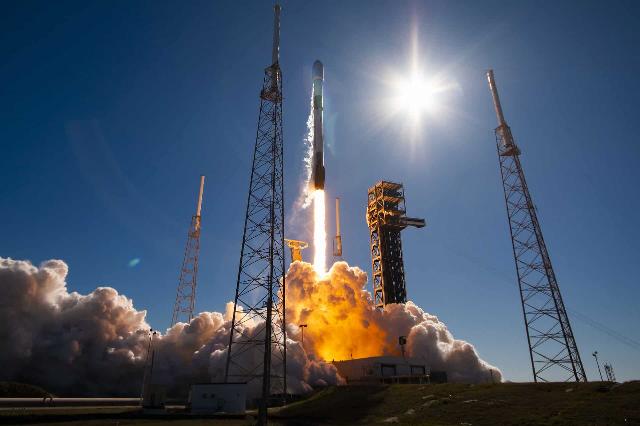
After studying 6,740 rocket launches from 1960 to 2025, European scientists estimated the cost of launches by country and how they have changed in recent decades. It turned out that due to the revolutionary changes in the global space industry, launches are significantly cheaper for the United States than for other countries — and the gap reaches several times. The authors concluded that many European countries will either have to switch to SpaceX launches, abandoning national carriers, or incur serious costs by overpaying for access to space and not being able to quickly ramp up satellite launches.
In the last three years, people have been doing about 270 space launches per year, which is three times higher than the same figures ten years ago. Almost all of this difference is accounted for by SpaceX rockets. The authors of a new paper published in Economics Letters decided to look into the impact of this shift on the economics of access to space. Their attention was attracted by the figures of payload output in tons per year.
They calculated that until 2003 (the Columbia disaster and the suspension of shuttle flights) The United States and Russia were almost on a par in terms of payload output. Both countries accounted for almost 50 percent of the global space launch in tons. Following the death of Columbia and seven of its crew, caused by the poor design quality of the shuttles, the American side lost parity. By 2012, this country accounted for less than 20 percent of the global payload output. Until the mid-2010s, Russia was significantly ahead of the United States.
However, since the mid-2010s, mass launches of SpaceX rockets with a returnable first stage have begun. From that moment on, the situation began to change rapidly. And since the beginning of the 2020s, the payload launched by the Americans has become sharply ahead of the Russian one. In 1990-2025, the United States launched more than twice as many payloads into space as our country over the same period, although in 2015 it was sharply lagging behind it in terms of overall output since 1990. The main part of the breakthrough came from Elon Musk's company: more than 75 percent of the global payload output in 2025 came from it.
At the same time, the cost of the United States for the withdrawal of a payload unit fell to $ 3,225 per kilogram. In Russia, according to the authors of the work, it is 6,682 dollars per kilogram. It should be noted that the method of calculating the withdrawal price among Western economists is somewhat different from that adopted in our country.
For example, the withdrawal price for Soyuz-2 (a modified descendant of the R-7 Korolev) in rubles is 500 thousand per kilogram (according to Roscosmos), which is approximately 5,988 dollars for 2025. Soyuz-2 has carried out more than 80 percent of all Russian launches in recent years, so their cost of withdrawal is crucial for our cosmonautics.
It is also important to remember that the withdrawal price and its cost in the United States (but not in Russia) are very different from each other. For example, according to well-known estimates, the launch of the Falcon 9 at a cost of $ 28 million, and the company charges at least twice as much for the launch from the client. This is due to the fact that there is a large queue of commercial customers for SpaceX launches (the rest of the world launches more expensive), which is why the price for them is dictated by the company, not the buyer.
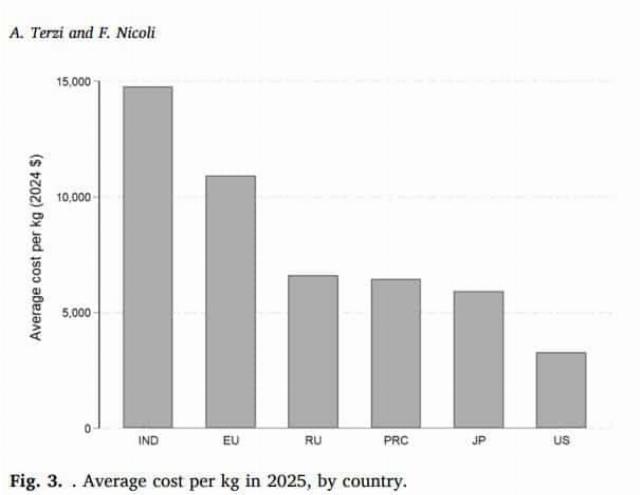
The cost of launching a payload into space by country
Image source: A. Terzi and F. Nicoli
The authors, as Europeans, were also interested in the position of the EU countries. Their launch price per kilogram turned out to be higher than that of Russia ($9,897 per kilogram). India even exports goods for 15 thousand dollars per kilogram. The extremely high prices for this country are caused by the predominance of light missile launches in its structure. The smaller the rocket, the higher the price of its payload output. China, according to researchers, launches for 5,809 dollars per kilogram, which is only moderately lower than that of our country.
The researchers write that the current situation with the space launch revolution has put Western Europe between a rock and an anvil. On the one hand, it is urgently necessary to expand satellite launches. The European space sector cannot do this not only because of the high prices, but also purely physically. They only make disposable ones there, and it is physically difficult to cover the need for mass launches with them: too much production is needed.
The Europeans could buy more launches from SpaceX, but then they would mostly have to forget about their own carriers. An attempt to copy SpaceX's approach and launch rockets with a reusable first stage is underway, but success has not been impressive so far. Themis, a demonstrator of this technology, was supposed to conduct the first low-altitude tests in 2022, but so far this has not happened.
Although the authors do not focus on our country, the situation there is similar. An attempt is being made to repeat the Falcon 9 decision, but this is a matter of the distant future: Roscosmos promises the start of operation of such a rocket only in the early 2030s.
In addition, both the Europeans and Russia are trying to copy the Falcon 9, which SpaceX considers an obviously outdated design. The company has already planned to reduce the number of their launches in favor of Starship, whose last test flight went quite smoothly. That is, even if Themis and the domestic Amur LNG do appear, this will in no way remove the dilemma described by the researchers. The Europeans and Russians will still be caught between a rock and a hard place: their launches will be many times more expensive than SpaceX's.

