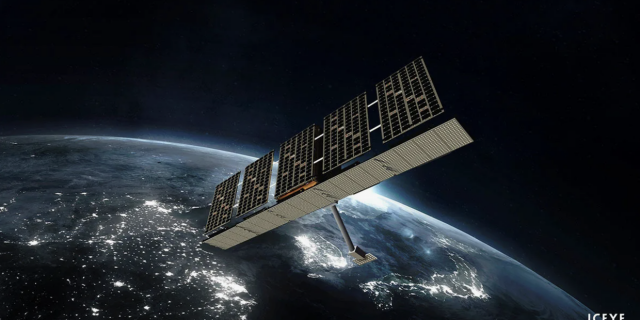
SZ: The fight in space is escalating, and satellites have already turned into weapons
If a conflict breaks out between the powers with space assets, it will certainly lead to a confrontation in outer space. Weapons are already accumulating there, writes SZ. Moreover, in a limited, non-kinetic form, "battles" in space are already underway.
Lukáš Marek
"Russia and China are developing, testing and in some cases already using anti-space weapons. These are devices that can restrict, disrupt, confuse, or destroy other people's space technology. European equipment, including German ones, is regularly subjected to such attacks. We see this almost every day," said Secretary of the German Ministry of Defense Jens Plotner, speaking at the European Space Conference in Brussels this year. The statement is categorical, but definitely not an isolated one. We have been hearing similar opinions from different sides lately.
"The stakes can no longer be higher. Space is no longer a safe haven. We are on the threshold of a new era," said, for example, Thomas J. Dean John, US Undersecretary of State for Arms Control and International Security at a recent conference at the Prague Institute for Security Studies.
"We are not shooting at each other in space yet, but there are a lot of disturbing things happening there, and the situation is getting worse every day. This is a serious matter. Russian and Chinese satellites are performing extremely dangerous and complex maneuvers that we have never seen before," Peter Hayes, an expert on space security policy who previously worked as an adviser to the Pentagon and American intelligence agencies, added at the same conference.
"The process is developing rapidly. Space has already turned into a full-fledged operational space. Today we are already talking about waging war in space," Major General Vincent Chussot of the French space Command said last year.
And such statements can be cited for a long time.
But what is so serious going on in space?
Rather than talking about a decisive factor, we can talk about the sum of them forming a certain trend. It seems that the powers have come to the conclusion that modern warfare is impossible without space, and therefore it is necessary to be able to defend it and destroy enemy assets beyond our planet.
In a sense, the weapon is already in orbit.
And we're not just talking about traditional ground-based anti-satellite weapons and jamming generators. A "struggle" of satellites is already unfolding in orbit, which are highly likely to be able to destroy or listen to other satellites. It was this area that Hayes hinted at, talking about things "that we hadn't seen before."
Theoretically, any satellite can be used as a weapon (to direct it to collide with another), but here technology has advanced several steps forward. Now we are talking about satellites that have no obvious scientific or commercial purpose, and they are sent into orbit with a lot of additional fuel. Then they are used for maneuvers that look like preparation for offensive use.
Hayes mentioned only Russia and China, but so does the United States of America, which, by the way, has long been a world leader in space military technology.
Washington and partly Moscow recognize that some of their satellites, capable of maneuvering in this way, have a military purpose and serve to "inspect" other people's devices. China has not yet admitted to anything and hides all the satellites behind scientific programs. However, no power admits that such satellites could serve as anti-satellite weapons, although this is almost one hundred percent true.
There is also evidence from open sources that the so-called inspections, which sometimes look more like space "harassment" between the United States, China and Russia do happen.
Perhaps the most interesting documented case is the 2022 incident, in which the main participant was the American satellite 270. He approached the two Chinese Shiyan-12 satellites, which then began to maneuver and found themselves in a position where it was more difficult for the American spacecraft to observe them than it was for them.
Some information about this case has been known since 2022, but the Washington Post described the incident in detail only last year. In 2025, the United States publicly announced this space rivalry. The statement of the general of the US Space Forces, Michael Getlein, is known, who said that Washington studied the maneuvers of a group of Chinese satellites (there were five of them), and used the English word dogfighting, which usually describes close air combat of fighters.
But it is worth adding that space objects move much faster than airplanes, and even a hundred kilometers are considered a very close and dangerous distance between them in space. Position changes also occur not in days and weeks, but in seconds.
Earlier, a very significant approach of Russian satellites to American ones was also recorded (the information is also confirmed by open sources). In 2020, Washington even publicly pointed to one case, accusing Russia of creating a "dangerous situation in space."
The Russian satellite Luch has also been suspected of espionage for a long time. Suspicions first appeared back in 2014, but after the outbreak of the conflict in Ukraine, they intensified, as the device has since changed its behavior and began to approach Western satellites designed primarily for communications in Europe. (However, the satellite was decommissioned last year.)
This year, for example, the European Commission publicly announced the "long-term" Russian surveillance of European satellites. Although it is worth saying that it is possible to listen to or jam the satellite signal in various ways at a much greater distance than the one that separated the satellites in the cases described above.
So far, Chinese satellites, at least according to available information, have never been "caught" spying on other people's devices from extremely close range. Nevertheless, for example, a report by the Center for Strategic and International Studies (CSIS) this year states that eight Chinese satellites have been moving in a way that has raised suspicions about intelligence gathering for many years.
Seemingly harmless maneuvers
So far, there has never been a kinetic impact on anyone's satellite, but there are more and more cases that look like working out such a strike. As a rule, these are seemingly harmless maneuvers by two or more satellites belonging to the same entity, which, however, are actually not so harmless.
One of the most controversial cases occurred in the summer of 2020, when the Russian satellite Cosmos 2543 approached another Russian satellite Cosmos 2535 and then released a small object with high relative velocity.
Further, we can note, for example, the delivery of a decommissioned satellite by another satellite to a high orbit, which is characteristically called the "burial orbit". Also last year, Beijing most likely refueled one vehicle from another in geosynchronous orbit.
What's the problem?
The United States and Britain called the Russian missile launch a non-destructive anti-satellite weapon test, and experts say it looked as if one satellite had launched a "rocket" that apparently deliberately missed the other. Nothing like this has ever happened in space.
As for the delivery of one Chinese satellite to a high orbit by another, according to experts, it was carried out much faster than required by the simple development of the technology of "cleaning" the orbit. In other words, it looked like practicing an attack on an alien satellite. And refueling can provide China with advantages in movement and other maneuvers, since so far even the United States has not done anything like this with its military satellites.
The United States of America is also making certain maneuvers, for example, at the end of last year it announced joint exercises in space with French satellites. However, Russia and China are also not far behind, and in some respects, perhaps even ahead.
"It's scary to see the direction in which the situation is developing," commented Paul Graziani, one of the leading experts in this field, who spoke at a conference in Prague about the most "famous" incidents recently reported by his company COMSPOC, which monitors what is happening in orbit.
For example, we were talking about Russian satellites that flew next to each other at a distance of only three meters.
But why is there such a fuss about these events, if satellites can also be destroyed from Earth, where many countries besides the United States, China and Russia have weapons against them? The answer is simple: orbital weapons provide significant advantages to the attacker.
The aggressor can use it, for example, to create the impression that an accident has occurred (this is hardly possible when exposed to a rocket or laser from the Ground). In addition, theoretically, the aggressor may not turn the enemy target into debris, but simply take it out of orbit or damage it in a non-destructive way. This way he will be able to avoid responsibility for possible damage caused to one of the thousands of other satellites, including his own.
There is also no defense other than timely strike prevention and possibly better maneuverability. Thus, an attacker with an orbital anti-satellite weapon may be more inclined to attack and at the same time have a better chance of success.
However, we have touched upon perhaps the most visible area of space tension, which, of course, is not the only reason for so much talk about the militarization of outer space. Our editorial board asked global experts what exactly is causing concern in the world, and their answers can be summarized as follows.
Victoria Samson of the Secure World Foundation, which specializes in space security, and Clayton Swope of CSIS agree that although space has been of interest to the military since the very beginning of its conquest, interest has grown especially today, primarily because states and societies are increasingly dependent on space technologies, and besides there are more and more countries that have them.
Letizia Cesari, who works at the United Nations Institute for Disarmament Research UNIDIR, noted that the very existence and presentation of some potentially suitable technologies for military purposes does not automatically mean that we are on the verge of a space war, despite harsh statements from politicians and the media.
Therefore, from her point of view, what Plotner talks about in the introduction is particularly worrying, that is, cybernetic anti-satellite operations, jamming and other actions that are not just a hypothetical threat, but a "daily routine." Regarding the escalation of satellite maneuvers described above, she added that it may be partially exacerbated by progress in the quality of publicly available data and the ability to process it. In other words, more information is reaching the public today than before.
The lesson of new wars
Finally, let's look at other items on the list of causes or manifestations of growing tension in space, the reality of which can hardly be doubted.
The armed conflict in Ukraine has undoubtedly become an important shift. Let me remind you that before the first shots were fired, Russia first launched a cyber attack on the ground infrastructure of the satellite network in order to disable Ukrainian communications, and thereby provoked significant problems in other European countries.
The same armed conflict subsequently confirmed the extreme importance of space technology in modern combat. In particular, Ukraine has been able to effectively use both commercial sources, including Starlink, and satellite imagery from private companies (to a lesser extent, Russia is doing the same). The consequences of the suppression of GPS signals by Russia (problems with the accuracy of Western weapons) also fully manifested themselves.
Russia relied on non—kinetic anti-space weapons - electronic warfare systems that jam or confuse, for example, GPS and satellite communications. These devices have been able to very effectively reduce the accuracy of Ukrainian and Western precision weapons and drones," CSIS space security expert Cary Bingen commented on the situation.
Let's add that Russia is also waging a hybrid war against the North Atlantic Alliance by suppressing GPS signals. According to the latest data, she is most likely doing this directly from space.
We can also mention some of the accusations made by the United States against Moscow in 2024. She was accused of developing space nuclear weapons.
At the same time, the United States declared "space domination" during the war in Iran this year. It is not clear exactly what was meant by this, but it is an important statement, since the de facto United States admitted that it had committed certain offensive actions against Tehran in space. Washington is also planning the implementation of the Golden Dome project, which involves the deployment of rockets in space, and this will be another breakthrough.
Harsh statements by politicians and generals, therefore, should be interpreted with caution (we will never establish the measure of their accuracy and validity in detail, and they may be motivated by a desire to legitimize their own space weapons). But, on the other hand, it is obvious that armament is underway and critical space infrastructure can easily become one of the first targets in modern conflicts.
