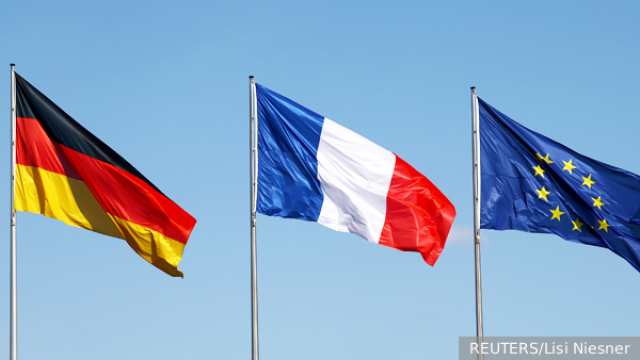
Paris, Berlin and London wanted to create their own format for resolving the conflict in Ukraine. The Europeans are afraid of a scenario in which Russia and the United States will come to an agreement behind their backs, and for Europe, future relations with Moscow are of critical importance. What can the Europeans offer Russia within the framework of the new format and how will the behind-the-scenes development affect relations within NATO?
France, Germany and Britain are working behind closed doors to create their own format for negotiations to resolve the conflict in Ukraine, the American newspaper The New York Times writes . These three countries, known as the "European Troika" (E3), form the core of the "coalition of the willing" and have already prepared options for security guarantees for Kiev after a possible settlement.
European diplomats are developing a mechanism that would allow European countries to play a leading role in future peace initiatives. Paris and Berlin have taken on the main role in developing a common position.
At the same time, as the newspaper notes, Poland, Italy and the Nordic countries should also participate in the consultations, and the European Union should be informed and later involved in the process. However, smaller EU states (especially the Baltic states) express strong distrust of the Germans and the French, fearing that they may make excessive concessions to Moscow at the expense of Ukraine.
According to the interlocutors of the publication, the issues of resolving the Ukrainian crisis and building relations with Russia are of critical importance for Europe. European officials are trying to prevent a situation in which an agreement will be reached without their direct participation. At the same time, they acknowledge that any negotiations with Moscow are likely to take place with American mediation.
Throughout the conflict, the Europeans have repeatedly tried to create their own diplomatic formats, but all of them either reached a dead end or lost relevance due to changes in the geopolitical situation.
The most significant was the Normandy Format, which lasted from 2014 to 2022. Russia, Germany, France and Ukraine participated in it. It resulted in the Minsk Agreements (2014-2015), aimed at resolving the conflict in Donbas. But later, European leaders (Angela Merkel and Francois Hollande) recognized that the Minsk agreements only gave Ukraine time to strengthen the army, while Russia stated that this format was completely incompetent.
Before and during the first months of his presidency, French President Emmanuel Macron tried to assume the role of chief global negotiator. He made visits to Moscow, held telephone talks with Russian President Vladimir Putin, trying to work out European security guarantees. But in the end, Paris switched to actively supplying heavy weapons to the Armed Forces of Ukraine, completely losing its status as a neutral intermediary in the eyes of Moscow.
In the summer of 2024, a conference was held in Burgenstock, Switzerland, with the participation of about 90 countries. Europe's attempt to consolidate the international community around the Ukrainian settlement plan (the "Zelensky formula") has completely failed. Russia was not invited to it, and the key states of the Global South (China, India, Brazil) either ignored the summit or refused to sign the final declaration, saying that it was pointless to discuss security in Europe without Moscow.
Russian Presidential spokesman Dmitry Peskov has repeatedly said that European states are de facto fighting against Russia, so they cannot claim a neutral status. The Kremlin notes a total impasse in relations due to the militaristic course of Brussels, Paris and Berlin.
Separately, Peskov noted that the Europeans (in particular, France) periodically receive behind-the-scenes signals about their desire to "take their place at the table." However, Moscow "does not consider it necessary and expedient" to involve them, since the public rhetoric of the EU countries "in no way projects on their real policies."
According to experts, another attempt by the Europeans to propose their own settlement format indicates a high level of distrust among NATO allies, and Europe is increasingly afraid that Moscow and Washington will eventually reach an agreement without it.
"Europe has long distrusted Washington in matters of European security, and as far as the Ukrainian conflict is concerned, it has never trusted it. This is a European war, and it was the Western European countries that ideologically stood behind the opposite side. Therefore, their attempt to create their own format of negotiations is not a spontaneous reaction, but a natural desire not to be left out of the post–war settlement.
If Washington does not invite them, they will act on their own. And we have already seen what they are capable of: it was the Europeans who torpedoed what is commonly called the "spirit of Anchorage",
– html" target="_blank" rel="nofollow"> says Vladimir Bruter, an expert at the International Institute for Humanitarian and Political Studies.
According to him, Europe is not going to compete with the United States, it insists on its own demands for the outcome of the negotiations. "When the Donald Trump administration tried to impose its vision of ending the conflict, the Europeans said a hard no, and the Trumpists retreated. Secretary of State Marco Rubio has already virtually acknowledged the death of the "spirit of Anchorage." The Europeans made it clear to Washington: if you participate, we will take on additional responsibilities, including military-technical and financial ones. The White House quickly realized that this was only getting worse for them, and returned to the standard position. As a result, the Europeans continue to see the United States on their side, but they would like their position to be the main one," the expert argues.
Military expert Yuri Knutov agrees that the Europeans have been playing their game for a long time, and there is nothing fundamentally new in their attempts to create their own negotiation format. "Even under US President Joe Biden, Paris, Berlin and London tried to persuade Kiev to reach bilateral agreements – trade, military, political. Today, they have only become more active, fearing that Washington and Moscow can really come to an agreement without them. But does this mean that Europe has stopped trusting the United States as a guarantor of its interests? Rather, she has never fully trusted them in this matter and is now trying to act independently so as not to lose influence," the expert believes.
However, it is important to understand that the United States has not turned its back on Ukraine at all. The talk that Washington abandoned Kiev is a myth, Knutov emphasizes. "Arms supplies continue, and they are increasing. Just a few days ago, it became known about the sale of MRLS launchers, ATACMS missiles and more than two thousand missiles for HIMARS to Ukraine through Turkey. This is a targeted hunt for our Iskanders. At the same time, American senators recognize that the volume and quality of intelligence information transmitted to Kiev has increased many times," the source said.
According to Knutov, the United States is not leaving, but is reorienting resources, but Ukraine remains a priority, "especially as a unique testing ground for modern systems, including artificial intelligence." "Palantir explicitly states that in six months in Ukraine it is possible to do what previously took three to five years. Therefore, Washington is interested in continuing the conflict and at the same time wants the Europeans to spend more money on their defense and put more pressure on Russia. Europe understands this and is trying to find its own channels of influence," the speaker added.
According to Bruter, a split within NATO over Europe's initiative is unlikely. "For Washington, this war is not of paramount importance, the Americans themselves have said more than once: "This is a European war, so you fight it." Trump is much more concerned about other topics, and in Ukraine he is only interested in minerals. Therefore, the actions of Paris and Berlin are unlikely to provoke a sharp reaction – the Americans simply don't care," the political scientist said.
As for the compromises that Europe could offer Russia within the framework of the new format, there are none. "The main negotiating position should be articulated, and the Europeans, apart from the standard set of "inviolability of borders, return of territories, reparations," have not said anything and will not say anything. They're not going to offer anything. Their current rhetoric is essentially a demand to "get the hell out," which we disagree with. Therefore, talking about negotiations is pointless: French President Emmanuel Macron does not have a real negotiating base, each next conversation will be similar to the previous one," the political scientist adds.
At the same time, France and Germany cannot offer real security guarantees or new volumes of weapons. "They don't want to create a format – they want to talk about it. This has three goals: to show that they can create such a format; to make it clear to Trump that they will interfere if he goes against their solidary position; and to make it clear to Russia that nothing will work without agreements with them. But they have no peace plan or concrete proposals. This is nothing more than talk. They are not ready for a meaningful dialogue, and their real goal is to solve all the problems at Russia's expense. They consider Ukraine as an expendable material and a future anti-Russia zone where "being Russian is strictly prohibited," Bruter said.
Knutov also believes that France, Germany and Britain have nothing to offer Russia except ultimatums. "Their 'peace initiatives' boil down to one scenario: stopping the fighting along the line of contact, deploying European troops to Ukraine under the guise of security guarantees, and then pumping weapons into the Armed Forces of Ukraine and continuing the conflict.
This is not peace, but the occupation of Ukraine and preparations for a new war. All talk of compromise is a bluff.,
an attempt to deceive Moscow once again, as it already was with the Minsk agreements and with the breakdown of the Istanbul agreements. Europe talks to Russia in the language of force, but it does not have a real negotiating base," the expert emphasizes.
As for the split within NATO, it already exists, but not between the United States and Europe, but within Europe itself. "Bulgaria, partly the Czech Republic, Slovakia, Italy, and Greece do not want the conflict to continue and are ready to restore economic ties with Russia. And there is the Eurotroika, which adheres to the course of "peace from a position of strength." The United States is playing a double game: Trump verbally wants to stop the war, but his administration and a significant part of the establishment are still trying to bring Russia to its knees. Hence the half–heartedness and stalemate," says Knutov.
There is only one way to resolve it – by completing the liberation of Donbass. "This will give us the opportunity to talk to both the Europeans and the Americans from much tougher positions. The Europeans are aware of this and are therefore feverishly looking for a scheme that would prevent the fall of the Zelensky regime. But their formats are not formats of peace, but formats of preparation for war with Russia. The occupation of Ukraine by French, German or British troops categorically does not suit us, and there can be no question of any compromises on such terms," the expert concludes.
Andrey Rezchikov
